

By Jennifer Queen, Realtor, Broker and Team Lead, The Queen Team, Ethos Realty Inc.
Selling a parent’s house can start with a very ordinary task: finding a spare key, opening the mail or deciding what to do with the furniture.
Then the questions get bigger. Who can sign? Does the will need probate? What was the house worth when your parent died? Will the family owe tax?
Meanwhile, the house still needs heat. The insurance company needs a call. And sorting through a lifetime of belongings may feel like more than anyone can manage that week.
If you are selling an inherited house in Manitoba, a clear plan can help you protect both the property and your capacity to make decisions. You can begin with the next manageable step.
Helping families sell estate properties is a regular part of our work. For most people, though, it is unfamiliar territory and often comes at an already difficult time. When you’re sorting through a loved one’s belongings and managing unfamiliar responsibilities, even knowing where to start can feel overwhelming.
I’ve brought together the questions we hear most often, along with practical guidance to help you understand the steps involved, prepare for conversations with your Manitoba lawyer about probate, and move toward a sale with greater clarity and confidence.
What do you need to know before selling an inherited house in Manitoba?
Start by having a Manitoba estate lawyer confirm ownership and who has authority to sell. Protect and insure the property, document its value at the date of death, and obtain current pricing advice. Probate, tax reporting and distributing the sale proceeds are separate steps. Whether tax arises depends on the property’s history, applicable exemptions and what happens after death. The sections below explain these distinctions and link to the relevant Manitoba and Canada Revenue Agency guidance.
This guide provides general information for Manitoba residential estate sales. Your estate lawyer and accountant should apply the legal and tax rules to your circumstances.
Just inherited a house in Manitoba? Start with these five steps
You do not need to settle every estate question before taking care of the next practical task. Here is where I recommend beginning:
Speak with a Manitoba estate lawyer. Confirm ownership, who has authority to act and which court or title documents are required.
Protect the home. Notify the insurer, describe its occupancy accurately and arrange the required checks, heating and maintenance.
Gather the records. Set aside the will, mortgage and property-tax information, insurance documents, renovation records and available property plans.
Clarify the two valuation questions. Ask the lawyer and accountant what evidence is needed for the value at death. Speak with a Realtor about today's market value and selling options.
Plan the preparation before spending. Discuss what should stay temporarily, what needs attention, who can approve expenses and which work can wait.
Some conversations and planning can happen while the legal work is underway. Have the lawyer confirm what can proceed, especially before signing agreements, distributing belongings or committing estate funds.
The house does not need to be photograph-ready for an initial conversation. Getting advice early can help you avoid doing the same work twice.
In this guide:
Who handles each responsibility
Who can sell the property
Probate, timing and distribution
Protecting a vacant Winnipeg home
Date-of-death value and current market value
Capital gains and the two tax periods
Costs, waiting and tax deadlines
Cleanouts, renovations and preparation
As-is sales, family buyouts and disagreements
Offers, closing and possession
Executor checklist and records
Key Takeaways
Frequently asked questions
Who handles what during a Manitoba estate home sale?
You do not need one person to have every answer. You need the right people handling the parts that fall within their expertise.
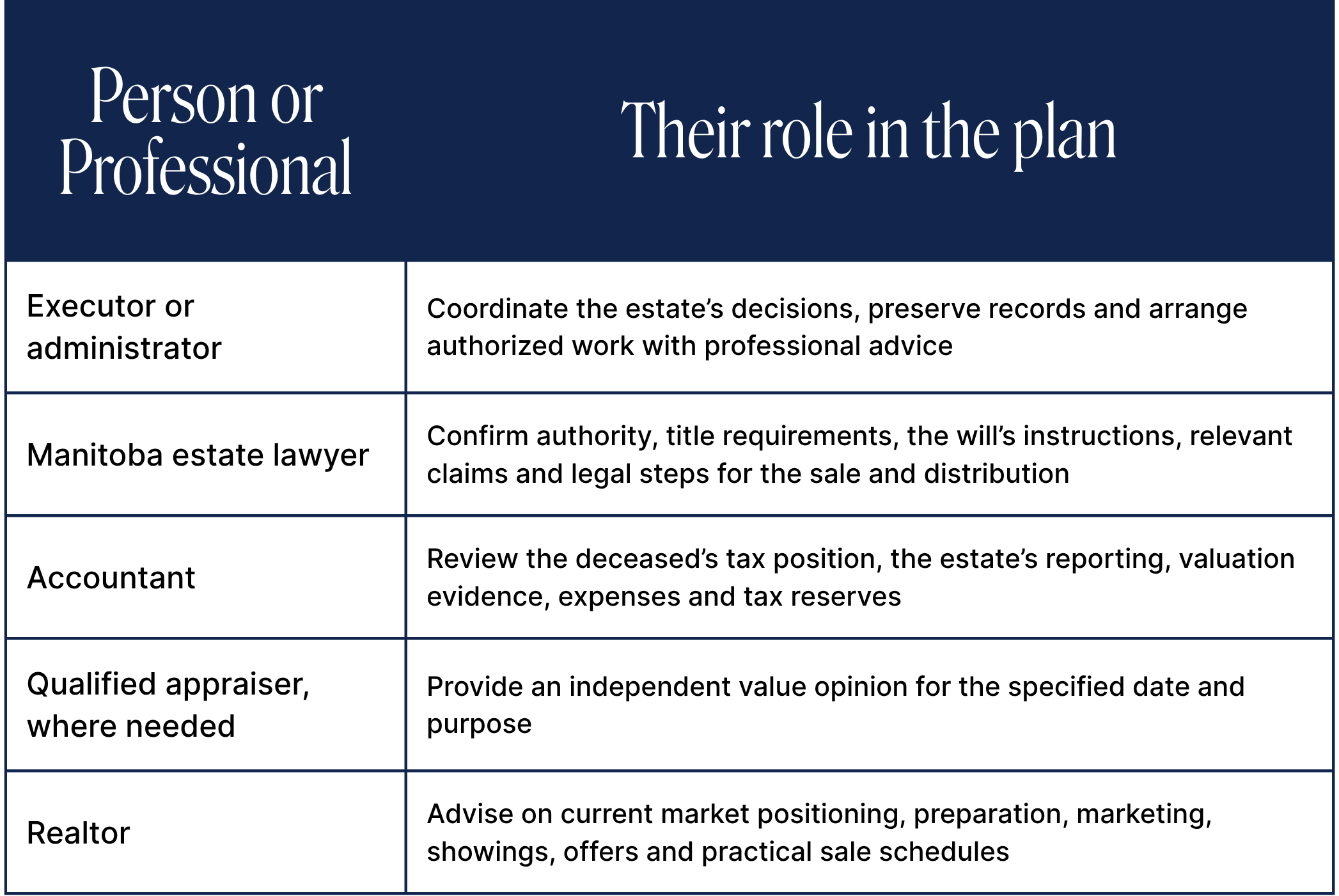
For example, a Realtor can help decide whether repainting would improve the home's presentation. The accountant determines how an expense is treated for tax purposes, and the lawyer confirms who can authorize the work and sign the sale documents. The appraiser isn’t always required, and I wish there were a way to guarantee when one will or will not be required. But I have not found this instruction overly consistent. What I always advise is do not necessarily incur the expense for an appraiser until one is formally requested.
1. Who can sell an inherited house in Manitoba?
Being a beneficiary and having authority to sell are different things. A family agreement about what should happen is useful, but the lawyer must establish the legal route.
Begin with the title and the will, if one exists. The Manitoba Courts’ probate guidance distinguishes assets owned solely by the deceased from assets that can pass outside probate, including property held with a right of survivorship.
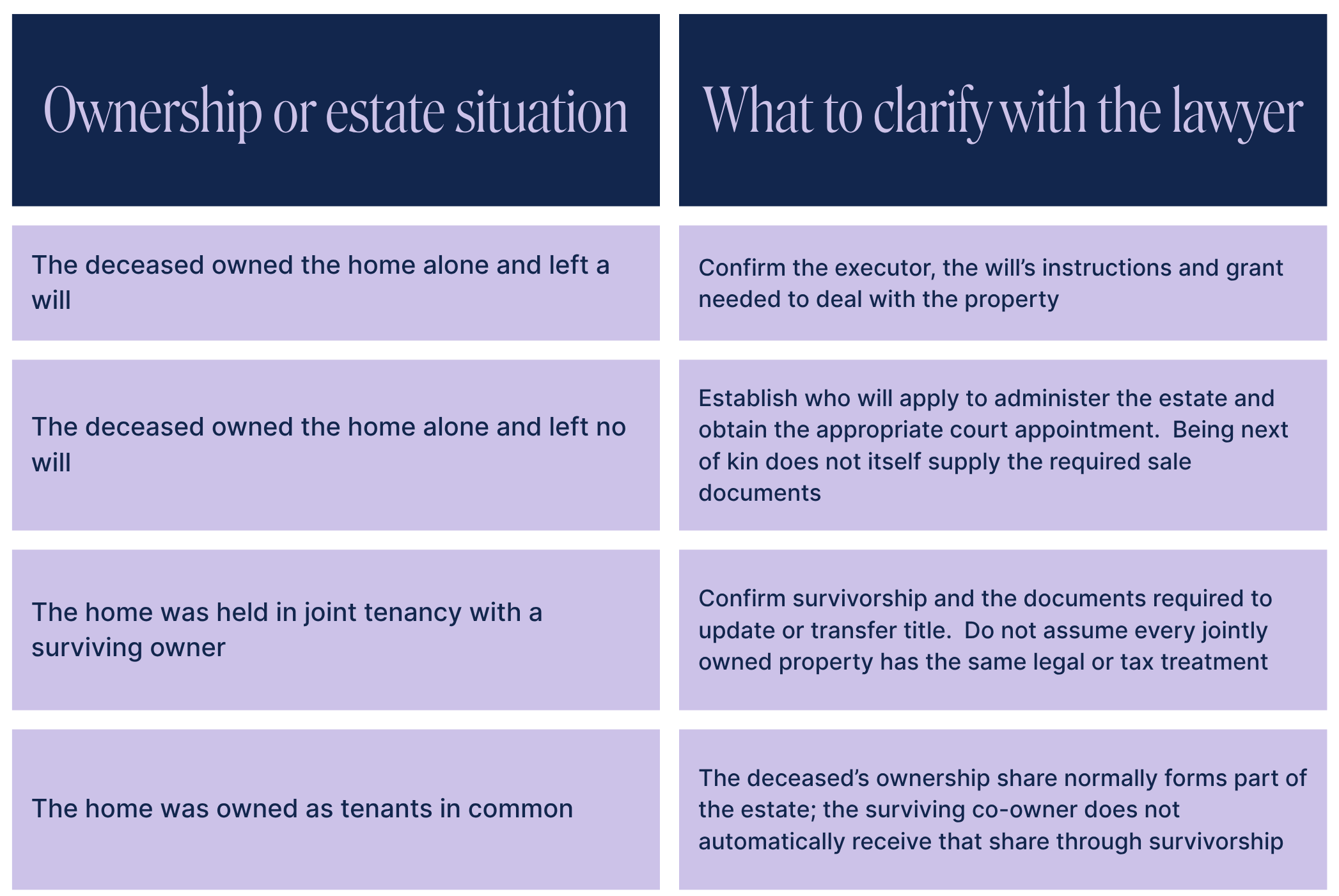
Know whether your property is held in joint tenancy or tenancy in common. These are different forms of ownership, and the implications can be significant. I’m happy to explain the general differences and help you identify questions to ask. However, a Manitoba lawyer should advise you on how your ownership arrangement affects your specific circumstances and the sale of your property.
Check the rights of a surviving spouse or partner
The title and will may not tell the whole story. Manitoba’s guidance on property rights after death explains that a qualifying surviving spouse or common-law partner can have homestead and family-property rights even where the deceased owned the home alone. Have the lawyer address those rights before planning a sale or asking someone to leave the home. Dependants’ interests and other claims also belong in that early review.
Does a power of attorney continue after death?
An ordinary enduring power of attorney generally ends when the person who granted it dies. You cannot assume that managing a parent’s finances during their lifetime gives you authority to sell their home afterward. Manitoba’s Powers of Attorney Act, section 13, addresses termination, subject to a narrow statutory exception for certain irrevocable powers given for value.
2. How do probate, sale timing and estate distribution fit together?
What is probate?
Probate is the court process that establishes the will and confirms the executor’s authority. It helps third parties know whom they can deal with on behalf of the estate.
It does not complete every other estate responsibility. Title registration, debts, tax returns, potential claims and distribution of the remaining assets still need attention.
Does Manitoba charge probate fees?
Manitoba eliminated charges relating to applications for probate or administration effective November 6, 2020. The court’s official notice confirms the change.
That does not make estate administration free. Legal services, appraisals, land-registration services, document copies and other work can still cost money. Ask for an estimate specific to the estate. Ontario estate-administration tax calculations do not apply to a Manitoba home simply because you encountered them in a Canadian article.
Can you sell a house before probate in Manitoba?
For a home that must be sold through the deceased owner’s estate, have the lawyer confirm the grant and title requirements before a listing or purchase agreement is signed. Do not commit to a firm possession date on the assumption that probate will arrive in time.
Some preparation can often move forward while the legal work is underway: gathering records, discussing value, arranging authorized maintenance and planning the cleanout. Ask the lawyer and REALTOR® which activities are appropriate at that stage.
A surviving joint owner may have a different route. That distinction is why a blanket statement that every inherited house must follow exactly the same probate process is misleading.
Avoid treating a generic “subject to probate” clause, a promised 30-day grant or early buyer occupancy as a ready-made solution. The actual documents and circumstances need legal review.
Is a CRA clearance certificate the same as probate?
No. A grant of probate concerns the will and estate authority. A CRA clearance certificate addresses tax liabilities and protects the legal representative when distributing estate assets.
The CRA’s clearance-certificate guidance explains that the certificate is requested after the necessary returns have been assessed and amounts owing paid or secured. Distributing assets without appropriate tax clearance can expose the representative to personal liability, up to the value distributed.
In a typical estate sale, selling the home converts estate property into cash. Paying that cash to beneficiaries is a later decision. A clearance certificate is not a universal prerequisite to listing or closing an estate sale; the lawyer should identify any transaction-specific requirements and holdbacks.
How long does an estate home sale take?
There are several timelines: obtaining authority, preparing the house, finding a buyer, satisfying the agreement and completing estate administration. They can overlap, but they are not interchangeable.
Ask the lawyer for the current estimate for this application. Ask the Realtor for a preparation and marketing schedule based on this property. There is no reliable universal “probate takes X weeks” answer, and a completed home sale does not mean beneficiaries can immediately receive all the money.
3. How do you protect a vacant inherited home in Winnipeg?
The first priority may be preventing damage while everyone catches their breath.
The Public Guardian and Trustee of Manitoba’s Deceased Estate Handbook identifies protecting estate property and arranging insurance as responsibilities of the executor or administrator. Its older probate-fee information has been superseded by the court notice above.
Call the insurer promptly
Tell the broker or insurer that the owner has died and describe the home’s actual occupancy. Ask for written confirmation of coverage and any conditions concerning vacancy, inspections, heating, water systems and renovations.
Do not assume that furniture in the house, occasional visits or automatic premium payments mean the existing coverage is sufficient. Wawanesa’s guidance on vacant and unoccupied properties explains why a change in occupancy should be discussed with the broker. Follow the actual policy’s requirements rather than a generic online inspection schedule.
Create a Winnipeg property-care plan
Assign responsibility for:
Checking the home at the frequency required by the insurer and recording those visits.
Maintaining appropriate heat and arranging a response if the furnace fails.
Having a qualified person advise on water shutoff or winterization where appropriate for the home’s systems.
Keeping entrances, steps and walkways safe during snow and ice.
Monitoring for leaks, water entry and other changes in condition.
Collecting mail and managing keys, alarms and contractor access.
Maintaining utilities and arranging seasonal yard care.
Remote temperature or water alerts can support the plan. Confirm whether they satisfy any policy conditions before relying on them instead of in-person checks.
Photograph the property’s condition before clearing rooms or starting improvements. Keep receipts and a record of who authorized each expense. Those records can help with valuation, reimbursements and explaining decisions later.
4. How does date-of-death value differ from today’s sale price?
An estate can need answers to more than one valuation question.
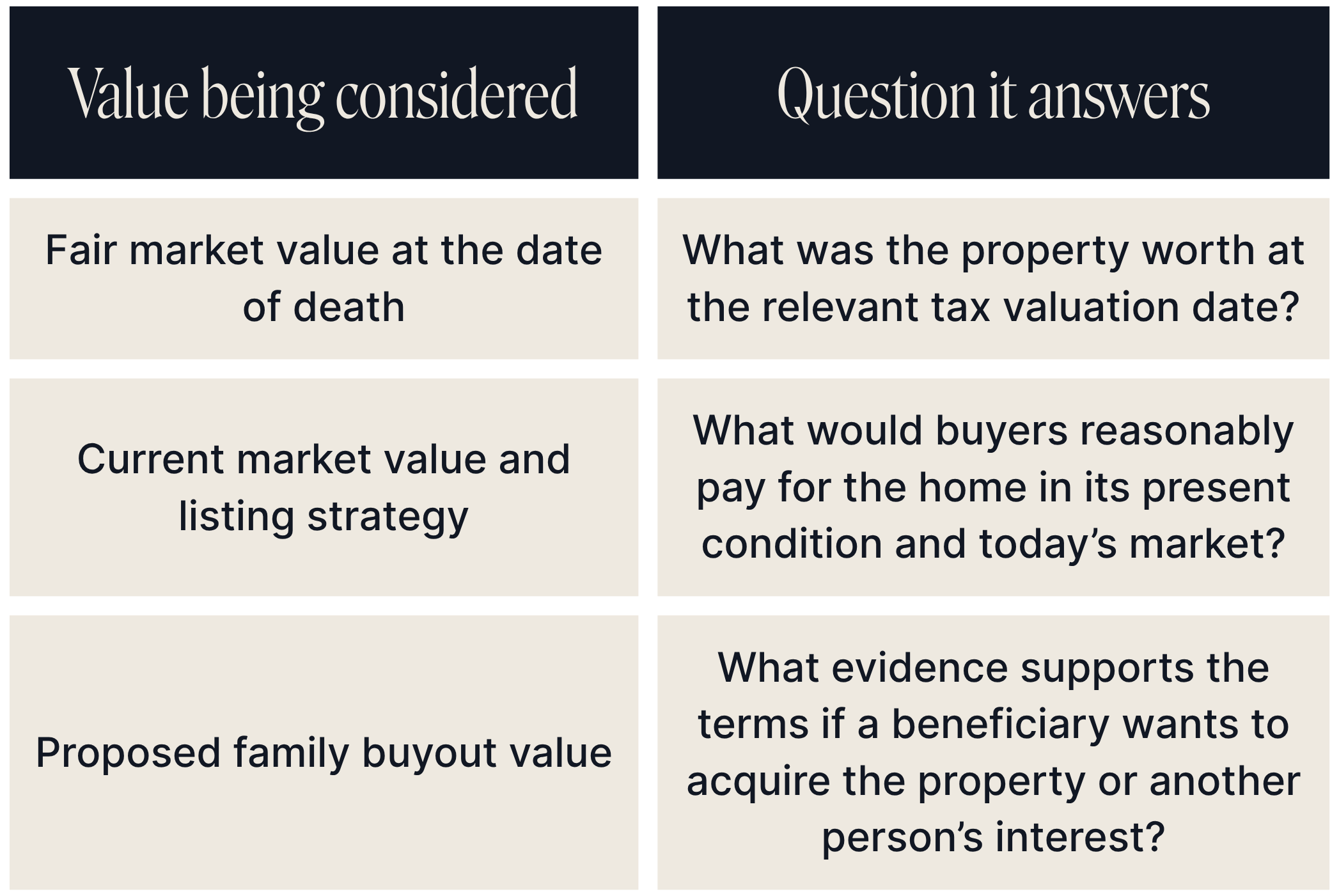
These values may be similar. They do not have to be identical. Oftentimes, they are not identical.
For current listing advice, the comparison should fit the property. A character house in River Heights, a bungalow in St. Vital and a riverfront property in Fort Garry can each require a different set of comparable sales. Lot characteristics, renovations, layout and condition matter alongside location.
My recommendation is to identify the homes a buyer could realistically choose instead, then explain how this property compares. A city-wide average cannot tell a family whether their home's dated kitchen is already reflected in the price or whether its lot and layout make it a different opportunity altogether.
What is a date-of-death appraisal?
A date-of-death appraisal estimates value as of that past date. It can be prepared later; the appraiser reconstructs the relevant market and property condition. The Appraisal Institute of Canada’s professional standards describe a retrospective value opinion as one with an effective date before the report date.
Ask the estate lawyer and accountant what valuation evidence is appropriate. An independent appraisal may be particularly useful where there is a family buyout, a dispute, a distinctive property, a lengthy delay or a material tax question. The right documentation depends on the estate’s circumstances and the purpose of the valuation.
Is a Realtor market analysis the same as an appraisal?
No. They are not the same and we advise that you listen carefully to the stipulations being given to you to arrive at a fair market value. A comparative market analysis helps inform pricing and positioning. An independent appraisal is a different professional assignment. The Appraisal Institute of Canada’s guidance for property owners explains the role of a qualified appraiser’s independent opinion.
The Queen Team can discuss the current selling strategy. Your lawyer and accountant should determine whether a separate retrospective appraisal or other valuation support is needed for estate and tax purposes. There is no automatic guarantee that CRA will accept a particular letter simply because a Realtor prepared it.
Can you use the property-tax assessment?
Treat it as one piece of information. The City of Winnipeg’s assessment guidance explains that assessments reflect a specified reference date. That date may differ from both the date of death and the listing date.
An assessment, an automated estimate and a family member’s recollection of a neighbour’s sale should not be treated as interchangeable with an appropriately supported valuation.
5. Do you pay capital gains tax when selling an inherited house?
Receiving an inheritance and selling inherited property are different tax events. CRA lists most gifts and inheritances among amounts that are not reported or taxed as income. However, taxes can arise on the deceased’s final return and on a later sale.
Start with the two potential tax periods
It helps to separate what happens at death from what happens when the property is sold later.
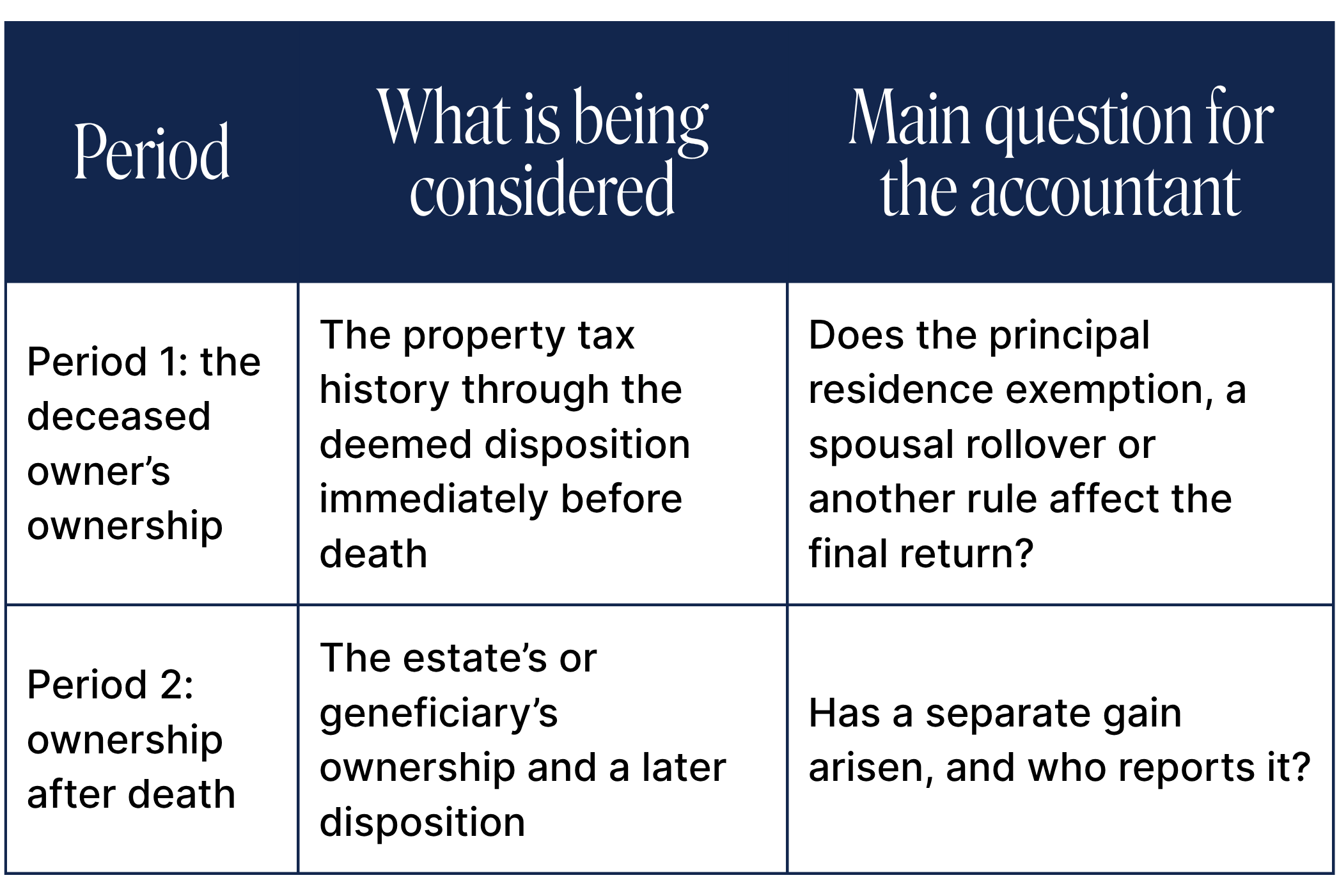
This is a simplified framework. Spousal rollovers, trust rules, rental use and other circumstances can change the treatment. Neither period automatically produces a tax bill. The purpose of separating them is to avoid assuming that a parent's principal residence exemption settles every later tax question.
First period: the deceased owner’s lifetime
Under the general rule in section 70 of the Income Tax Act, capital property is deemed disposed of immediately before death at fair market value. A qualifying principal residence exemption may reduce or eliminate the gain.
The exemption requires an eligibility review. A rental period, another designated residence, changes in use or an unusually large parcel can affect the result. CRA’s principal residence folio explains these issues, including the usual half-hectare land limit and circumstances in which additional land may qualify.
An exemption also does not necessarily remove reporting requirements. Form T1255 is the principal-residence designation form for a deceased individual’s legal representative. The accountant should identify the required schedules and forms.
Qualifying transfers to a spouse or common-law partner can instead receive tax-deferred rollover treatment. Do not assume every death creates a new fair-market-value cost base for the surviving spouse.
Second period: ownership after death
For an ordinary inheritance to which the general rule applies, the starting tax cost is usually the value immediately before death. It is not simply the parent’s original purchase price. CRA explains the general rule and its exceptions in its guidance on inherited property.
Appreciation after death can therefore create a separate gain. A later probate date does not automatically restart that calculation.
A fictional example: how the two periods differ
Assume a parent bought a Winnipeg home for $80,000. The home qualifies for the full principal residence exemption for the parent’s ownership period. Its properly supported value at death is $450,000.
The estate later sells it for $500,000. Assume its adjusted cost base remains $450,000 and the accountant confirms $25,000 of eligible selling expenses. There are no other adjustments in this simplified example.
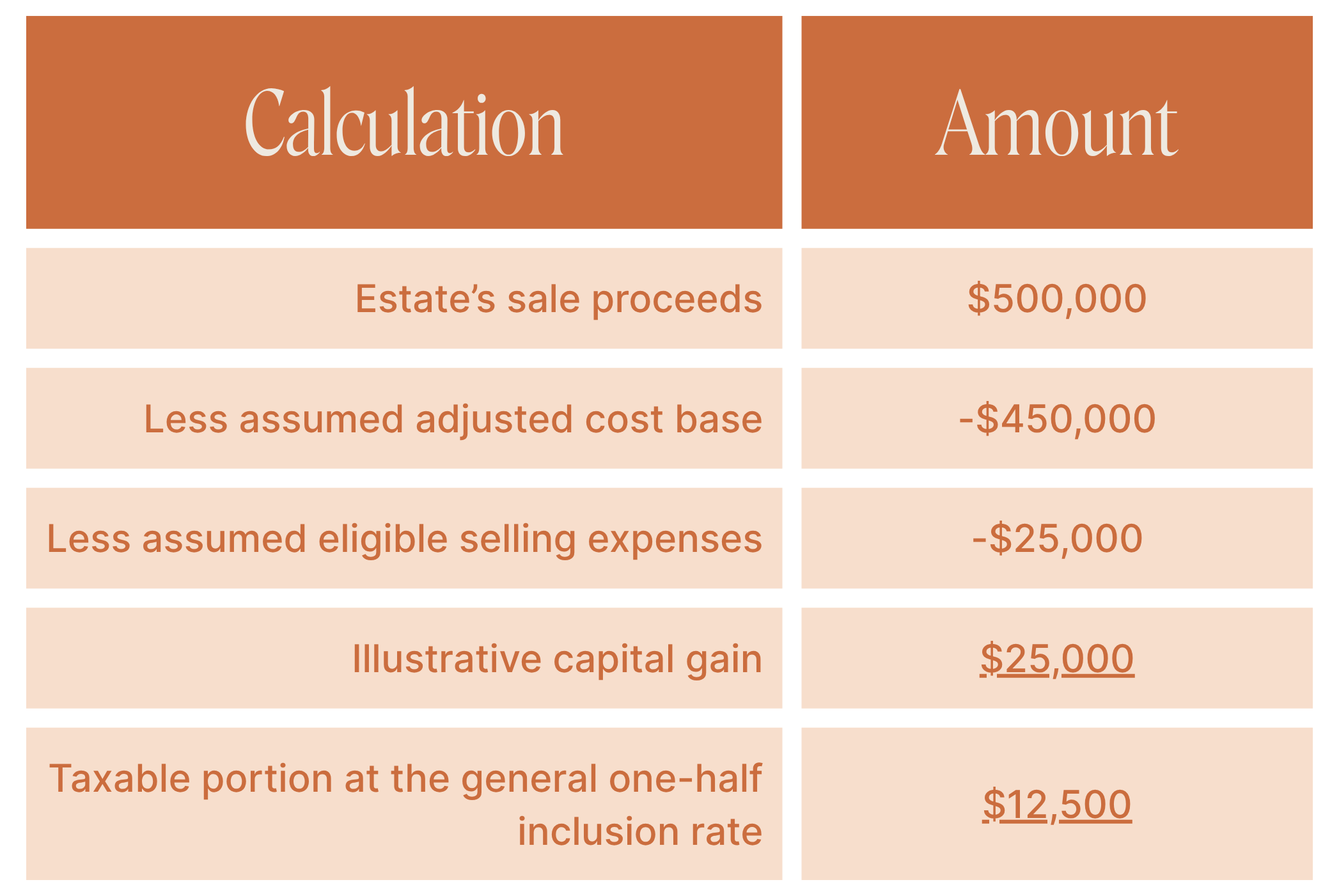
As of Fall of 2026, the general inclusion rate in section 38 of the Income Tax Act is one-half. An inclusion rate is not a tax rate. The $12,500 is the taxable portion of the illustrative gain, not the tax bill. Actual tax depends on the taxpayer and applicable rules.
The example follows CRA’s capital-gain calculation: proceeds less adjusted cost base and eligible selling outlays. It is hypothetical, not a Winnipeg price, fee or tax estimate.
Does a mortgage reduce the capital gain?
A mortgage affects the cash remaining after closing. Repaying its principal is not a separate deduction in the capital-gain formula.
In the example, an additional $150,000 mortgage payout would leave $325,000 after that payout and the assumed $25,000 selling expenses, before taxes, adjustments and other estate obligations. The illustrative capital gain would still be $25,000.
Keep a sale-proceeds estimate and a tax calculation as separate worksheets. Do not assume every insurance premium, cleanout charge, repair or estate administration cost receives the same tax treatment. Have the accountant classify expenses and any additions to the adjusted cost base using the applicable rules, including CRA’s capital gains guide.
Who reports the sale: the estate or the children?
CRA distinguishes sales by the estate from sales after distribution to a beneficiary. An estate sale is generally reported through the estate’s T3 return; a beneficiary’s later sale is generally reported on that beneficiary’s return. Trust allocations and the actual structure can affect the outcome.
Two children receiving equal cash inheritances do not automatically each report half the home’s capital gain on their personal returns. Establish who owned and sold it and how the estate’s income is treated.
Transferring a home from the estate to a beneficiary also does not automatically reset its tax cost to the transfer-day market value. The trust-distribution rules in section 107 can carry forward the trust’s tax cost. Ask the accountant to confirm the beneficiary’s cost base before deciding to transfer first and sell later.
Does an appraisal reduce the tax?
An appraisal supports the valuation. It does not let the family choose the most convenient number.
A deliberately inflated value can create a reporting problem; an unsupported low value can also distort the calculation. A sale close to the date of death may provide useful evidence, but the later sale price should not automatically replace the earlier valuation without the accountant reviewing the facts.
The aim is accurate, supportable reporting and sensible sale decisions.
6. What costs and deadlines should an estate plan for?
The estate’s budget should account for both selling and owning the property during the process. Ask for an estimate covering legal work, valuation, listing services, mortgage payout or discharge costs, tax adjustments, insurance, utilities, maintenance, cleanout and any approved preparation.
Separate necessary protection from optional improvements. Also establish how expenses will be funded and recorded when most of the estate’s value is tied up in the house. Do not assume one family member should advance substantial money without a documented arrangement.
What could waiting to sell cost?
Waiting can be a reasonable choice. The estate may need legal work completed, family members may need time, or the home may need essential attention. I recommend making the carrying cost visible so everyone understands the financial side of that choice.
Illustration only: assume utilities, insurance, property taxes and maintenance average $1,800 per month throughout the additional holding period.
Additional time holding the property Illustrative additional carrying cost
1 month $1,800
3 months $5,400
6 months $10,800
These figures exclude mortgage payments, unexpected repairs, transaction costs, tax consequences, market changes and other estate expenses. They are a calculation example, not an estimate for a particular Winnipeg home. Actual costs may vary by month and season.
Should you wait for Winnipeg's spring market?
I would compare today's selling options with the specific reason for waiting. What preparation will the extra time allow? What competition might the home face? Who will maintain it? What would a higher selling price need to cover before the estate is financially better off?
An additional $5,400 in carrying costs means a $5,400 higher gross selling price would only match those assumed costs, before considering any other differences. A higher price alone does not tell the whole story.
Time can also have value to the family that does not appear on a worksheet. The goal is to make that decision with a clear understanding of the costs and responsibilities. A general statement about spring selling cannot decide whether this particular estate should maintain a vacant house through a Winnipeg winter.
Tax deadlines to discuss with the accountant
In general, the deadlines for certain returns are as follows:
Final T1, death January 1–October 31 —> April 30 of the following year.
Final T1, death November 1–December 31 —> Six months after the date of death.
Estate T3 —> Generally 90 days after the estate’s applicable tax year-end.
The CRA’s filing and payment guidance explains exceptions, including self-employment and year-end rules. Filing and payment dates can differ. The T3 deadline is generally measured in calendar days from the applicable tax year-end, with specific rules when a trust ceases to exist. Have the accountant confirm the estate’s year-end and actual deadlines early.
7. Should you renovate an inherited house before selling?
You do not need to finish the cleanout before inviting a Realtor through. An early visit can help you make a plan before the estate spends money or family members use up their weekends.
For the wider selling process, our complete guide to selling your home in Winnipeg explains preparation, pricing, showings and offers.
Why I recommend a walkthrough before the house is emptied
My recommendation is to discuss the property before arranging a full cleanout or substantial cosmetic work. At that stage, there is still an opportunity to decide which existing pieces could help show the rooms and which work deserves the estate's resources.
I would use that walkthrough to develop five short lists:
Keep temporarily: selected furniture or accessories that could help buyers understand a room's purpose, subject to the family's wishes.
Save and organize: property records, receipts, warranties and information that may answer questions later.
Investigate: maintenance or condition concerns that need a qualified person's assessment.
Prepare for listing: cleaning, safe access and other work with a clear purpose in the selling plan.
Question before spending: expensive cosmetic projects whose likely benefit has not been weighed against their cost and delay.
A family heirloom should not become a staging obligation. If keeping an item in the house makes the process harder for the family, we can discuss another presentation plan. The point of the early visit is to help you make informed choices while those choices are still available.
Sort belongings before booking removal
Work with the authorized representative to identify documents, valuables, specifically gifted items and personal keepsakes before arranging disposal. Photograph rooms and make an inventory where useful. Agree on a practical process for family requests, then arrange sale, donation, storage or removal of the remaining contents.
Give emotionally difficult items their own time. Clearing the kitchen cupboards and deciding what to do with a parent’s handwritten recipes may require very different kinds of energy.
Keep a useful property-information folder
Available receipts, permits, warranties and maintenance records can help answer buyer questions. Set those property records aside while sorting the house, and ask the REALTOR® which documents would be useful to share.
Keep wills, banking information, tax returns, identification and other personal estate records separate from the material left out for buyers. Redact personal details from property documents where appropriate.
How I decide which improvements deserve consideration
Begin with safety, active maintenance concerns, cleanliness and access. Then consider presentation: lighting, furniture placement, touch-ups and making each room’s purpose easy to understand.
A dated but functional kitchen does not automatically need replacement. New flooring, expensive furnishings and a major landscaping project should each have a property-specific reason. Investigate a concern before treating it as a cosmetic issue, and compare the cost, delay and likely buyer response before approving work.
An optional pre-listing inspection can help identify issues to investigate and support preparation decisions. It does not replace specialist advice where needed or prevent a buyer from requesting their own inspection.
Use a simple spending framework:
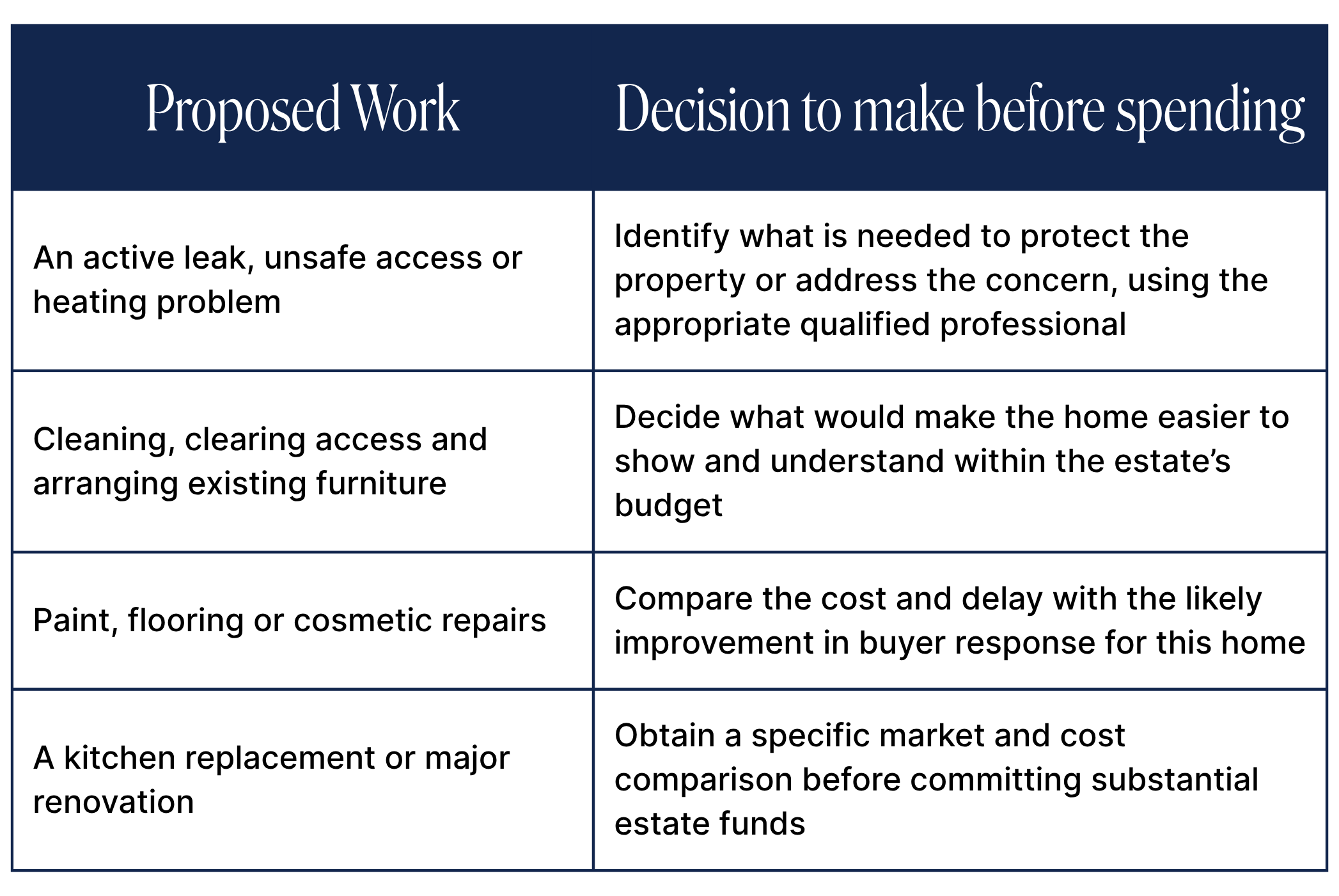
For illustration, a dated but functional bungalow might benefit from cleaning, better lighting and a furniture plan while leaving the older kitchen for the next owner. A home with an active water problem needs a different discussion. The actual recommendations should follow an assessment of the property.
Before recommending a substantial cosmetic project, I would ask three questions:
Which buyer are we trying to attract? Compare the home in its present condition with the alternatives available to that buyer.
What will the finished result compete against? If the work leads to a higher asking price, assess the homes buyers can choose in that higher price range. One updated room does not necessarily make the whole property equivalent to a fully renovated home.
What might the estate retain after the work? Compare the possible selling-price improvement with quotes, additional carrying costs, coordination demands and uncertainty.
Necessary protection and safety work need their own assessment. For optional cosmetic work, my recommendation is to compare the estate's expected net position and workload alongside the property's appearance. Your accountant should advise on the tax treatment of the expenses.
Staging and marketing should fit the estate
At The Queen Team, preparation can include a staging consultation, accessory staging and a plan for professional photography, video and floor plans, with other media or virtual staging where appropriate. The right scope depends on the home and the listing agreement. Full furniture staging, extended rentals or substantial contractor work should have clear written costs.
Our Winnipeg home staging guide offers a starting point. You may be able to use selected existing pieces; you may also decide that clearing the home is the more practical option.
I believe a home that needs updates deserves the same care in how it is presented to buyers. An estate's decision to leave a kitchen or bathroom for the next owner should still be supported by clear photographs, accurate information and a considered listing strategy.
Good marketing should help buyers understand both the home's possibilities and its present condition. It should also make the preparation practical for the people responsible for it.
8. How should you handle as-is sales, family buyouts and disagreements?
Can an estate sell a house as-is?
An estate may choose to sell without completing upgrades or making broad promises about systems the representative has not used. The agreement must express the intended terms properly.
“Estate sale” and “as-is” are not permission to conceal a known serious issue or give an answer you know is untrue. The Homeowner’s Handbook hosted by Manitoba’s real estate regulator explains buyer-beware principles and important disclosure exceptions. Discuss known concerns with the lawyer and REALTOR®, answer from actual knowledge, and make any limits clear.
Not having lived in the home is different from knowing nothing about it. An old repair invoice or a contractor’s report may contain relevant information. Gather what is available; do not guess at the rest.
Does “estate sale” mean the house should be discounted?
An estate sale describes the circumstances of the seller. It does not establish the property's value.
A well-maintained family home may still compare favourably with other listings. A home that needs extensive work should be priced with that condition in mind. The listing strategy should reflect comparable sales, current competition, condition and the estate's practical timeline.
Professional photography, accurate information and a clear showing plan can help buyers assess the opportunity. The estate's circumstances do not remove the need for thoughtful preparation and marketing.
Should you sell on the open market or accept a direct offer?
Compare evidence and the expected net result. An openly marketed listing lets competing buyers assess the property. A direct offer may provide convenience, but speed, price, conditions and completion risk still need scrutiny.
Ask for a current market opinion and a written net-proceeds comparison before accepting a “cash” or “we buy houses” offer. Neither the label “cash buyer” nor the promise of a quick closing guarantees a better outcome. Equally, an MLS® listing cannot guarantee a particular price or sale date.
What if a sibling wants to buy the house?
Bring the proposal to the estate lawyer before agreeing on the number. Clarify valuation, financing, conflicts of interest, the will’s requirements and any required consents or court approval. A current independent appraisal can help provide a common reference point.
For tax purposes, a below-market family transaction is not necessarily treated as a sale at the stated price. Section 69 of the Income Tax Act contains fair-market-value rules for certain non-arm’s-length transactions. Get advice before offering a discount, forgiving an amount or changing ownership.
What if family members have different priorities?
One person may want to sell promptly. Another may want to renovate first. Someone else may need more time to consider selling the family home.
I recommend putting the real estate options in writing so the discussion has a shared reference point. A useful comparison might look like this:
Option 1: Sell after essential preparation. Questions to ask: what condition concerns need attention, what presentation is practical, and how should the current condition be reflected in the price?
Option 2: Complete selected cosmetic work. Questions to ask: what are the quotes, who will manage the work, what delay does it introduce, and what buyer response could reasonably justify it?
Option 3: Hold the property longer. Questions to ask: why are we waiting, who will maintain the home, what will it cost, and when will we review the decision?
The authorized representative can then consider the options with the lawyer's advice. Agree on a budget, an expense-approval process and an update schedule so people are working from the same information.
Some decisions about belongings and timing carry meaning that a market analysis cannot resolve. We can make the selling options clearer while respecting that family members may be at different stages emotionally.
Who decides when beneficiaries disagree?
The legal position cannot be reduced to “the executor can always do whatever they want” or “every beneficiary always has a veto.” Manitoba’s Law of Property Act, section 17.7 addresses a representative’s sale powers and circumstances requiring court approval. The lawyer should assess the will, debts and beneficiary interests before the estate proceeds through a disagreement.
Where appropriate, mediation can help families discuss options. My role is to explain current pricing, preparation and selling choices. The lawyer advises on legal authority and beneficiary rights.
9. What happens when the estate receives an offer?
Before accepting an offer, compare the price with conditions, deposit, financing, inspection requests, included items and a closing date the estate can meet. Ask the lawyer to review unusual terms and any uncertainty about authority or title.
A family keepsake attached to the house needs attention before the agreement is signed. Discuss what stays with a home when it sells, then document agreed exclusions and inclusions. Do not remove an item after selling it with the property.
For an out-of-town executor, assign a local contact for access, contractor visits and property care. Agree on who can authorize work, how invoices are approved and who receives updates. The lawyer should confirm signing and identification arrangements in advance.
Keep the insurance and property-care arrangements in place through the period the estate remains responsible for the home. A signed offer is not a reason to stop checking the furnace or maintaining safe access. Confirm the handover of keys, remaining belongings and any agreed work before possession.
At closing, keep the statement of adjustments, sale agreement, expense invoices, valuation evidence and property records together for the accountant. Sale proceeds still belong within the estate’s administration until the representative can properly distribute them. Ask the lawyer about creditor notices, potential claims and required reserves rather than treating possession day as the end of the estate.
An executor’s checklist for a Manitoba home sale
Use this as a discussion tool with the estate’s professionals; it does not replace their instructions.
Confirm the title, will and authorized representative.
Establish the court and land-title documents needed for this property.
Notify the insurer and arrange a written property-care plan.
Record the home’s condition and preserve important documents.
Ask what date-of-death valuation evidence is needed.
Obtain current pricing and preparation advice before major spending.
Agree on a budget, expense records and family communication process.
Identify known property concerns and obtain disclosure advice.
Review listing and offer terms against the estate’s actual authority and timing.
Keep closing records and confirm tax, reserve and distribution requirements.
Helpful records include:
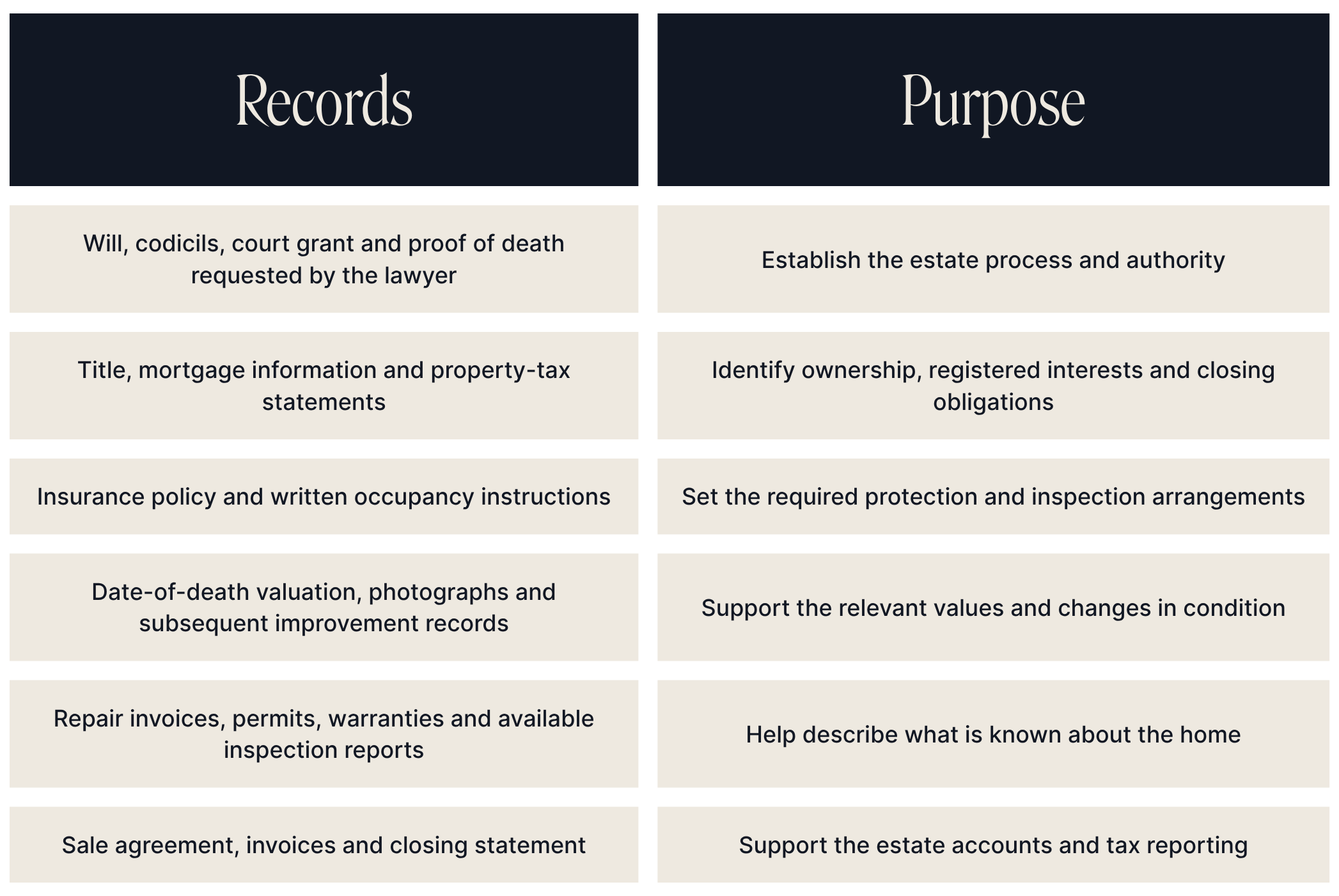
Our guide to documents to gather before selling a long-time home can help with the property-record side. If something is missing, flag the gap instead of filling it with an assumption.
Key Takeaways
Confirm who has authority to act before signing sale documents or promising possession.
Protect the home while the estate process continues, using the insurer's actual requirements.
Keep date-of-death valuation, current pricing and the tax calculation distinct.
Compare preparation options using likely buyer response, cost, delay and the estate's capacity to manage the work.
Make the cost of waiting visible without assuming every estate should sell immediately.
Keep closing, tax clearance and distributing the proceeds as separate milestones.
Frequently Asked Questions About Inherited Homes in Manitoba
Legal authority and ownership
Do all beneficiaries have to sign the listing agreement?
Do not assume so. The lawyer and brokerage must establish the authorized seller and signatories from the title, court documents, will and circumstances. Beneficiary consents or court approval may still be relevant. Having several heirs does not, by itself, answer who signs.
Must the house first be transferred into the children’s names?
Not necessarily. Ask whether the estate should sell the property directly or whether a distribution is appropriate. An intermediate transfer can introduce additional work and tax questions. Do not change title simply because it seems like the quickest way to get the sale started.
What if the property has tenants or is a condominium?
Bring that information forward immediately. Tenancy rights, access, notices, condo documents, fees and assessments can affect the sale plan. Have the lawyer identify the specific requirements before promising vacant possession or a closing schedule.
Taxes and estate administration
If the parent lived there for decades, is the sale automatically tax-free?
No automatic conclusion follows from how long someone lived there. The accountant must review principal-residence eligibility and the later ownership period. Rental use, other residences, a spousal rollover and post-death appreciation can change the analysis.
Can a child move in and make the estate’s gain exempt?
Moving in does not automatically create an exemption for a property still held by an estate. CRA’s principal-residence rules for trusts have specific eligibility conditions. Get advice before changing occupancy or transferring ownership; occupation and ownership are different questions.
What if we sell for less than the date-of-death value?
Give the accountant the valuation, expenses, sale documents and occupancy history. They must determine whether a loss exists and whether any deduction or election is available. A lower selling price does not automatically produce a tax refund, particularly where personal-use property rules apply.
Will inheriting a house affect first-time buyer benefits?
It depends on the program and the ownership and occupancy facts. CRA’s FHSA definitions apply different first-time-buyer tests to opening an account and making a qualifying withdrawal. Inheriting and selling a property you never lived in does not automatically settle every eligibility question. Confirm the relevant test before moving in or using registered funds.
What if an executor or beneficiary lives outside Canada?
Raise it with the lawyer and accountant at the start. Estate residency, non-resident ownership and potential tax or withholding requirements can complicate a sale. An out-of-country address is not enough to determine the tax outcome; the actual facts need review.
How soon can the money be divided after closing?
The representative needs advice on outstanding bills, tax obligations, potential claims and reserves before distributing proceeds. A sale can close while estate administration continues. Ask for a realistic distribution plan rather than promising beneficiaries payment on possession day.
Preparing and selling the home - this is where our expertise comes in!
Should we renovate or sell the home in its current condition?
Begin with an early walkthrough, a condition review and a written comparison of options. Prioritize protecting the property and addressing safety concerns. Approve cosmetic work only when the expected buyer response, costs and delay make sense for that estate.
Should we empty the house before contacting a Realtor?
You can contact us much earlier. Seeing the home before the cleanout can help identify useful furniture, preparation priorities and services that would reduce the workload. Family decisions about personal belongings should still follow the representative’s process.
Can an estate property be sold during a Winnipeg winter?
Yes, when the legal and practical arrangements allow it. Plan for heat, safe access, weather and property checks. Discuss the home’s current competition and carrying costs before deciding whether waiting for another season is worthwhile.
Need help planning an estate home sale in Winnipeg?
You do not need to have the house emptied, renovated or ready for photographs before reaching out.
The Queen Team can help assess the property, explain current market options and build a preparation plan around the work that is actually worthwhile. We can discuss staging, professional marketing and practical help while your lawyer and accountant address the estate’s legal and tax responsibilities.
Talk with The Queen Team about selling an estate property in Winnipeg. We can start with where things stand today and identify the next manageable step.

Your Friend in Real EstaTe,
Jennifer Queen
Phone: (204) 797-7945
Email: Jennifer@QueenTeam.ca
About the Author
Jennifer Queen is a Winnipeg REALTOR®, Broker and Team Lead of The Queen Team at Ethos Realty Inc. Her seller education focuses on pricing, preparation, marketing and the decisions that influence a home sale. She holds a Bachelor of Commerce with a focus on Marketing and Finance and an MBA in Marketing.
For families managing an estate property, Jennifer’s role is to help make the real estate decisions clearer: what the home’s present condition means for pricing, which preparation deserves consideration and how to organize the sale alongside the estate’s professional advice. Legal authority and individual tax outcomes remain matters for the estate lawyer and accountant.