

By Sheyla Duncan, REALTOR® | The Queen Team
Understanding a Winnipeg home starts with drainage, foundation condition, electrical and plumbing systems, major components and renovation history. Buyers and homeowners should know what is present, what has been updated, what has changed and when a qualified professional should take a closer look.
You don't need to be a home inspector to understand the basics of a house.
Whether you're buying a home or already own one, knowing what to pay attention to can help you catch problems earlier, plan for future expenses and know when it's time to call in a professional.
The things that make a home feel right (the layout, the light, the backyard) matter. So do the things that are easier to overlook, like where a downspout empties or whether there are records for a basement renovation.
If you're moving to Winnipeg, getting familiar with these details is part of settling into your home, especially as you experience its first spring melt, heavy rainfall and winter.
This guide is a starting point for understanding your home. You don't need to have every answer. You need to know which questions are worth asking.
Start With Water Management
Water is one of the most important things to pay attention to around a home.
Start outside. Does the ground slope away from the foundation? Are eavestroughs and downspouts carrying water away, or is it collecting beside the house?
Inside, pay attention to:
Water staining.
Musty smells.
White, powdery deposits on foundation walls, called efflorescence.
Damaged drywall or flooring.
Visible moisture.
Previous water-related repairs.
These observations don't tell you the cause or extent of a problem on their own. They are reasons to ask questions and, where needed, get a professional assessment. Health Canada's moisture guidance includes staining, odours and efflorescence among signs worth investigating.
For buyers, useful questions include: Has water entered before? When did it happen? What work was completed, and are there records?
For homeowners, check your basement after heavy rain or spring melt. Knowing what is normal for your home makes changes easier to notice.
For a closer look at drainage and prevention, read our Winnipeg basement flooding guide.
Get Familiar With Your Foundation
Foundation cracks can be intimidating, especially for buyers. But seeing a crack doesn't automatically tell you whether there is a serious structural issue.
What matters is understanding the context: whether something has changed, whether moisture is present, whether there is visible movement and whether previous work has been completed.
If you own the home, keeping dated photographs of existing cracks can help you describe changes to a professional. A photograph is a record, not a diagnosis.
If you're buying, ask for available repair reports, invoices and warranties. A previous repair is something to understand rather than automatically dismiss or accept as proof that everything has been resolved.
When there is uncertainty about movement or structural condition, get advice from an appropriately qualified professional, such as a structural engineer.
Our Winnipeg foundation guide explores the topic further.
Understand Your Electrical and Plumbing Systems
Electrical and plumbing aren't exciting, but they're important parts of understanding a home.
Depending on its age and renovation history, a home may contain a combination of original materials and newer upgrades. With electrical systems, that could include older wiring such as knob-and-tube or aluminum wiring. Plumbing may also include different generations of supply and drain materials.
You don't need to become an electrician or plumber. Start with these questions:
What systems and materials are present?
What was updated, and when?
Did the work cover the whole home or only part of it?
Are permits, invoices or inspection records available?
Is further evaluation recommended?
An updated kitchen or newer electrical panel doesn't answer every question about what remains elsewhere in the home.
If something needs clarification, an electrician or plumber can assess the relevant system. For a purchase, confirm any property-specific insurance questions directly with an insurer before relying on assumptions.
Know the Age and History of Major Components
Keep track of the approximate age, condition and service history of:
Furnace or other heating equipment.
Air conditioner, if present.
Hot water tank or other water-heating equipment.
Roof covering.
Windows.
Major appliances.
Age helps with planning, but it doesn't tell you exactly when an item will fail or need replacement.
If you're buying, ask what documentation is available rather than relying only on “approximately” or “recently updated.” If you already own the home, save installation invoices, model details, service records and warranties together.
A simple record can look like this:
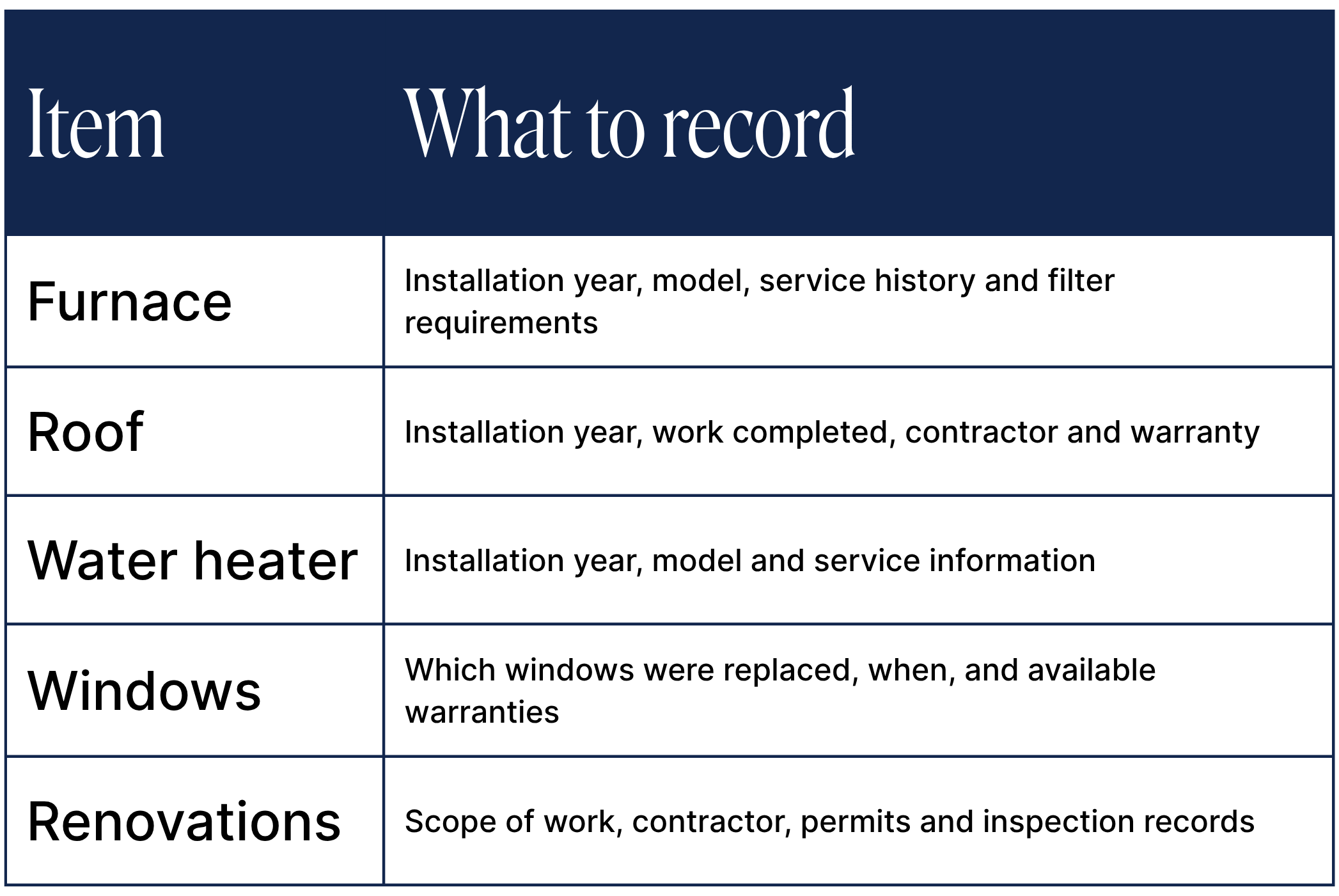
Knowing what may need attention next makes it easier to plan, particularly when several components are of a similar age.
For broader ownership considerations, see our guide to owning a home in Winnipeg.
Walk Around the Exterior
You can learn a lot about a home without going inside. From safely accessible areas at ground level, look at:
Grading around the foundation.
Eavestroughs and downspouts.
Visible roof surfaces.
Exterior finishes.
Windows.
Decks and stairs.
Driveways and walkways.
Trees or vegetation close to the house.
You're mainly looking for changes: something pulling away, deteriorating, leaking, cracking or suddenly looking different.
You don't need to climb onto a roof or open equipment to get familiar with your home. Record what you notice and arrange the right assessment when needed.
Older Doesn't Mean Bad, and Newer Doesn't Mean Problem-Free
Age alone doesn't determine whether a house is in good condition.
I'd rather see an older home that has been well maintained than a newer home that has been neglected.
With an older house, I want to know what's original, what's been updated and what expenses could be coming next. With a newer home, I'm still paying attention to the foundation, grading, drainage, workmanship and maintenance.
Every house should be evaluated on its own.
Ask Questions About Renovations
If significant work has been done, I want to know what changed.
Who completed it? Were permits required? Were they obtained? Is there documentation? What was there before?
This is especially important with finished basements because finishing can conceal parts of the foundation, plumbing, electrical and other components we'd otherwise be able to see.
A renovation looking good doesn't necessarily tell us how well it was done.
The City of Winnipeg's basement development guidance explains that creating rooms and living spaces requires a building permit, while cosmetic changes such as painting and flooring do not. Other permits may apply depending on the work.
The City's permit search can help you begin reviewing available records. Its online coverage has date limits and exclusions, so a missing result isn't proof that work was unpermitted. Ask the City about records you cannot locate.
For homeowners, keeping permits, inspection records, receipts and warranties organized is useful now and when it's eventually time to sell.
Learn Where the Important Things Are
Every homeowner should know where a few basic things are located. Locate the following, where applicable:
Main water shutoff.
Electrical panel.
Furnace filter or other equipment filters.
Sump pit and pump.
Interior shutoffs serving exterior taps.
Sewer cleanout.
You don't want to be figuring out where your main water shutoff is while water is actively leaking.
If you're unfamiliar with a valve or piece of equipment, ask a qualified professional to explain its purpose and safe operation. Knowing where something is located is the first step; knowing how your particular system works matters too.
A Home Inspection Is One Piece of the Puzzle
A Realtor isn't a substitute for a qualified home inspector. But I also don't think my job at a showing is simply to unlock the door.
If I notice something, I'll point it out. If I can explain it within my knowledge, I will. If I don't know, I'll tell you that too—and we can determine whether someone qualified should take a closer look.
A home inspection provides another layer of information. The Government of Canada's home inspection resource describes a non-invasive, visual evaluation of the home's main systems and components.
Ask the inspector what is included, what is inaccessible and whether separate assessments are recommended. An inspection cannot reveal everything concealed behind finished surfaces.
Our complete guide to home inspections in Winnipeg explains the process in more detail.
Understanding your home shouldn't stop after the inspection. Homes change, equipment ages and maintenance needs continue after possession.
Sellers Can Use the Same Approach
Before listing, walk through your home as if you're seeing it for the first time.
Look for deferred maintenance, staining, drainage concerns, unfinished repairs and things you've simply become used to seeing. Gather the records that explain completed work.
You don't necessarily need to fix everything before selling. But understanding what buyers may question gives you a better starting point for discussing preparation with your REALTOR®.
The Goal Isn't a Perfect House
Almost every house has something.
What matters is understanding what needs routine maintenance, what may require repair, what could become expensive and what deserves a professional opinion.
This Understanding Your Home series brings those questions together, from drainage and foundations to inspections, renovations and ongoing care. Use this introduction alongside the more detailed guides linked throughout.
You don't need to diagnose every crack, leak or strange noise. Knowing when to ask the question is often just as valuable as knowing the answer.
Key Takeaways
Start with drainage, foundation condition, major systems and renovation history.
Ask what was updated, who completed the work and what records are available.
Use component ages to plan, without treating them as guaranteed replacement dates.
Pay attention to changes after you move in.
Evaluate each home individually rather than judging its condition by age.
Get qualified advice when a concern needs technical assessment.
Have Questions About a Winnipeg Home?
If you're buying or selling in Winnipeg, I'll help you ask the right questions along the way.
You don't need to know everything about houses. You need people around you who can help you understand what you're seeing and when to bring in an expert.
Connect with Sheyla Duncan to talk about your next move.
Frequently Asked Questions
What should I learn about my home first?
Start with the main water shutoff, electrical panel, heating equipment, drainage and any sump system. Then gather the available inspection report, service records, renovation documents and warranties. These give you a useful starting point for maintenance and professional questions.
Does a foundation crack mean a house has a structural problem?
A crack alone doesn't establish its cause or seriousness. Moisture, movement, changes over time and repair history all deserve context. If the condition is unclear, obtain an assessment from an appropriately qualified professional rather than judging by appearance alone.
What documents should I ask for when a home has been renovated?
Ask for the scope and dates of work, contractor information, permits where required, inspection records, invoices and warranties. Ask whether the changes affected structural, electrical or plumbing components. Review available records with the relevant professionals.
Does a home inspection show everything behind the walls?
No. A typical inspection is a non-invasive visual assessment, and finished surfaces can limit access. Ask about the inspector's scope and exclusions, and whether a particular concern calls for a separate assessment.
Are newer homes maintenance-free?
No. Newer homes still require attention to their systems, exterior, grading, drainage and maintenance instructions. The construction date is one piece of information; the condition and history of the individual property also matter.
How can I keep track of home maintenance?
Keep one folder with component ages, model details, service dates, renovation documents, warranties and dated photographs of changes you want to discuss. Follow the maintenance instructions for your equipment and use professional advice to set priorities.

Your Friend in Real Estate,
Sheyla Duncan
Phone: (204) 871-3228
Email: Sheyla@QueenTeam.ca
Sheyla Duncan is a Winnipeg REALTOR® with The Queen Team. Her educational content focuses on relocating to Winnipeg and understanding the responsibilities of homeownership, including maintenance and common property questions. Her approach is practical: help people ask informed questions, understand their options and recognize when to seek qualified advice.
