
Buying a Home in Winnipeg: The Complete Guide from Financial Preparation to Possession Day

How do you buy a home in Winnipeg?
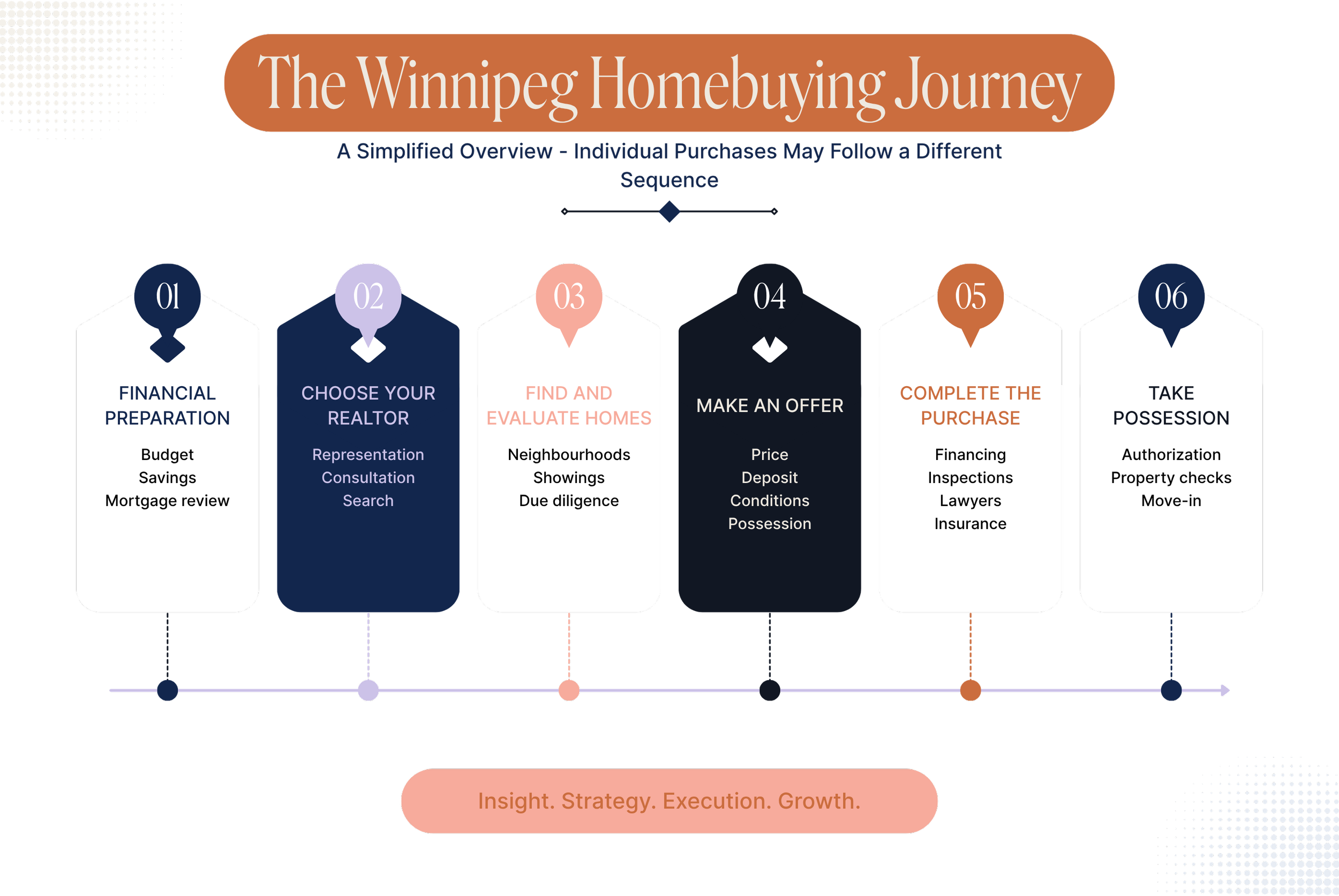
Start by working out a comfortable household budget, saving for your down payment and closing costs, and having a lender review your finances. Choose a Realtor, clarify your priorities, and compare homes and recent sales. When you find a suitable property, investigate its condition and prepare an offer with a price, deposit, possession date, and conditions you understand. After acceptance, work through your contractual deadlines, financing, insurance, and legal arrangements. Enter your new home only after your lawyer authorizes possession, then promptly check its condition and included items.
Sounds Simple Enough, Right!?
If you answer no, that is completely okay - and normal!
Buying a home often begins with a very small moment. You notice a listing while scrolling. You walk through an open house on a Sunday afternoon. You start wondering whether the money you put toward rent could help you build something of your own.
Then the questions arrive.
How much money do we actually need? Is being pre-approved enough? What if the house sells for more than its asking price? Can we still have an inspection? What happens if we already own a home and need to sell it?
Our team recorded a detailed conversation about those questions because we hear them every day. This guide brings that discussion together with additional explanations and links to official resources. It is designed for first-time buyers, people returning to the market after several years, and buyers relocating to Winnipeg who want to understand how the process works here.
You do not need to memorize everything before your first showing. You do deserve to understand the decisions you will be asked to make.
Watch our Winnipeg homebuying conversation
The written guide expands on the discussion and clarifies details that depend on current rules, individual financing, or the wording of a purchase contract.
Key takeaways
Your mortgage approval and your comfortable household budget may be different numbers. Establish both before shopping seriously.
A down payment is only part of the cash you need. Plan for closing costs, your deposit timing, moving expenses, and a reserve for homeownership.
Mortgage pre-approval does not guarantee financing for a particular property.
Choose a Realtor whose communication, judgment, and approach fit your needs. Understand your written service agreement and how compensation works.
Evaluate the neighbourhood, layout, condition, and future costs alongside the features you love.
An asking price is a marketing decision. Recent comparable sales help you assess value.
Competition does not remove the importance of inspections, financing protection, or your own limits.
An accepted offer starts another phase of work: deadlines, documents, financing, insurance, and legal preparation.
Possession requires your lawyer’s authorization. Check and document the property promptly after you are allowed to enter.
In this guide
Start with your budget
Understand down payments
Plan for closing costs
Understand deposits and accessible funds
Get meaningful mortgage pre-approval
Document where your money comes from
Understand your mortgage options
Explore first-time buyer programs
Choose your REALTOR® and understand representation
Make the most of your buyer consultation
Use your property search portal
Choose a neighbourhood for your everyday life
Build a useful needs-and-wants list
Look beyond the listing photos
Investigate condition, permits, and disclosures
Use open houses and private showings effectively
Understand asking prices and offer dates
Prepare an offer you can stand behind
Make informed decisions about conditions and inspections
Plan for buying and selling at the same time
Know what happens after acceptance
Prepare for your lawyer and your move
Know what to do on possession day
Use a homebuying checklist
Frequently asked questions
1. Start with your budget
Before asking how much a lender will approve, decide what owning a home can comfortably cost your household. Those are related questions, but they measure different things.
A lender examines whether a mortgage meets its lending requirements. Your household budget also needs room for groceries, child care, transportation, travel, hobbies, savings, and the ordinary surprises that do not pause because you bought a house.
In our video, we talk about doing a financial audit before becoming attached to a property. Look at what actually comes into your accounts and where it goes. Several months of real spending can tell you more than an optimistic budget written on a quiet afternoon.
A mortgage payment is one part of ownership
If your rent is $1,500 and a mortgage calculator shows a $1,500 payment, those two situations do not necessarily cost the same. Build a budget that considers:
Mortgage principal and interest.
Property taxes, whether collected with your mortgage or paid separately.
Home insurance.
Heating, electricity, water, and other utilities.
Condominium fees, where applicable.
Maintenance, repairs, and eventual replacement of major components.
Parking, commuting, and any lifestyle changes associated with the location.
Savings and an emergency reserve.
Be careful not to count property taxes twice if they are already included in an estimated lender payment. Equally, do not leave them out because a calculator displays only principal and interest.
Practice the payment before you own the house
One suggestion from our discussion is to try living with your expected ownership budget before buying.
For example, suppose your current housing costs are $1,800 a month and you estimate the next home will cost $2,700 a month including its ongoing expenses. Setting aside the $900 difference for several months helps you test that change. It also builds savings.
The exercise may confirm that your budget is comfortable. It may reveal that you would rather buy at a lower price. Both are useful discoveries to make before a binding commitment.
Understand debt-service ratios
Lenders use gross debt service, or GDS, and total debt service, or TDS, to assess borrowing capacity. GDS considers qualifying housing costs relative to gross income; TDS adds other debt obligations. FCAC describes benchmarks of 39% and 44%, respectively, while noting that qualification can vary. These are lending measures rather than a complete household spending plan. Source: FCAC, preparing for a mortgage.
Ask your lender which debt payments most affect your application before making a large repayment. Using all your savings to eliminate a loan could leave too little for your down payment or closing costs. The useful question is: “What combination of savings and debt reduction puts us in the strongest position?”
Starting this conversation a year before buying is entirely reasonable. So is starting now and learning what needs attention.
2. Understand down payments
The minimum down payment depends on the purchase price and whether your situation qualifies for the applicable financing. It is not automatically 5% for every home in Manitoba.
For an eligible owner-occupied purchase, the federal minimum structure is:
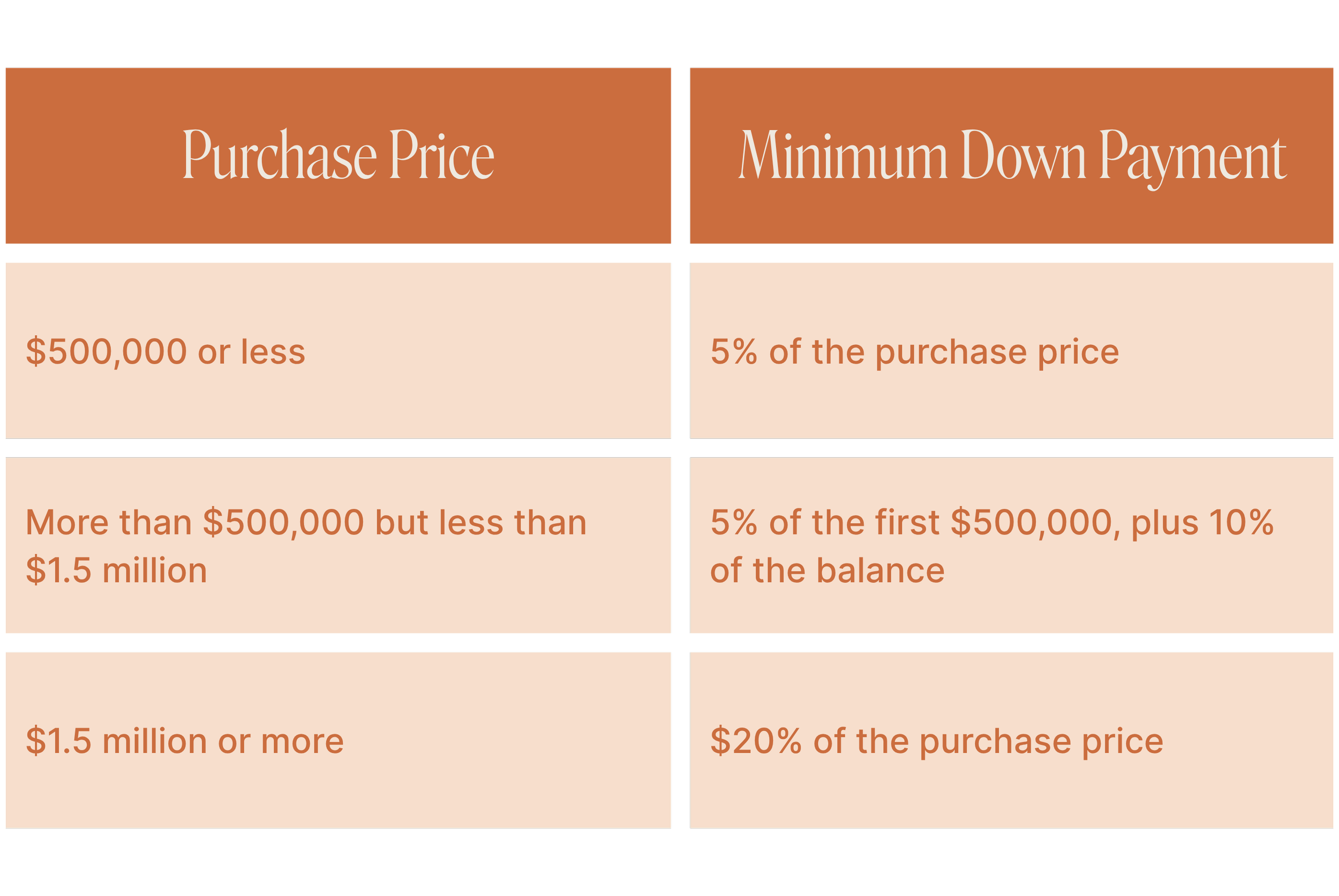
A lender may require more based on the borrower, property, or financing arrangement. Source: FCAC, down payments.
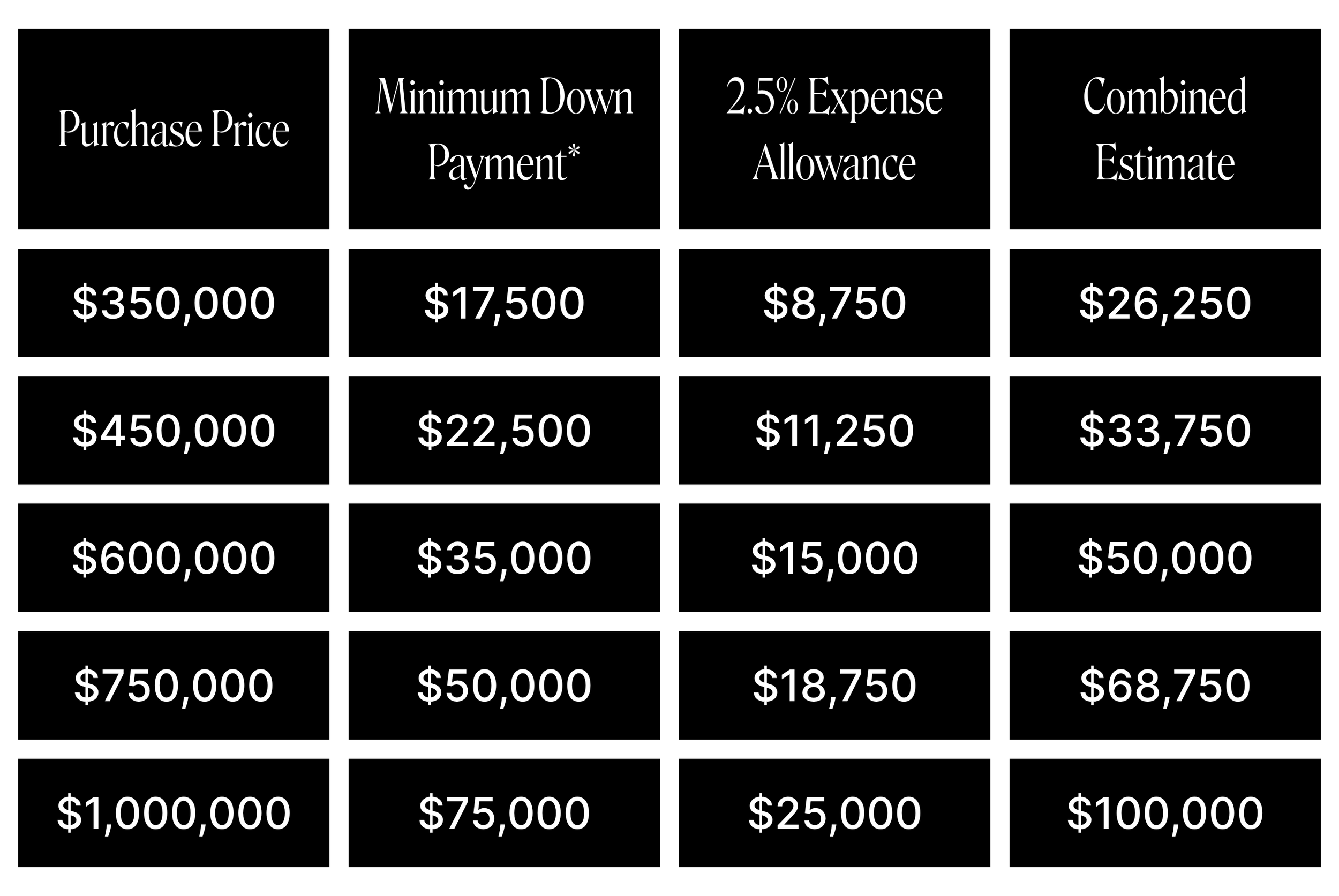
Here is what that formula produces at several example prices:
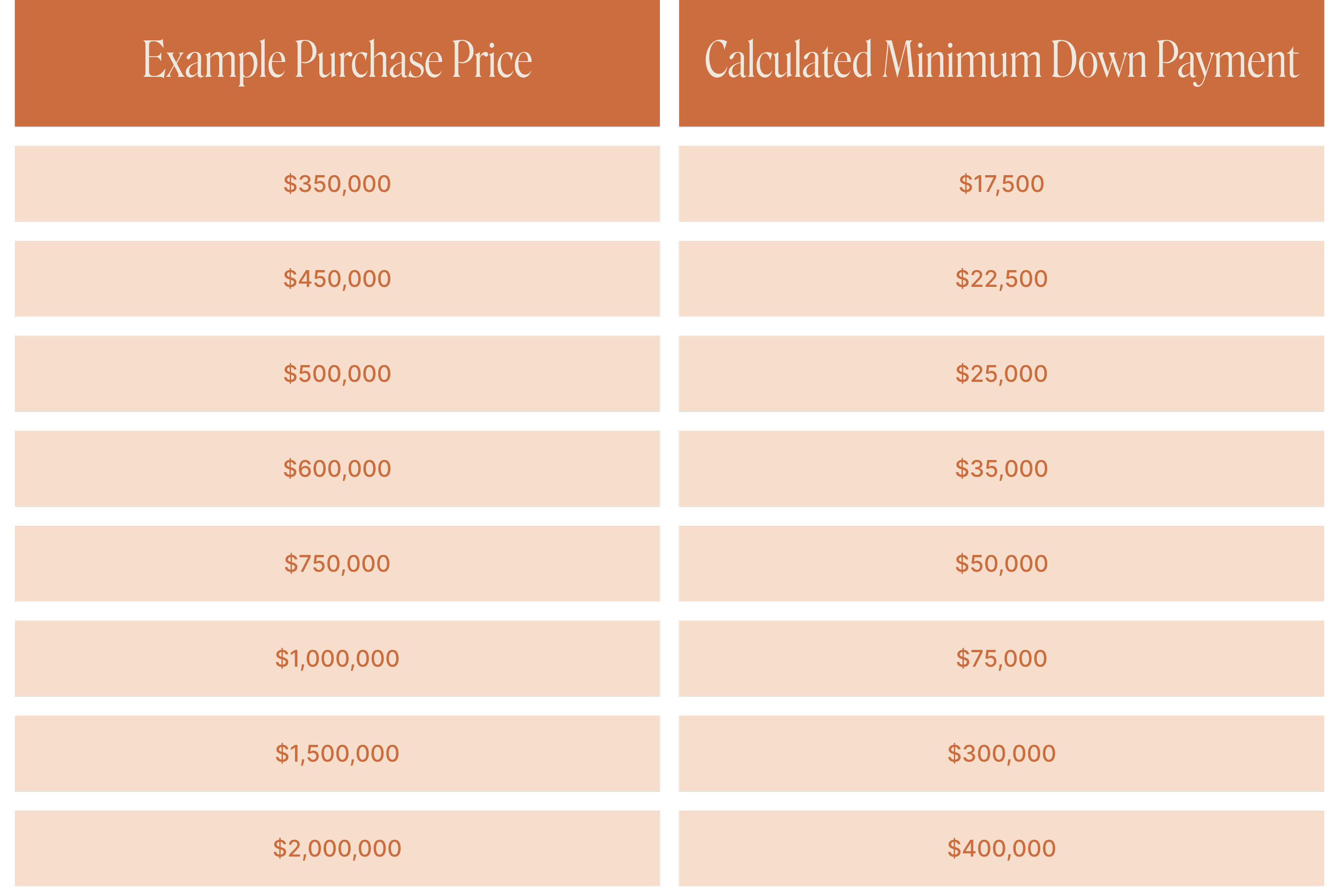
These are calculations using the minimum structure, not promises of financing. Closing costs and reserves are additional.
Do you need 20% down to buy your first home?
Not necessarily. An eligible buyer can purchase below the insurance price limit with less than 20% down. Mortgage default insurance generally applies in that situation. It protects the lender if the borrower defaults; it does not replace your home insurance or protect your household income.
There is a planning decision here. A larger down payment can reduce borrowing, but using every available dollar may leave you vulnerable to an early repair. Ask your lender to compare options while you keep a separate cash reserve in view.
What if you are buying an investment property?
Do not apply the owner-occupied minimums to a rental purchase without confirmation. Tell your lender whether you will live in the property, whether there are multiple units, and how you intend to use it. Get the down-payment requirement for that actual scenario before searching at a particular price.
3. Plan for closing costs
Closing costs are separate from your down payment. In the video, our team discusses using roughly 2% to 2.5% of the purchase price as an early planning allowance for many typical resale purchases. That is a budgeting starting point from our experience, not a fixed fee or a guarantee that every purchase fits within it.
The better number is a property-specific estimate prepared with your lawyer and lender. Some costs are paid before closing, some are collected through your lawyer, and some arise during the move. Keep a running list so you neither overlook an item nor count it twice.
What belongs in your purchase budget?
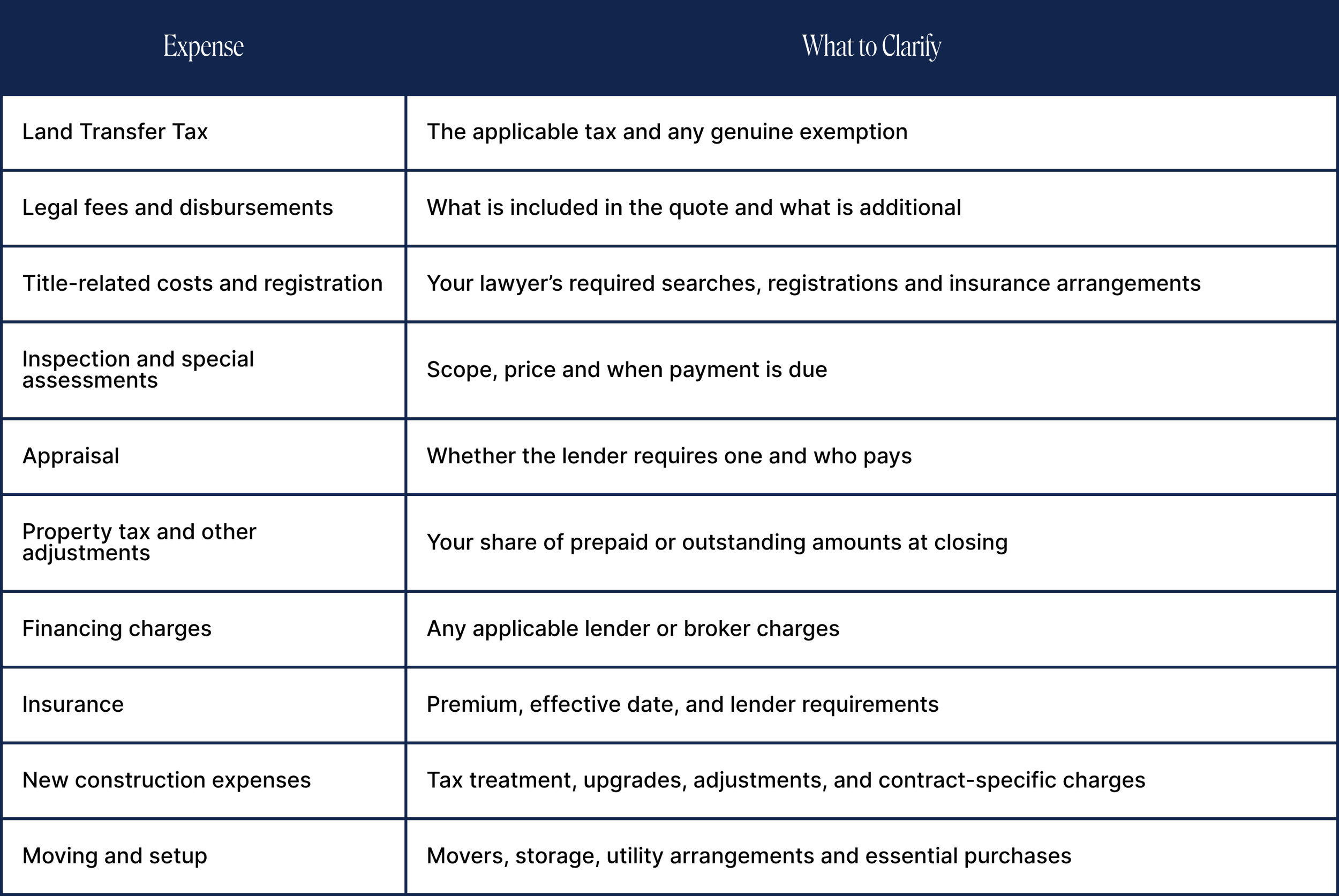
Manitoba land transfer tax
Manitoba calculates land transfer tax on the property’s fair market value at registration, subject to applicable exceptions. The provincial brackets are:

For a $450,000 value, the bracket calculation totals $6,650, excluding registration and other closing costs. Your lawyer should confirm the amount for your transaction. Source: Manitoba Finance, land transfer tax.
Admittedly, even when clients request an approximate number, I will defer to the RateHub calculator for this purposes. Just google Manitoba Land Transfer Tax Calculator Rate Hub. I find the links have moved over the years, but the website always pops up first when I search this!
Why your lawyer’s bill may be larger than the legal fee
We often hear buyers describe everything paid through their lawyer as “lawyer fees.” That can make the legal service itself sound much more expensive than it was.
Ask for a breakdown. The amount you deliver may include land transfer tax, registration charges, adjustments, and the balance of your down payment, alongside legal fees and disbursements. Understanding the categories helps you plan and compare quotes sensibly.
A $450,000 cash-planning example
Using the video’s planning approach:
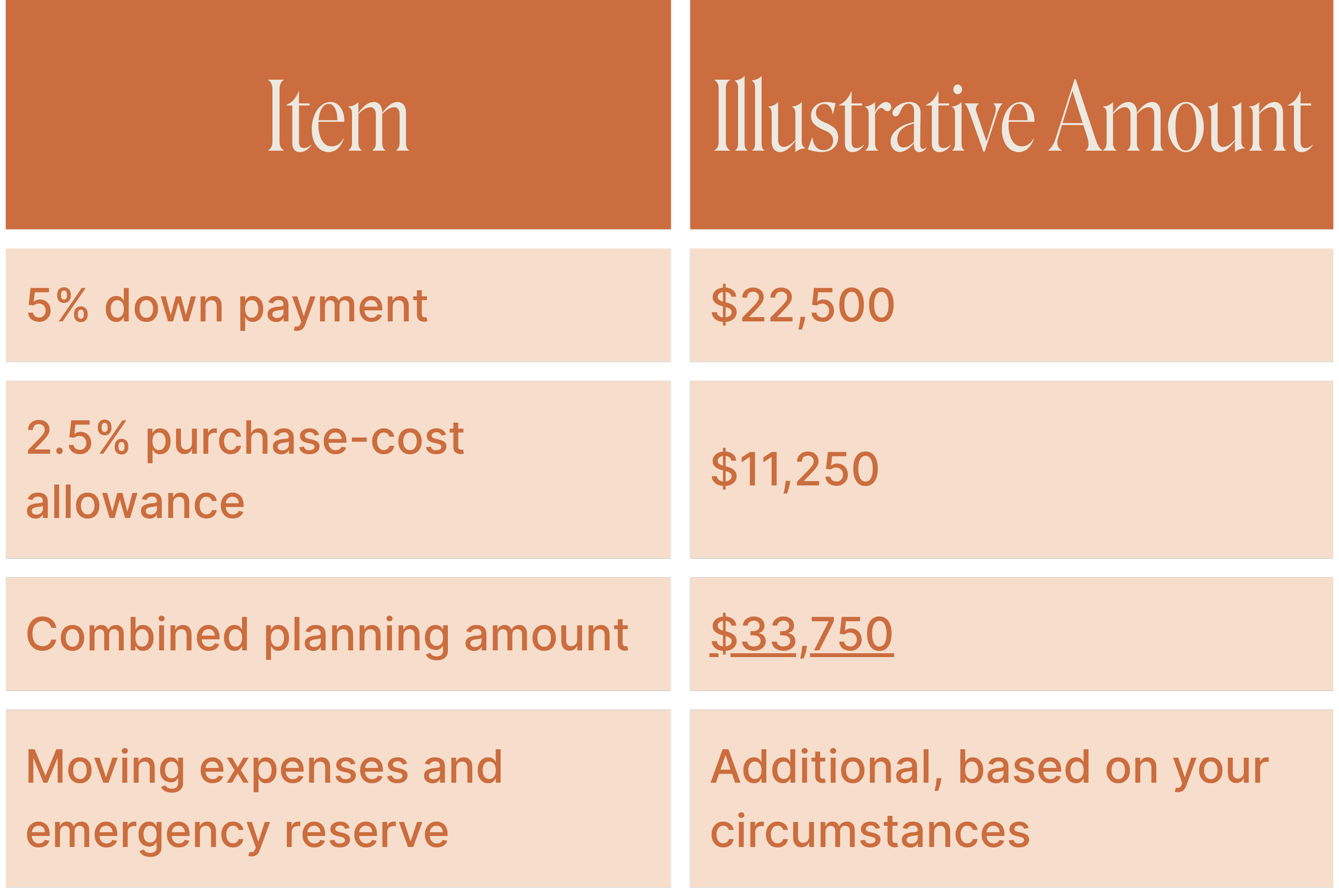
The $11,250 allowance is intended to cover closing and purchase expenses, including the applicable land transfer tax. Do not add the full land transfer tax again unless you have deliberately excluded it from that allowance.
This is why our discussion rounds toward having approximately $35,000 available for that example, with further reserves where possible. The example price is not a statement about Winnipeg’s current average sale price.
Mortgage insurance premiums and Manitoba tax
Where mortgage default insurance applies, the premium can often be added to the mortgage. For example, CMHC’s standard premium schedule lists 4% for a traditional down payment at a loan-to-value ratio above 90% and up to 95%; other circumstances can change the premium. Source: CMHC premium information.
Manitoba removed RST from mortgage insurance effective July 1, 2020. Some general calculators or summaries may retain older provincial assumptions; have your lender confirm the actual charges.
4. Understand deposits and accessible funds
Your purchase deposit forms part of the money paid toward the purchase price. It is not an extra charge on top of the purchase price.
Suppose your planned down payment is $22,500 and you provide a $10,000 deposit. You have advanced $10,000 toward the purchase; you would generally have $12,500 of that down payment left to provide, plus the separate amounts needed for closing. Your lawyer will reconcile the final figures.
The practical issue is timing. Money earmarked for a house may be in an investment, registered account, or account with transfer limits. That does not necessarily make it ready for a deposit tomorrow.
Before offering, confirm:
The amount you can access promptly.
Any withdrawal forms or processing time.
The required payment method and recipient.
The delivery deadline that will be written into the offer.
How you will verify payment instructions through a trusted contact.
How large should the deposit be?
Our conversation includes different examples because there is no single amount that fits every purchase. Price, available cash, competition, and the rest of the offer all matter. Ask your Realtor what is reasonable for the property and your circumstances.
A larger deposit can signal commitment, but it should be an amount you can actually deliver on time. It also cannot solve a problem with financing or make an unaffordable purchase safe.
What happens to the deposit if a purchase does not complete?
Do not assume that every unsuccessful purchase produces an automatic refund, or that a buyer’s maximum exposure is the deposit. Contract terms, the reason the transaction fails, and legal rights matter. Ask your lawyer before relying on a cancellation or walking away.
The prescribed Manitoba residential contract sets out deposit handling, including trust provisions and circumstances for return. Its deadline and notice requirements deserve careful attention. Source: Manitoba residential offer form.
5. Get meaningful mortgage pre-approval
Before writing an offer, understand what your lender has verified and what remains outstanding. The label on an email is less useful than the work behind it.
People often use “pre-qualified” for an early estimate and “pre-approved” for a more detailed review. However, FCAC notes that lenders use different terminology and criteria. A pre-approval is not a guarantee of final mortgage approval.
An online estimate can be a starting point. Before making a serious commitment, ask a mortgage professional to explain the status of your actual application.
Questions to ask before you start offering
Ask your lender:
Have you reviewed my income and supporting documents?
Have you reviewed my debts and credit?
Have you accepted the source of my down payment?
What purchase price and mortgage amount are we discussing?
What assumptions could change that amount?
What property types or conditions could create an issue?
What needs to happen after an offer is accepted?
How quickly can your team review a Winnipeg purchase?
Is there a rate hold, and when does it expire?
What changes should I report before possession?
A lender who can serve Manitoba purchases and meet your deadlines is more useful than a reassuring estimate with no workable follow-through. They do not necessarily need a local office, but they do need to understand the transaction.
The property also needs to qualify
Your income may support a mortgage while a particular property raises concerns for the lender or insurer. An appraisal, unusual construction, property condition, or another issue can affect the final decision. FCAC specifically cautions that a lender can refuse a mortgage after pre-approval.
That distinction matters when considering a purchase without a financing condition. “We were pre-approved” does not mean every remaining financing risk has disappeared.
What is the mortgage stress test?
For a typical new mortgage at a federally regulated lender, qualification uses the higher of 5.25% or the contract rate plus two percentage points. This tests payment capacity at a higher rate; it is not necessarily the interest rate you pay. Ask your lender which rules apply to your application.
6. Document where your money comes from
Tell your lender about gifts, transfers, and other down-payment sources early. Having enough money and having the documentation a lender will accept are two different tasks.
One story in our video captures this perfectly. Buyers had been paying rent to their parents. Their parents had quietly saved it and later offered it back to help with a home purchase. A generous surprise became an extra documentation task at exactly the moment everyone wanted to move quickly.
The lesson is to bring the lender into the conversation as soon as the gift is discussed.
Ask what records are required for family gifts, investment withdrawals, funds moving between accounts, proceeds from another property, or money coming from outside Canada. Requirements can include account statements, transfer records, sale documents, and gift letters. Your lender determines what is acceptable.
Is there a universal 90-day rule?
Our discussion mentions a commonly requested history period. Do not interpret that as a rule that all funds must sit untouched in one account for precisely 90 days. Ask your lender what history and source evidence they need for your situation. Moving money to simplify your accounts does not eliminate the need to explain its origin.
A practical question is: “Before I move or withdraw these funds, what will you need to see?”
Keep your finances steady through closing
Check with your lender before changing employment, taking on a vehicle payment, financing furniture, co-signing a loan, or making another major financial change. If something changes unexpectedly, tell them promptly. A plan based on yesterday’s circumstances needs updating when today’s circumstances are different.
7. Understand your mortgage options
Your mortgage choices affect flexibility and total cost as well as the payment. Bring your expected time in the home, income stability, savings plans, and tolerance for changing payments into the discussion.
High-ratio and conventional mortgages
“High-ratio” generally refers to borrowing more than 80% of the property’s value. With a conventional mortgage, the borrowing is generally 80% or less. A larger down payment usually avoids borrower-paid default insurance, but financing requirements can vary.
The terminology can sound intimidating. Ask your lender to show the full cost of each suitable option, including any premium and interest on a premium added to the loan.
Fixed and variable interest rates
A fixed rate stays the same during its term. A variable rate can change. Within variable-rate products, some payments adjust when the rate changes, while other products initially keep the payment fixed and change how much goes toward principal and interest. Those fixed-payment products can still require changes under their contract provisions.
Ask what happens to your payment if rates increase, what happens to your amortization, and whether you could absorb the change. Neither product is automatically right for every buyer, and a past period of good results does not establish what will happen next.
Open and closed mortgages
An open mortgage generally offers more freedom to repay early and often has a higher rate than a comparable closed mortgage. Closed mortgages restrict extra repayments, but may include prepayment privileges.
Ask about the actual privileges and penalties rather than assuming “closed” means no extra payments. If you may sell during the term, request an explanation of how a break penalty would be calculated.
Term and amortization
The term is the period covered by your current mortgage contract. Amortization is the projected time to repay the loan. A longer amortization generally lowers the payment while increasing interest paid over time, assuming otherwise comparable borrowing. Eligible first-time buyers and new-build purchasers can access 30-year insured amortizations under current rules; other insured purchases generally have a 25-year maximum. Confirm eligibility and costs with your lender.
Use calculators as planning tools
A mortgage calculator helps you test prices, down payments, amortizations, and rates. Our video mentions Ratehub as a tool the team has used. Compare any calculator result with a lender’s current quote, and replace generic utility, insurance, and tax assumptions with property-specific information wherever possible.
A precise-looking payment is only as useful as the assumptions behind it.
8. Explore first-time buyer programs
Review assistance programs before committing to a purchase. Eligibility definitions, timing, and access to funds vary. Being a first-time buyer for one program does not automatically qualify you for another.
First Home Savings Account: FHSA
An FHSA allows eligible buyers to save toward a qualifying first home with tax advantages. Contributions are generally deductible, and qualifying withdrawals are tax-free. Participation room starts when you open your first FHSA. The annual starting room is $8,000, subject to the rules, and the lifetime contribution limit is $40,000. Up to $8,000 of unused participation room can carry forward; it is not unlimited accumulation from every year before opening an account. Sources: CRA FHSA overview and participation rules.
If two people are purchasing together, each person should check their own eligibility and room. Do not multiply the maximums and assume the money is immediately available: those figures describe contribution limits, not a grant.
Ask your financial institution about account investments, withdrawal timing, and what happens if you do not purchase a qualifying home. A savings account intended for a near-term purchase needs an investment approach appropriate to that timeline.
RRSP Home Buyers’ Plan: HBP
The HBP allows eligible withdrawals of up to $60,000 from RRSPs for a qualifying purchase. A qualifying HBP withdrawal can be combined with a qualifying FHSA withdrawal for the same home. HBP withdrawals generally have a 15-year repayment schedule; the start date depends on current rules and your withdrawal year. Source: CRA Home Buyers’ Plan.
These are your retirement savings being redirected to a purchase, with repayment obligations. Ask your tax adviser how repayment fits your future budget and what happens if a required repayment is not made. Where two buyers are involved, assess each person separately.
Federal home buyers’ amount
The federal home buyers’ amount is a non-refundable tax credit for eligible purchases. CRA’s current published page lists a claim amount of up to $10,000 for the 2025 tax year. The claim amount is not a $10,000 cash payment, and eligible co-buyers share the maximum for the same home. Check the rules for your purchase and filing year rather than treating it as cash available at closing. Source: CRA, line 31270.
First-time home buyers’ GST/HST rebate
Eligible first-time buyers of qualifying new housing may receive relief for the federal GST: up to 100% for homes valued up to $1 million, with reduced relief between $1 million and $1.5 million. No relief under this particular rebate applies at $1.5 million or above. Eligibility, agreement dates, construction deadlines, and other conditions matter. Source: CRA first-time buyers’ rebate.
For a Manitoba new build, ask whether the advertised price includes GST, which rebates have already been assumed, whether an assignment to the builder is involved, and what happens if you do not qualify. Have those assumptions reviewed before signing a contract.
Red River Métis First Time Home Purchase Program
The program administered through Louis Riel Capital Corporation offers eligible Red River Métis households down-payment assistance of up to 5% of the price, capped at $18,000, and closing-cost assistance of up to 1.5%, capped at $2,500. Other eligibility limits and a forgivable-loan control period apply.
Contact the administrator and obtain the required program approval before making an offer. The program states that an already accepted purchase contract cannot be funded retroactively. Sources: LRCC program page and program guidelines.
Assistance can meaningfully change someone’s path to ownership. It is worth investigating early enough for the program to help.
9. Choose your Realtor and understand representation
Choose someone you can communicate with openly, who explains their advice and helps you evaluate the risks alongside the possibilities.
A referral from someone you trust is a useful starting point. So is meeting Realtors at open houses or arranging an introductory conversation. You are allowed to care about the fit. This person will hear about your money, priorities, uncertainties, and sometimes the differing opinions of everyone involved in the move.
Ask how they communicate, who handles showings, how they assess value, and what happens when a property raises a concern. Listen for explanations you understand. You should feel able to say, “We like this house, but we are not comfortable offering that much,” without feeling that you have disappointed anyone.
Understand who represents whom
The agent marketing a listing has responsibilities to the seller. Do not assume that contacting that agent creates a separate advocacy relationship for you. Ask who the brokerage represents and what any proposed arrangement means before sharing confidential negotiating information.
If you already have a buyer’s representative, use that relationship to arrange private showings, ask questions, and prepare offers. The point is to have someone who understands your circumstances across the entire search.
What is a buyer service agreement?
Manitoba requires written service agreements before real estate services are provided. MREA explains that these agreements specify the services, termination rights, and how the brokerage will be paid. Source: MREA, service agreements.
Read yours before signing. Discuss its duration, exclusivity, geographic or property scope, cancellation arrangements, and compensation provisions. If something is unclear, ask for an explanation or independent advice.
The agreement should make the working relationship clearer. Treat it as a conversation about expectations, not simply another form to get through on the way to a showing.
Is working with a buyer’s Realtor Really free?
Our recorded conversation uses that familiar shorthand. A more precise explanation is that the seller’s brokerage often offers compensation to a cooperating buyer’s brokerage, which may cover the buyer brokerage’s agreed fee. However, the actual arrangement and any buyer obligation depend on the service agreement and transaction.
Ask how much the brokerage is to receive, who is expected to pay it, and what happens if the amount offered through a listing does not cover the agreement. Avoid assuming there can never be a direct cost to you.
You can learn more about our approach on the Queen Team buying a home page.
10. Make the most of your buyer consultation
A useful buyer consultation connects the purchase process to the life you are trying to build. We want to understand what is motivating the move before narrowing the search.
Perhaps your commute has become exhausting. Perhaps you need a main-floor bedroom, space to work from home, or a different school arrangement. Perhaps the house is intended as a first step, and you expect another move within a few years.
Those details change what we look for and what we investigate.
Come prepared to discuss:
Your comfortable price range and lender’s assessment.
Who will live in the home and any accessibility needs.
Your preferred timing and how flexible it is.
Your expected time in the property.
Location, commuting, schools, and everyday activities.
Repairs or renovations you can realistically manage.
Any current home, lease, relocation, or financing constraint.
How you prefer to receive advice and make decisions.
Set expectations using actual properties
A consultation is also a place to compare your wish list with recent inventory and sales. If your budget and preferred property type rarely overlap in a neighbourhood, it helps to see that evidence early. Then you can decide whether to broaden the area, change the property requirements, allow more time, or reconsider the budget within your financial limits.
Looking at that mismatch together is productive. Discovering it only after several disappointing offer nights is harder.
Returning buyers benefit too
Even if you bought a few years ago, forms, financing, technology, and practices may have changed. Manitoba’s revised prescribed purchase forms came into effect November 1, 2025. Reviewing the process again gives everyone a current starting point. Source: Manitoba Real Estate Services Regulation.
11. Use your property search portal
A search portal helps organize suitable listings and creates a useful record of what you have considered. Our conversation refers to Matrix, the system used by our team, and its buyer-facing portal experience.
A well-set-up search reflects your priorities without being so restrictive that it hides reasonable options. We can discuss boundaries, price, property type, bedrooms, parking, and other searchable features, then review the results together.
Why looking at sold properties helps
As sales information becomes available and can be shared through the system, it helps connect your expectations to actual outcomes. A home you liked may have sold well beyond your range. Another may show that a different layout or location offers more room within your budget.
It is an ongoing education in what your priorities cost. Ask how to locate available sold information in your portal; a sold price does not necessarily reveal every negotiated term.
Can public listing sites show different information?
Yes, information displayed can differ by platform, listing status, permissions, and update timing. When a property interests you, have your Realtor confirm its status and availability. Do not assume every home visible online can still be purchased, or that every portal updates without delay.
Keep the search collaborative
Use favourites and comments, but also explain what they mean. “We loved the house, but the entry would be difficult with the stroller” is more useful than a heart icon alone. If the search consistently misses what you like, revisit its criteria rather than waiting for the system to guess.
12. Choose a neighbourhood for your everyday life
Choose a location you can enjoy on an ordinary weekday as well as during a sunny weekend showing.
In the video, we talk about buyers who fall in love with a beautiful house before working out whether its location fits. A kitchen can be changed. A regular cross-city drive is a different commitment.
Think through a normal day. Where do you work? Who handles school drop-off? Where do you buy groceries, see friends, exercise, or take the dog? How will those routines feel in winter?
Explore the trade-offs in person
An established neighbourhood, a newer community, a central condo, and a property outside Winnipeg can each serve different goals. Rather than rank them universally, compare the things that matter to you:
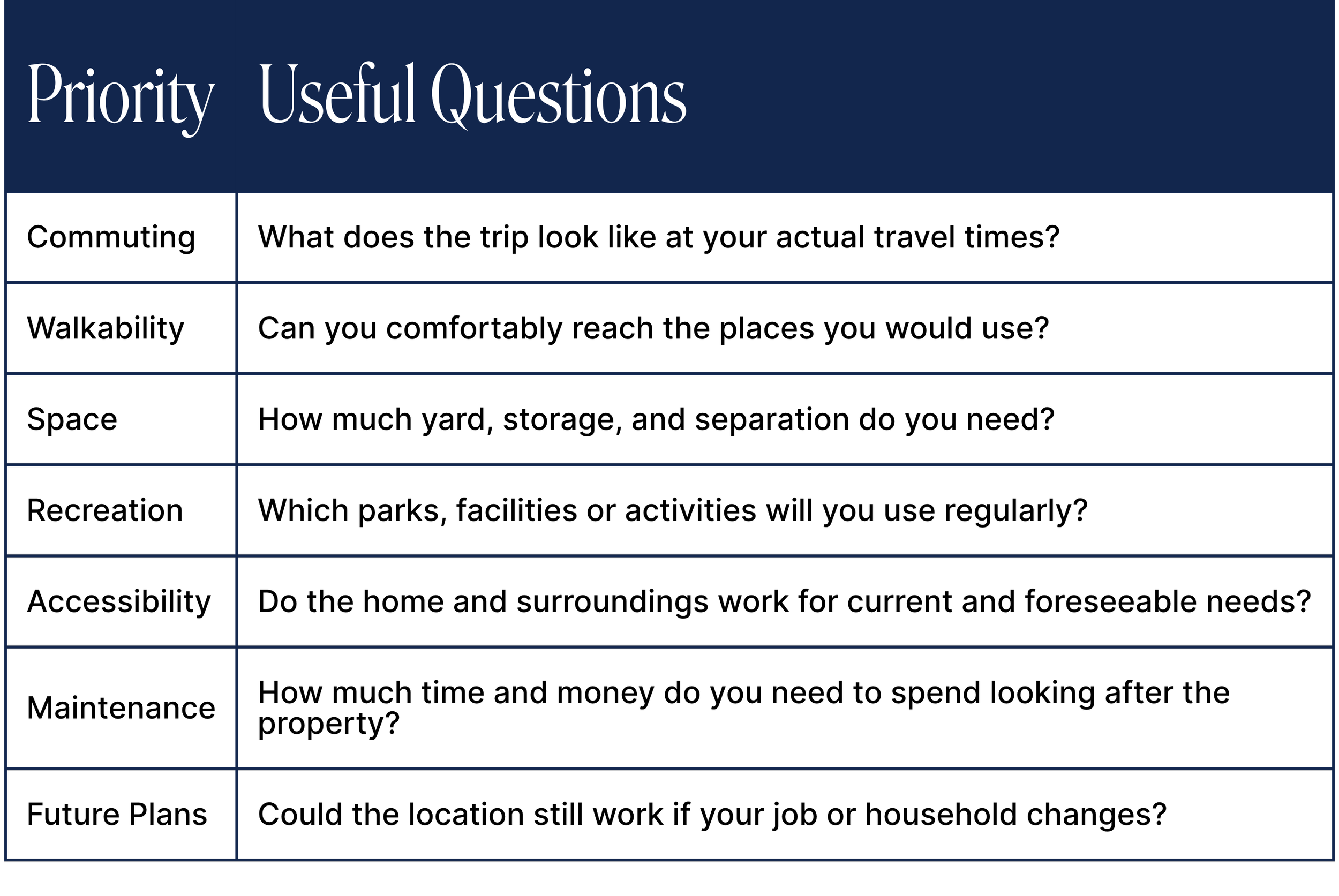
Explore our Winnipeg neighbourhood guides. For example, our Linden Woods and Linden Ridge guide can help you begin comparing that area with other communities.
Verify school arrangements directly
If a school or program is central to your purchase, confirm the current arrangements for the exact address, grade, and program with the school division. Manitoba has a Schools of Choice process, but admission outside a designated school is subject to conditions, including space. Buying a nearby home is not a substitute for confirming the designation or program access. Source: Manitoba Schools of Choice.
Moving to Winnipeg from elsewhere?
Build in time to understand the geography and the local transaction. Our Winnipeg relocation resource is a useful companion to this guide. We can help you compare locations and arrange a search around the time you have available, including discussing virtual viewing options when needed.
13. Build a useful needs-and-wants list
Separate the features you need from the features you would enjoy, then decide which compromises you can live with.
Almost every purchase involves a trade-off. Naming it early makes the decision more deliberate.
Try three categories:
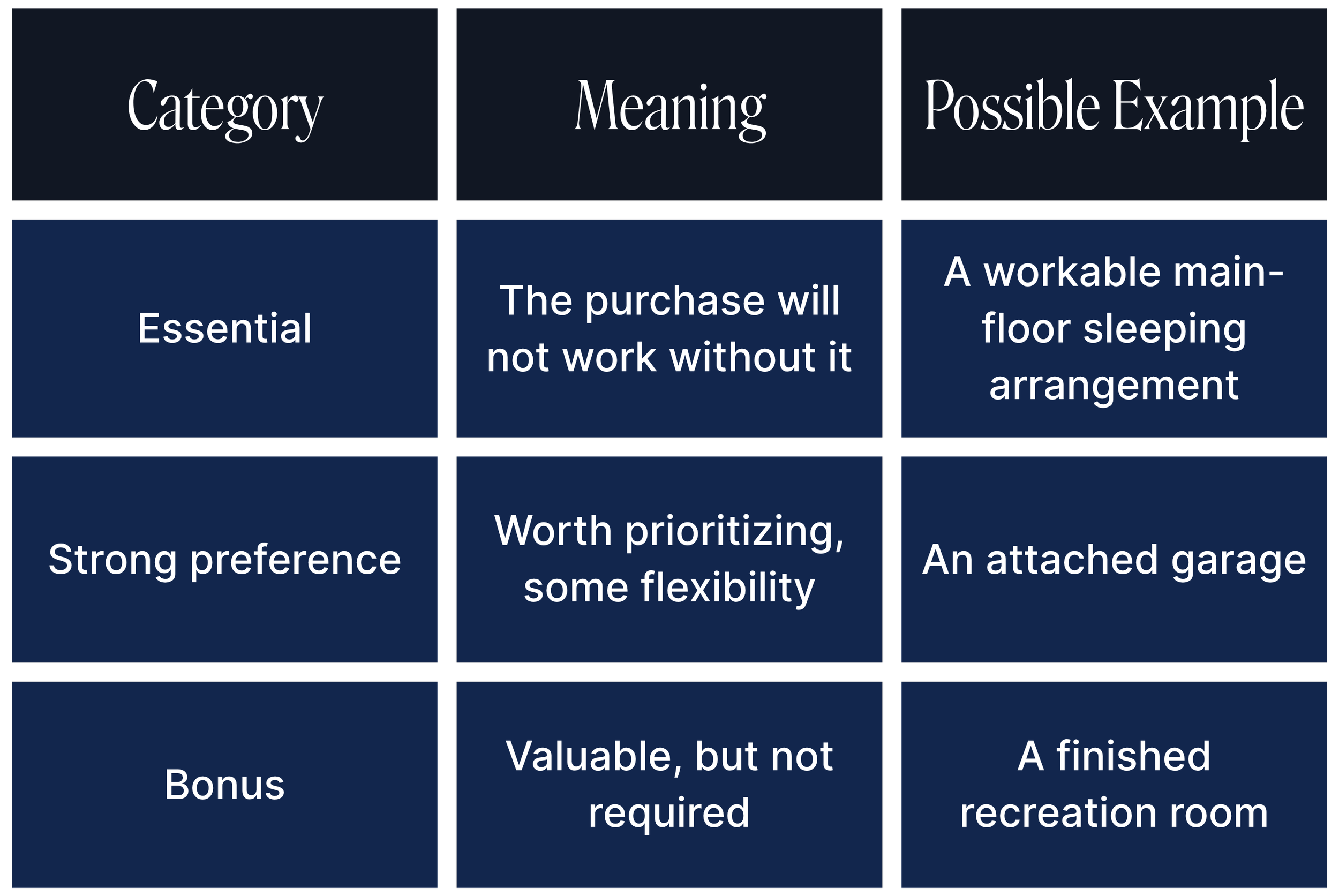
The same feature can fall into different categories for different households. A garage may be a bonus to one buyer and essential to another. Neither needs to defend that preference to us; we need to understand it.
Make compromises specific
“We are flexible” is difficult to search for. “We would accept an unfinished basement if the main floor has enough living space” is useful.
Ask what it would take to improve a compromise later. Is there physical room? Would you need permits? Can you afford the work? Would you still be content if it never happened?
Your criteria may change
Seeing homes often changes a buyer’s priorities. You may discover that an extra bedroom matters less than a usable entryway, or that a smaller home with a better layout feels more spacious. That is information gained through the process.
Tell your Realtor when something changes. If your wish list can only be met at a higher price, return to the budget before expanding the search. A stronger preference does not automatically create more financial capacity.
14. Look beyond the listing photos
Use photos and video to decide what to investigate; use the showing to understand how the home works.
One of our favourite moments from the conversation is the missing dishwasher. Buyers had found a home they loved and wanted to offer. The question was simple: “Do you remember that there is no dishwasher?”
They had been so focused on everything they liked that the absence had barely registered.
That is easy to understand. You are imagining birthdays, dinner parties, or finally having a yard. Part of our role is to keep paying attention to the practical details while you picture the possibilities.
Walk through an ordinary day
Stand at the entrance you would actually use. Where do boots, coats, sports equipment, and bags go? Walk from the parking area with imaginary groceries. Look at the laundry route. Picture where the table, desk, bed, and storage will fit.
Questions worth asking include:
Is there a proper dining space if you need one?
Do door swings or narrow passages affect furniture placement?
Is there enough storage where you use it?
Can the kitchen accommodate the appliances you consider essential?
Does bedroom placement work for your household?
Is basement space suitable for the use you have in mind?
What will maintaining the yard and clearing snow involve?
A photograph can show finishes beautifully while giving little sense of these routines.
Let the showing include some criticism
We should be able to explain both what is appealing and what deserves investigation. Sometimes a feature you barely notice is unusually well done. Our discussion includes a plumbing installation that impressed the professionals much more than it impressed the buyers at first glance.
The reverse also happens: attractive finishes can distract from incomplete work or an impractical layout. Our job is to help you notice the difference, and to recommend a qualified specialist when the issue goes beyond our role.
15. Investigate condition, permits, and disclosures
Treat property condition as a set of questions to investigate, with appropriate professional help. A Realtor can identify concerns and coordinate next steps. That does not replace an inspector, engineer, licensed trade, insurer, or lawyer.
The appropriate investigation depends on the property. An older character home, newer infill, condominium, riverfront property, and rural acreage may each raise different questions.
Areas that deserve attention
Discuss the roof, foundation, water history, drainage, heating and cooling, electrical, plumbing, windows, additions, and major renovations. Ask about repairs, supporting records, and any specialist assessments that already exist.
A visible crack is a reason to investigate its significance; it is not enough information on its own to diagnose a structural problem. Similarly, an updated room is not proof that all related work was properly permitted or completed.
Check permit information thoughtfully
The City of Winnipeg provides permit searches and other property records. An online permit search has limits, including the periods it covers. A missing entry does not by itself prove that work was unpermitted, and an issued permit is not the same thing as confirmation that all necessary inspections were completed. Sources: City property records and permit-search explanations.
Ask what records are needed for the particular concern. Do this early enough to leave time for a useful answer; some records or professional assessments will not be available within a short offer window.
Understand the property disclosure statement
A property disclosure statement, often called a PDS, records the seller’s answers about the property. Review the answers, explanations, and any supporting documents. The current Manitoba residential form allows different arrangements for a PDS, including an attached statement, a condition requiring one, or no requirement to provide one. Source: Manitoba residential offer form.
A statement with explanations is not automatically worse than a blank-looking form. A documented repair may give you something concrete to investigate. A “no” answer may need a follow-up about what was actually checked.
The form is part of the investigation; it is not a warranty that everything behind the walls is sound. Ask your lawyer about its contractual effect rather than assuming that excluding it removes every disclosure responsibility or possible claim.
Radon needs testing
A seller who has never tested cannot establish a home’s radon level by observation. Health Canada recommends long-term testing for at least three months, so an ordinary showing or brief inspection cannot settle that question. Ask for any existing results and discuss a testing plan. Source: Health Canada radon testing.
Check insurability early
Ask an insurance professional about the specific property and any concerns identified during the search. Obtain enough information before removing conditions to understand whether coverage is available on acceptable terms. Leave time for follow-up if the insurer needs records or an assessment.
Add the right questions for the property type
For a rural or acreage purchase, discuss water supply, wastewater systems, access, outbuildings, and ongoing servicing costs with the appropriate professionals. For a riverfront property, ask what additional records, assessments, and insurance questions are appropriate. For a new build, arrange contract review and understand the specifications, allowances, completion arrangements, taxes, and warranty documents before committing.
A standard checklist is a starting point. It needs to expand when the property requires it.
16. Use open houses and private showings effectively
Open houses can help you explore, even when you already work with a Realtor. Let the host know you are represented, and give your own agent prompt feedback afterward.
If you love a property, tell your agent immediately, particularly if an offer date is near. We want time to see it, ask questions, review records, and prepare useful advice. Our team’s preference is to examine the property ourselves before helping you commit to it.
For private showings, contact your own representative. Arranging access, researching the home, and discussing what you see are part of the service you have engaged them to provide.
Plan enough time to compare
There is no magic number of houses you must see. Some buyers find a suitable home quickly; others need a broader search. What matters is whether you understand the alternatives and have enough information to make the decision.
After a showing, make a few notes while the details are fresh. Separate what you loved, what you would change, what you still need to verify, and what would stop you from proceeding. Several homes can blur together surprisingly quickly.
17. Understand asking prices and offer dates
An asking price is not a complete valuation. A property can be priced to invite competition, priced close to the seller’s expectations, or priced optimistically. Recent comparable sales and the particular home’s characteristics provide more context.
A house listed at $399,900 and sold for $450,000 has not necessarily sold for $50,100 more than its market value. Equally, paying below an asking price does not automatically mean you found a bargain.
How should you assess value?
Review comparable sales with attention to location, property type, size, layout, condition, lot, garage, basement, renovations, and timing. Discuss which differences are meaningful and which comparisons are less useful.
There can be three different numbers in the conversation: what the available evidence supports, what your Realtor expects competition might produce, and what you are personally willing and able to pay. They do not have to be identical.
No comparative analysis guarantees future resale value or a lender’s appraisal. It gives you a more informed basis for deciding.
What does “offers on” mean?
Some sellers set a date for reviewing offers. Others consider offers as they arrive. Confirm the instructions for each listing, including any separate showing start date.
Manitoba’s regulator states that when a “no offers until” protocol is used, accepting or countering an offer before the stated deadline can expose the listing agent to disciplinary action. Ask your agent to explain the applicable instructions; do not import assumptions about early “bully offers” from another province. Source: Manitoba offer presentation directive.
View early when you can
An offer date may create a useful window to investigate. Book early enough to ask follow-up questions, consult your lender, consider an inspection, and revisit the home if needed. Seeing it for the first time shortly before the deadline compresses all of that work.
Market conditions are specific
Our recording describes competitive conditions the team was encountering. Competition can change by neighbourhood, price range, property type, season, and the individual listing. Do not assume every Winnipeg home will receive multiple offers or that every seller will reject conditions.
For a particular purchase, ask what the current evidence says about that segment of the market. A broad label such as “seller’s market” is less useful than understanding the home in front of you.
18. Prepare an offer you can stand behind
An offer is a contract proposal that needs to work financially, practically, and legally for you. Price matters, but so do its other terms.
Review the offer carefully with your Realtor. Discuss the deposit, included items, excluded fixtures, possession date, conditions, schedules, and deadline for acceptance. CMHC identifies these as core elements buyers need to consider when preparing an offer. Source: CMHC, making an offer.
Make included items clear
Do not rely on a photograph or memory to establish what stays. If an appliance, window covering, garage remote, or other item matters to you, have the relevant inclusion addressed in writing. Ask how fixtures and exclusions are handled.
This is another reason we revisit practical details before signing. You want the written agreement to reflect the purchase you believe you are making.
Set your limit before offer night
Competition can make it difficult to separate “we want this home” from “we want to win.” Before you learn the final offer count, decide what you can afford and what risks you will accept.
Ask: Would we feel comfortable owning the home at this number? Would it still work if a repair arose soon after possession? If we lose above this number, can we accept that outcome?
A decision made calmly in advance is easier to stand behind than one improvised in a rushed phone call.
Know what information you can expect about competing offers
Manitoba’s offer directive requires buyers to be advised when they are in competition without disclosure of the other offers’ terms. It also addresses offer counts: a listing agent must answer a request for the number of offers accurately at that point in time, but does not necessarily have to provide continuous updates. Source: Manitoba offer presentation directive.
An offer count does not tell you what the other buyers are paying, what conditions they have, or how the seller will choose. Prepare your offer using the information you have and your own limits.
Be available, and do not assume a second chance
Keep your phone accessible and ensure every required signer can respond. There may be limited time to consider a change. Do not assume the seller will counter your offer or invite another round.
Response timing varies. Silence for an hour is not proof of rejection, and a quick call is not a guarantee of success. Your agent should confirm the actual result rather than infer it from the clock.
Possession flexibility can help, when it is realistic
A possession date that suits the seller may make an offer more appealing. Ask whether there is a preferred date, then calculate what accommodating it would mean for you. Extra rent, storage, temporary accommodation, child care, or two housing payments can carry real costs.
Flexibility is useful when it is workable. You should not promise a date that leaves your own household without a viable plan.
If the offer is not accepted
It can sting, especially once you have pictured your life in the house. Review what you can learn without assuming you know all the winning terms. Perhaps the price exceeded your limit. Perhaps the timing or conditions mattered. Sometimes there is very little useful feedback.
A rejected offer does not mean you should abandon your safeguards next time. A successful first offer does not mean you overpaid. The quality of the decision depends on the evidence, terms, and fit—not on how many unsuccessful offers came before it.
19. Make informed decisions about conditions and inspections
Use conditions and investigations that reflect the risks you need to manage. A competitive listing may make those choices harder, but it does not make the underlying risks disappear.
Common topics include financing, property inspection, disclosure review, and selling an existing home. The right wording and deadlines depend on the transaction. Have your agent explain the practical requirements, and involve your lawyer where legal advice is needed.
Financing protection
Before removing or omitting a financing condition, discuss the exact property, offer amount, appraisal risk, down-payment source, and remaining requirements with your lender. Understand what happens if the mortgage is smaller than expected or cannot be funded.
A possible family loan or co-signer is not a confirmed solution until the lender has assessed it and the people involved have agreed. A backup plan needs to be feasible before it can manage risk.
Home inspection conditions
An inspection can provide information about visible and accessible components within its scope. Ask the inspector what is included, what is excluded, and which findings call for a specialist. An inspection cannot eliminate every uncertainty or reveal every concealed defect.
If an inspection is important to your ability to proceed, say so early. We can discuss the options available for that property rather than waiting until the final minutes before submission.
What is a pre-offer inspection?
A pre-offer inspection takes place before you submit the offer, with the required access and permission. Its advantage is that you receive information before deciding what to offer. Its financial drawback is that you may pay for the inspection and still not purchase the home.
Clarify the scope. A shorter consultation or walkthrough may differ substantially from a full inspection. Ask what report you will receive and whether any systems or areas cannot be assessed.
A pre-offer inspection can inform your decision. It does not automatically make an unconditional purchase appropriate.
Short deadlines must still be achievable
Our video discusses the short condition periods the team often encounters. The actual deadline is negotiable and belongs in the contract; two or three days is not a universal legal requirement.
Before promising a short turnaround, check lender capacity, inspection availability, access, weekends, holidays, and outstanding records. A deadline that looks attractive but cannot be met creates another problem.
Unconditional does not mean “we will sort it out later”
If the contract does not contain a financing condition, a lender’s refusal is not automatically a contractual exit. Similar caution applies to property concerns discovered after an inspection condition has been omitted or removed. Get legal advice before making assumptions about your rights or liability.
The regulator emphasizes that buyers need to understand the consequences of waiving inspections or conditions. Source: Manitoba offer presentation directive.
Your safest competitive strategy may sometimes be to keep a condition and accept the possibility of losing the property. The purchase has to work for the buyer who will own it.
Condominium buyers have additional considerations
A condo purchase involves the unit and the condominium corporation. Arrange appropriate review of its finances, reserve information, rules, insurance arrangements, and any known assessments or significant projects.
Manitoba provides a seven-day cooling-off period tied to the later of entering the agreement and receiving the required disclosure. Buyers can cancel for any reason during that period, following the applicable notice requirements. Have your lawyer confirm the exact deadline and any issues with document delivery or material changes. Do not treat it as an ordinary optional inspection condition. Source: Manitoba condominium buyer information.
A pet policy or planned renovation can be as important to your enjoyment as the floor plan. Review the actual documents rather than relying solely on a sign, summary, or conversation.
20. Plan for buying and selling at the same time
There is no single right order for every household. Selling first reduces some uncertainty and creates another; buying first reverses that balance.
Our team’s conversation includes different perspectives because the appropriate recommendation depends on your finances, the saleability of your present home, the availability of your next home, and your tolerance for a temporary move.
Selling first
Selling first helps establish what your home has sold for and when you need to leave. It can make the next purchase budget clearer. The challenge is finding the next property within that period or having suitable temporary accommodation.
Consider whether a longer possession period could help, what a short-term rental would cost, and whether you can manage moving twice. A longer timeline is useful, but it does not guarantee that the right property will appear.
Buying first
Buying first can secure a property that is difficult to replace. It also leaves you exposed to the timing and price of your sale. Ask your lender what you can carry, whether any bridge financing is actually available, and what approvals it requires.
Have the current home assessed and discuss preparation before making the next purchase. “We can list quickly” should mean there is a concrete plan for repairs, staging, media, paperwork, and the household’s move.
Sale-of-home conditions and time clauses
A sale-of-home condition may be acceptable in some negotiations and difficult in others. Discuss the specific listing rather than assuming it is either impossible or guaranteed.
If a seller asks for a time clause, have the wording explained carefully. It may allow continued marketing and require you to respond within a defined period if another qualifying offer arrives. The notice process, deadline, and consequences are contractual matters. Do not remove a sale condition unless you can actually complete the purchase without it.
Stress-test the moving plan
Before proceeding, work through three scenarios: your home sells as expected, it takes longer, or it sells for less. Then ask what happens if the purchase or sale cannot close on the expected day.
A useful plan makes room for an outcome that is less convenient than the one everyone hopes for.
21. Know what happens after acceptance
Acceptance begins the next stage; it is not the end of your responsibilities. The tasks depend on the contract you signed.
Deliver the deposit as agreed
Confirm its deadline and method immediately. Have payment instructions verified through a trusted, independently confirmed contact. Keep the record of delivery.
Move financing forward
Your lender needs the purchase documents and any additional information it requests. Confirm that they have what they need and respond promptly. If an appraisal or insurer review is required, ask how it fits the deadline.
Do not assume that sending documents means approval has been granted. Ask what remains outstanding and what written confirmation is needed before a financing condition can be dealt with.
Complete the agreed investigations
Book inspections and specialist reviews promptly. Read the reports and ask questions. If a result changes your ability to proceed, raise it while the relevant condition and deadline still allow it to be addressed.
Handle conditions formally
Your agent should explain what must happen to satisfy, waive, extend, or otherwise address each condition. Obtain legal advice where necessary. A friendly text saying “everything seems fine” is not a substitute for completing the required contractual steps.
Once the purchase is firm, many buyers shift mentally into packing mode. Keep responding to your lender and lawyer; further signatures, documents, and funding arrangements may still be required.
Choose and engage your lawyer
It helps to identify a lawyer early, especially for a complex purchase or when you want advice before signing. Confirm that they have accepted your file and can meet the transaction’s requirements. Ask your agent to ensure the purchase documents have been sent to the correct office.
22. Prepare for your lawyer and your move
Work backward from possession and leave time for questions. Your lawyer coordinates legal completion, but you still need to provide information, sign documents, and deliver the required funds.
Ask what identification, insurance confirmation, payment method, and other documents will be needed. Confirm that mortgage instructions are being sent to the lawyer. The meeting date and requirements vary; do not treat “about a week before possession” as a guaranteed schedule.
Understand the final funds required
Your lawyer will reconcile the purchase funds, deposit credit, mortgage advance, adjustments, taxes, fees, and other transaction amounts. Use the lawyer’s actual statement and payment instructions rather than a rough estimate from early in the search.
If the number differs from your expectation, ask for the breakdown promptly. There may be an adjustment you had not anticipated or a misunderstanding about what was included in an earlier estimate.
Put insurance in place
Arrange the required coverage to begin when needed, and ensure the lawyer and lender receive the appropriate confirmation. Discuss any gap between legal completion, possession, and your physical moving date with your insurance adviser.
Organize the practical move
Plan utilities, address changes, movers, storage, medication and essential items, children, pets, and building access where relevant. Condo moves may require elevator or loading arrangements, so ask the property manager early.
Keep documents and contact details somewhere accessible on moving day. Your phone, identification, charger, medications, and a change of clothes should not be in the least accessible box on the truck.
Allow flexibility around access to the property. A moving schedule based on assumed morning entry can become expensive if you are not authorized to enter then.
23. Know what to do on possession day
Wait for your lawyer’s authorization before entering the property. Having keys does not by itself mean you have permission to move in.
The current Manitoba prescribed residential form provides for completion and possession no later than 6 p.m. on the possession date. Your actual contract and closing arrangements govern; do not assume noon or an earlier access time.
Ask in advance how keys and authorization will be coordinated. Follow the instructions for your transaction rather than assuming every closing uses an identical key handover.
Check the home promptly after authorized entry
Before unpacking takes over, walk through and compare the property with your agreement. Subject to safe operating conditions and professional instructions, check the included appliances, plumbing, heating, and other agreed items. Avoid operating equipment in conditions that could damage it; air conditioning in cold weather is an example to discuss with a professional.
Look for unexpected water, damage, missing inclusions, or possessions left behind. Take date-stamped photos or video where useful, record what you found, and contact your Realtor and lawyer promptly about a concern.
They can help you assess the agreement and next steps. Do not assume that every breakdown is automatically the seller’s responsibility or that you can create a holdback yourself after discovering a problem.
Record meter readings and settle in
Record applicable utility readings and follow the providers’ instructions for your accounts. Locate the water shutoff, electrical panel, and equipment instructions. Plan lock changes or rekeying and check safety devices as appropriate.
Then take a breath. There has been a great deal to coordinate. You can order the pizza, find the box with the plates, and start making the place your own.
24. Use a homebuying checklist
Use this as a conversation guide with your Realtor, lender, and lawyer. Your property and contract may require additional steps.
Before shopping seriously
Review actual household spending and choose a comfortable ownership budget.
Review credit, debts, and financial preparation with a lender.
Confirm the down payment, closing-cost allowance, and reserve.
Investigate eligible assistance programs before their deadlines.
Have the lender review supporting documents and explain outstanding requirements.
Choose your Realtor and understand the service agreement and compensation.
Discuss location, timing, needs, wants, and possible compromises.
Set up and review a useful search portal.
Before writing an offer
Confirm listing instructions and availability.
Review the home’s layout and suitability for your everyday needs.
Review comparable sales and set a comfortable price limit.
Discuss condition, disclosures, permits, insurance, and appropriate investigations.
Speak with the lender about the property and intended offer.
Confirm accessible deposit funds and delivery arrangements.
Understand every condition and deadline you propose.
Confirm inclusions, exclusions, possession, and other terms.
Ensure all buyers understand and can respond during negotiations.
After acceptance
Deliver the deposit in accordance with the contract.
Provide documents requested by the lender.
Complete inspections and reviews within the agreed time.
Address conditions using the required written process.
Engage your lawyer and confirm receipt of the file.
Arrange insurance and any required confirmations.
Keep the lender informed of financial changes.
Complete legal signing and provide the lawyer’s required funds.
Confirm utilities, moving arrangements, keys, and possession authorization.
On possession day
Obtain authorization before entering.
Check the property and included items promptly and safely.
Photograph and report unexpected issues.
Record applicable meter readings.
Locate shutoffs and equipment information.
Begin your household safety and maintenance setup.
Frequently asked questions about buying a home in Winnipeg
How much money do I need to buy a home in Winnipeg?
You need your down payment plus closing and purchase expenses, with additional room for moving and a reserve. At an illustrative $450,000 price, 5% down is $22,500. Adding the team’s 2.5% planning allowance produces $33,750 before separate moving and emergency reserves. Your lender and lawyer should confirm the actual requirements.
Can I buy a Winnipeg home with 5% down?
For an eligible owner-occupied purchase at $500,000 or less, the federal minimum is generally 5%. Higher prices and different lending situations change the requirement. Confirm the rules for your specific purchase before relying on that percentage.
Is the deposit extra money on top of the down payment?
The deposit is credited toward the purchase price. In a typical financed purchase, it counts toward the cash contribution you are making. Its earlier delivery deadline means you need accessible funds before the rest of your closing money is due.
How much should I budget for closing costs?
Our team discusses roughly 2% to 2.5% as an early allowance for many typical resale purchases. It is not a fixed charge. Get an itemized estimate for the property, financing, and legal work involved, and allow separately for moving and emergency savings.
Does mortgage pre-approval mean I can safely remove financing protection?
Pre-approval does not guarantee final funding. Have the lender review the property, price, and remaining requirements, then understand the contractual risk before deciding about a financing condition. Ask your lawyer for advice where needed.
Should I choose the mortgage with the lowest rate?
Compare the rate with the full product: term, payment structure, prepayment privileges, penalties, portability, and expected time in the home. A lower quoted rate can come with restrictions that matter to your plans.
Can I use a family gift for my down payment?
Ask your lender whether the gift is acceptable and what documentation is required. Tell them early, including whether the money is truly a gift or needs to be repaid. Do not assume funds can simply arrive at the last minute without review.
Can I use an FHSA and the Home Buyers’ Plan together?
CRA permits qualifying withdrawals from both for the same qualifying home when the requirements for each are met. Review each buyer’s eligibility, contribution history, withdrawal timing, and HBP repayment obligations separately.
Do I need to choose a Realtor before going to open houses?
You can explore open houses before choosing representation. When you are ready for services such as a coordinated private search and offer advice, discuss representation and the written agreement. If already represented, tell the host and communicate any serious interest to your own agent promptly.
Will I have to pay my buyer’s Realtor directly?
The answer depends on your agreement and the compensation available in the transaction. A seller’s brokerage may offer cooperating compensation that covers the agreed buyer brokerage fee. Ask about any possible shortfall or direct obligation before proceeding.
Should I contact the listing agent to arrange every viewing?
If you have a buyer representative, ask them to coordinate private showings and questions. The listing agent has responsibilities to the seller. Understand any proposed representation arrangement before sharing confidential financial or negotiating information.
How do I find out what homes actually sold for?
Ask your Realtor about available sales information and how to use your portal. Reviewing relevant recent sales helps you understand pricing. A reported sale price alone does not reveal every condition, inclusion, or negotiation detail.
Does offering over asking mean I am overpaying?
Not automatically. Asking prices reflect listing strategies as well as seller expectations. Compare the home with relevant sold properties, review its condition and differences, and stay within your financial limits. Paying below asking does not automatically establish a bargain either.
Can a seller accept an offer before a published offer date?
Manitoba has specific requirements around a “no offers until” process. Have your agent confirm the actual instructions and applicable rules. Do not assume that an early-offer strategy used elsewhere applies here.
Will I get another chance to increase my offer?
There is no guarantee. A seller may accept another offer without countering yours. Discuss a price and terms you can stand behind before submission, and be available if your agent contacts you during negotiations.
Can I still get a home inspection in a competitive market?
Discuss an inspection condition and any pre-offer inspection option early. Seller preferences and access vary. A pre-offer inspection involves a cost even if you do not buy, and its scope needs to be clear. Keep the protection you need to make a sound decision.
Is the property disclosure statement enough to assess the home?
No single document provides a complete assessment. Review the seller’s answers, ask follow-up questions, consider records and appropriate inspections, and get specialist advice where required. A lack of reported problems is not proof that no problems exist.
Should I sell my current home before buying?
It depends on your ability to carry both properties, the likely sale of your current home, the availability of your next home, and temporary housing options. Compare both sequences with your Realtor and lender before committing.
Are condos purchased differently from houses in Manitoba?
There are additional disclosure and review requirements and a statutory cooling-off framework. Consider the corporation’s finances, rules, insurance, and potential assessments alongside the unit itself. Have your lawyer explain the documents and exact deadlines.
When can I enter the property on possession day?
Enter only after your lawyer authorizes it. The prescribed residential form provides for completion and possession no later than 6 p.m., subject to the agreement and closing arrangements. Confirm your own transaction rather than assuming morning or noon access.
What should I do if something is wrong when I take possession?
Document the issue promptly and contact your Realtor and lawyer. Keep photos, video, messages, and relevant records. The appropriate response depends on the contract and facts; avoid assuming responsibility or a remedy before obtaining advice.
Is there a perfect time to buy a home in Winnipeg?
There is no dependable date that makes every purchase a good decision. Consider your financial readiness, expected time in the home, suitable inventory, and the specific market segment. Future appreciation is not guaranteed, and renting longer can be a reasonable choice when buying does not yet fit.
What Makes Buying a Home in Manitoba Different?
While many steps in the homebuying process are similar across Canada, there are some Manitoba-specific rules and practices buyers should understand.
Written buyer service agreements: Manitoba requires written service agreements for real estate services. Before signing, understand the services being provided, how compensation works and the terms of your agreement.
Offer presentation rules: Winnipeg sellers may establish a date for reviewing offers. Manitoba has specific requirements surrounding these arrangements, so buyers shouldn't assume that early-offer strategies used in other provinces apply here.
Manitoba land transfer tax: Buyers should account for provincial land transfer tax when estimating closing costs. The amount depends on the property's value and any applicable exemptions.
Condominium cooling-off period: Manitoba condominium buyers have a statutory seven-day cooling-off framework tied to the agreement and required disclosure. Your lawyer should confirm the applicable deadlines and notice requirements.
Possession timing: Manitoba's prescribed residential offer form provides for completion and possession no later than 6 p.m. on the possession date, subject to the actual contract and closing arrangements. Buyers should not assume they can move in first thing in the morning.
These details can affect your budget, offer strategy and moving plans. Having someone explain how the Manitoba process works before you commit can make a significant difference.
How long does it take to buy a home in Winnipeg?
The timeline varies depending on your financing, the type of property you're looking for, market conditions and how quickly you find a suitable home.
Some buyers find the right property within their first few showings, while others search for several months. Once an offer is accepted, the timeline to possession depends on the date negotiated in the contract and the steps required to complete the transaction. Rather than planning around an assumed average, we recommend discussing your ideal moving date with your Realtor and lender early in the process.
What should I do before I start viewing homes in Winnipeg?
Start by reviewing your household budget and speaking with a mortgage professional about your borrowing capacity and available funds. Then meet with a Realtor to discuss your priorities, preferred neighbourhoods, timeline and the type of home you're hoping to purchase.
You don't need to have every detail figured out before that first conversation. In fact, part of the consultation is helping you identify which features matter most and where you may need to compromise.
Starting with a clear financial picture and a realistic search strategy can save a great deal of frustration later.
Start with a conversation about what comes next
Buying a home is a sequence of decisions. Some are exciting. Some are technical. Many become easier once someone explains what the choice means for your own circumstances.
At Queen Team, we want to understand what you are working toward, help you evaluate the options, and give you room to ask questions. That might mean introducing you to a lender, building a search around your daily life, investigating a concern, or talking through why a particular offer would stretch you too far.
If you are considering a purchase, visit our buying a home page to begin the conversation. You do not need every answer before reaching out. We can help you work out the next useful step.
This guide provides general information. Financing, program eligibility, property investigations, and contractual rights depend on your circumstances and the applicable rules. Consult your mortgage professional, lawyer, accountant, insurer, and qualified property specialists for advice specific to your purchase.

Your Friend in Real EstaTe,
Jennifer Queen
Phone: (204) 797-7945
Email: Jennifer@QueenTeam.ca
About the Team Leader
Jennifer Queen is a Winnipeg REALTOR®, Broker and Team Lead of Queen Team at Ethos Realty Inc.
With more than 15 years of experience in Winnipeg real estate, Jennifer has helped buyers navigate everything from their first home purchase to competitive multiple-offer situations, luxury properties, investment opportunities and complex transactions involving the sale of an existing home.
The Queen Team works with approximately 200 real estate transactions annually, giving its Realtors firsthand experience with Winnipeg's changing market conditions, neighbourhoods, pricing strategies and the practical challenges buyers encounter. The team includes Jennifer Queen, Logan Queen, Sheyla Duncan and Samantha Scribilo, supported by a dedicated administrative and marketing team.
This guide brings together the team's real-world experiences and conversations with buyers, along with references to official Canadian and Manitoba resources. Our goal is to help Winnipeg homebuyers understand not just the steps involved in purchasing a property, but the reasoning behind the decisions they'll make along the way.