

One of the hardest parts about relocating to Winnipeg isn't finding homes for sale, it's figuring out where you should actually live.
When you're unfamiliar with the city, neighbourhood names don't mean much yet. River Heights. Sage Creek. St. Vital. Transcona. Charleswood. Bridgwater. St. Boniface. Linden Woods.
You can look at houses online for hours and still have no idea which area actually fits your lifestyle. And that's where many relocating buyers make a mistake: they choose the house before they choose the lifestyle.
If you're moving to Winnipeg, here's how I recommend narrowing down your neighbourhoods before you start seriously shopping for a home.
How Do You Choose a Winnipeg Neighbourhood When Relocating?
If you're moving to Winnipeg and don't know the city, start by identifying your workplace, comfortable housing budget, preferred home style and everyday lifestyle priorities. Then compare a shortlist of neighbourhoods based on commuting routes, schools, amenities, property age and maintenance expectations. Explore different areas in person when possible, and use detailed virtual showings and local guidance if you're purchasing remotely. The goal isn't to find the most popular Winnipeg neighbourhood, it's to find an area that suits the way you actually want to live.
Start With Your Daily Life, Not the House
Before talking about bedrooms, bathrooms and granite countertops, think about what a normal Tuesday will look like after you move. Ask yourself:
Where will I work?
How often will I commute?
Do I have children who need school or childcare?
How often do I want to drive?
Do I want restaurants and shops nearby?
Do I prefer quiet suburban streets?
Do I want a large yard?
How important are parks and walking paths?
Do I want a newer house or an established neighbourhood?
How much maintenance am I comfortable with?
Your answers will often eliminate large portions of the city immediately. That's a good thing. The goal isn't to find 20 neighbourhoods you might like. It's to find a handful that genuinely fit your life.
Step 1: Determine Where You'll Be Working
For many relocating buyers, commute is one of the easiest places to start. Winnipeg isn't an enormous city, and many commutes are quite manageable compared with Toronto, Vancouver or other larger Canadian centres. But where you live still matters.
Someone working at the University of Manitoba may prioritize completely different neighbourhoods than someone working near the airport or in northeast Winnipeg.
Your workplace doesn't necessarily dictate where you have to live, but it gives us a starting point. Think about:
How many days per week you'll commute
What time you'll travel
Whether you'll need to cross the city
Whether you need quick access to the Perimeter Highway
Whether a 15-, 20- or 30-minute commute feels comfortable to you
And remember that winter driving conditions can occasionally make travel slower.
Understanding Winnipeg's Geography Before Choosing a Neighbourhood
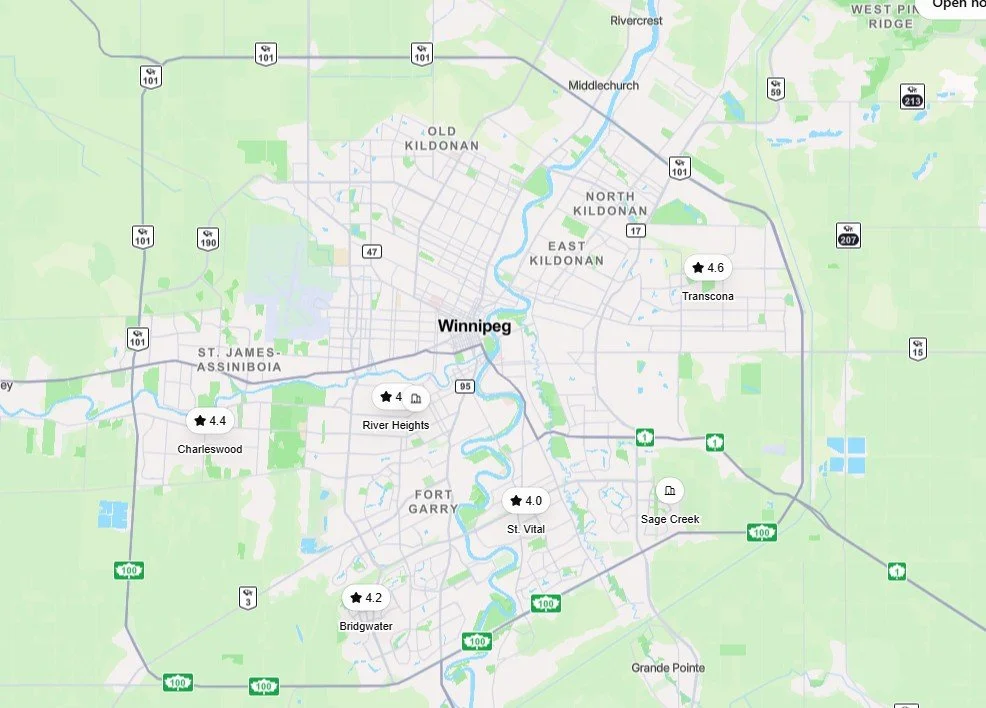
One thing I always encourage relocating buyers to do is look at Winnipeg as a whole before narrowing their search to individual communities. When you're unfamiliar with the city, neighbourhood names don't tell you much about where you'll be spending your time.
For example, someone working at the University of Manitoba may naturally start exploring south Winnipeg. Someone working near the airport might want to investigate different areas. And someone who travels regularly outside the city may place more importance on access to the Perimeter Highway.
That doesn't mean you need to live in the same part of Winnipeg where you work. It simply gives us a practical starting point. Here's a general way to begin exploring the city:
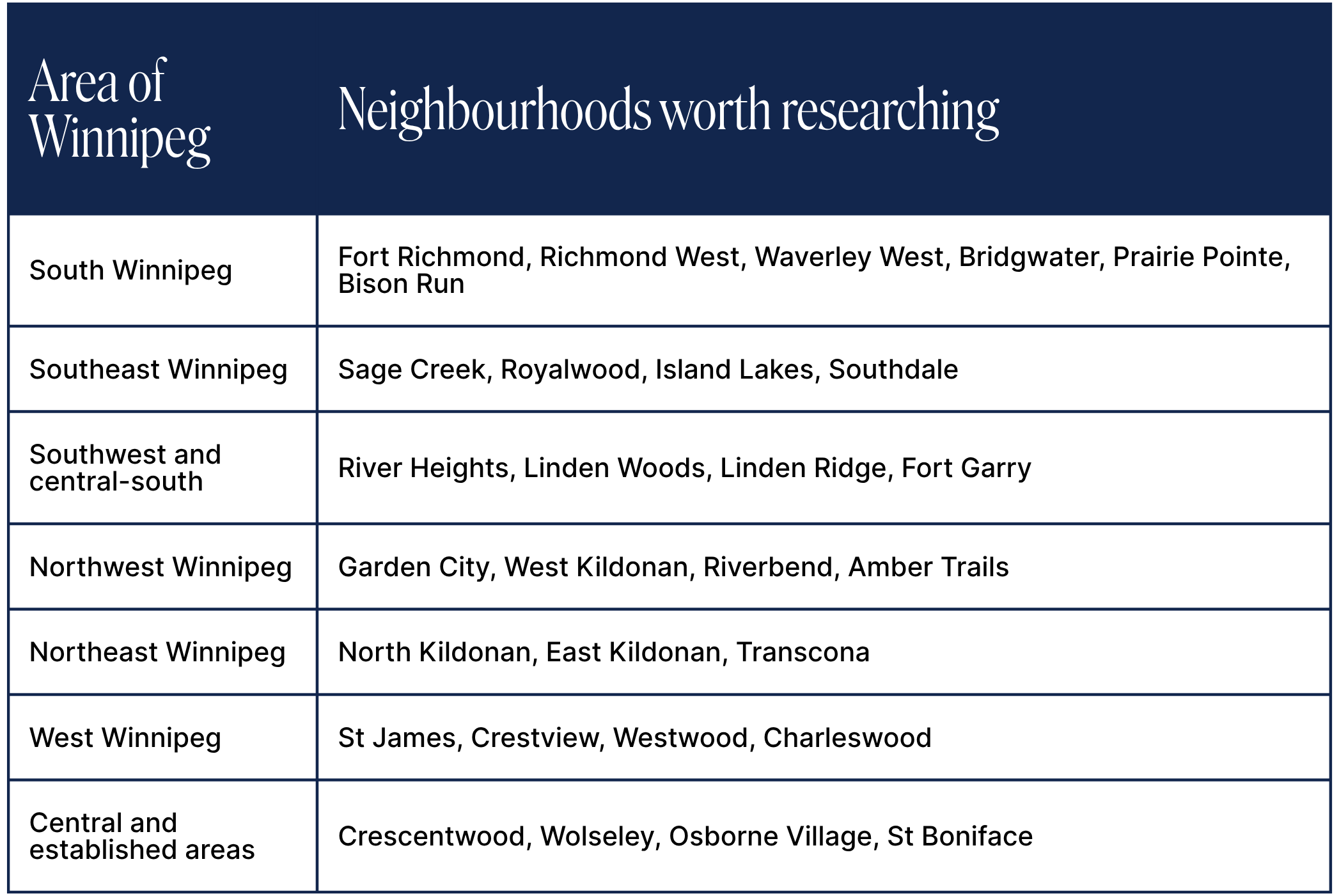
These aren't strict boundaries, and the neighbourhoods within each area can offer very different housing options.
They're simply starting points.
Once we know where you'll work, what kind of home you're hoping for and which amenities matter to you, we can narrow that larger map into a much more manageable list.
I also encourage buyers to consider their commute during winter, not just during ideal summer driving conditions. A route that looks convenient on a map may feel different during rush hour or after a significant snowfall.
My advice? Don't choose a neighbourhood based on its distance from work alone. Think about the actual route you'll travel and how often you'll need to make that trip.
Step 2: Decide What Type of Neighbourhood You Want
This is where Winnipeg gets interesting. Different parts of the city can feel surprisingly different.
If you prefer newer suburban communities, you may be drawn toward areas with newer homes, walking paths, parks, ponds and modern commercial development.
If you love mature trees and established streets, older neighbourhoods may appeal more. If you want character architecture and central living, that's another completely different search.
Before worrying about specific neighbourhood names, figure out which environment sounds most like you.
You May Prefer a Newer Community If You Want:
Modern homes
Open-concept layouts
Attached garages
Newer infrastructure
Walking paths
Parks and playgrounds
Less immediate home maintenance
You May Prefer an Established Area If You Want:
Mature trees
Larger lots
Established schools and amenities
Unique homes
Central locations
More architectural character
Neither is better. They're just different lifestyles.

Step 3: Decide How Much Home Maintenance You're Comfortable With
This is something people often overlook when relocating. You might love the idea of a beautiful 1920s character home on a tree-lined street.
But do you actually want to own one? Older Winnipeg homes can offer incredible character, larger lots and desirable locations. They can also have older:
Electrical systems
Plumbing
Windows
Insulation
Foundations
Mechanical systems
That doesn't mean they're bad homes. It simply means ownership may look different.
On the opposite end, newer construction may reduce immediate maintenance but often comes with smaller lots, younger landscaping and neighbourhoods that are still developing.
Choose based on the ownership experience you actually want,not just the photos you like online.
Step 4: Set Your Housing Budget Before Choosing Areas
Neighbourhood and budget are closely connected. Winnipeg offers housing across a wide range of price points, but the same budget can buy very different homes depending on the area. Your budget might buy:
A larger older bungalow in one neighbourhood
A smaller renovated home in another
A townhouse in a newer area
A character property requiring updates in an established neighbourhood
Instead of asking:
"What is the nicest neighbourhood I can afford?"
Ask:
"Which neighbourhood gives me the best combination of home and lifestyle within my budget?"
That tends to produce a much better long-term decision.
Step 5: Think About the Home You Actually Want
This sounds obvious, but it matters. If you absolutely need an attached double garage, some neighbourhoods will naturally offer more options than others.
If you want a large yard, another group of areas may make more sense. If your dream home is a renovated character property, your search changes again.
Think about your true priorities:
Detached vs condo or townhouse
Bungalow vs two-storey
Attached vs detached garage
Lot size
Finished basement
Number of bedrooms
Age of home
Renovated vs fixer-upper
New construction vs resale
Your neighbourhood and home preferences need to work together.
Step 6: Consider Schools, But Don't Assume
If schools are important to your move, research them early.
Winnipeg is divided into different school divisions, and catchment areas can affect which schools serve a particular address.
Don't assume that because a school appears nearby on Google Maps, a property automatically falls within that catchment. School boundaries can vary.
When we narrow down potential homes, school catchments are something buyers should verify directly with the appropriate school division. This becomes especially important for families relocating before the start of a school year.
Step 7: Look at Your Everyday Amenities
Ask yourself what you actually use regularly. Do you care about being close to:
Grocery stores?
Restaurants?
Gyms?
Hockey arenas?
Parks?
Trails?
Shopping?
Medical facilities?
Family?
Childcare?
Golf courses?
Your workplace?
Someone who spends weekends walking to cafés has very different priorities than someone who wants a large backyard and easy highway access.
There isn't a universally "best" Winnipeg neighbourhood. There's only the neighbourhood that works best for your lifestyle.
Step 8: Think About Driving and Transportation
Most Winnipeg households rely heavily on vehicles. That means you should pay attention to how easily you can get in and out of the neighbourhood.
Look at nearby major routes. Consider where you'll regularly travel. A neighbourhood may appear geographically close to your workplace while the actual driving route feels less convenient.
And don't only test the drive on Sunday afternoon. If commute matters to you, look at what the route is like during the time you'd actually be travelling.
Step 9: Don't Judge a Neighbourhood From One Street
This is especially important when you're unfamiliar with Winnipeg. Neighbourhoods can change quite a bit from one pocket to another. You may love one section of an area and feel completely differently six blocks away. That's why broad statements like "I want to live in St. Vital" or "I only want River Heights" sometimes need to be narrowed further.
Once you identify the general area, the next step is understanding the individual pockets within it.
Step 10: Explore Winnipeg Before You Buy, If You Can
If possible, spend some time driving around potential neighbourhoods. And don't only visit the houses for sale.
Drive through the surrounding streets.Visit a grocery store. Grab a coffee. Look at the parks. Drive your potential commute. See what the neighbourhood feels like in the morning and evening. Sometimes an area that looked perfect online doesn't feel right in person.
Other times, a neighbourhood you hadn't considered becomes your favourite. That's exactly why narrowing your search too aggressively before you know Winnipeg can backfire.
What If You're Moving to Winnipeg From Another Province?
Not everyone relocating to Winnipeg has the opportunity to spend several weekends exploring neighbourhoods before buying. Sometimes you're moving for a new job. Sometimes your family has a limited window to relocate. And sometimes you're coordinating a military posting and need to make important housing decisions within a fairly short timeframe.
In those situations, I think it's especially important to have a clear plan before you begin touring properties.
Start With a Virtual Neighbourhood Consultation
Before we start looking at individual houses, I'd want to understand:
Where you'll be working or posted
How much commuting you're comfortable with
Your comfortable purchase budget
Whether you prefer newer or established housing
Which property features are essential
Whether schools, childcare or specific amenities need to be researched
Your expected arrival and possession dates
Whether you'll have an opportunity to visit Winnipeg before purchasing
From there, we can begin identifying neighbourhoods that might make sense.
Use Virtual Showings to Look Beyond the Listing Photos
Professional listing photography is designed to show a property at its best. That's helpful when you're browsing, but it doesn't necessarily tell you everything you need to know. Virtual showings can help you understand far more than what appears in listing photos. During a virtual showing, I can help point out things like:
Street and surrounding homes
Traffic
Lot position
Yard size
General condition
Layout and room proportions
Signs of maintenance issues
Nearby amenities
How the property compares with others we've viewed
Photos are designed to make a house look its best. A proper virtual walkthrough should help you understand what the house actually feels like. During a virtual showing, I can help you look more closely at the layout, room proportions, lot, surrounding properties and visible maintenance concerns. We can also talk through the neighbourhood, nearby amenities and how the property compares with other homes we've considered.
I want you to understand the home as realistically as possible, not just fall in love with the photographs. Of course, a virtual showing has limitations. It doesn't replace an appropriate home inspection, specialist assessment or other due diligence.
What If You Only Have a Few Days to House Hunt?
If you're travelling to Winnipeg for a limited house-hunting trip, preparation becomes even more important.
I'd recommend having your financing reviewed, your neighbourhood shortlist established and your essential property criteria clearly identified before you arrive. That allows us to use your time here much more efficiently.
Rather than spending the first day figuring out which end of the city you want to live in, we can focus on properties and neighbourhoods that already align with your priorities.
And if you're relocating through a military posting, it's worth confirming your applicable relocation benefits, approvals and requirements with your relocation coordinator before making financial commitments.
The goal is to make the most informed decision possible with the time and information available.
Winnipeg Neighbourhoods by General Lifestyle
These aren't hard rules, but they can help give relocating buyers somewhere to start.
If You Want Newer Suburban Living
You may want to explore communities such as:
Bridgwater
Prairie Pointe
Bison Run
Sage Creek
Highland Pointe
Headingley
These tend to appeal to buyers looking for newer construction, modern layouts and growing communities.
If You Want Mature, Established Neighbourhoods
Areas worth exploring may include:
River Heights
Charleswood
St. Vital
Windsor Park
St. James
These areas offer varying combinations of mature trees, established amenities and older housing stock.
If You Love Character and Central Living
You may be drawn toward areas such as:
River Heights
Crescentwood
St. Boniface
You'll find older homes, established streets and distinctive architecture in many of these areas.
If Affordability Is a Major Priority
Your search may include areas such as:
Transcona
St. James
Portions of St. Vital
Other established neighbourhoods throughout the city
But affordability changes significantly depending on the individual property, pocket and market conditions. That's why it's better to start with your budget and priorities rather than automatically declaring one area "cheap" or another "expensive."
The Biggest Mistake Relocating Buyers Make
One of the biggest mistakes is deciding on a neighbourhood based entirely on what someone else recommends.
A coworker tells you:
"You HAVE to live in this area."
A family member says:
"Don't look anywhere except here."
Someone online tells you one neighbourhood is the best in Winnipeg. The problem is that they're recommending what works for them. Your lifestyle may be completely different.
Someone with three children who wants a new two-storey home and playgrounds nearby may love an area that wouldn't appeal at all to someone wanting a walkable character neighbourhood near restaurants.
Advice is useful. But your priorities should ultimately determine where you live.
A Better Way to Choose Your Winnipeg Neighbourhood
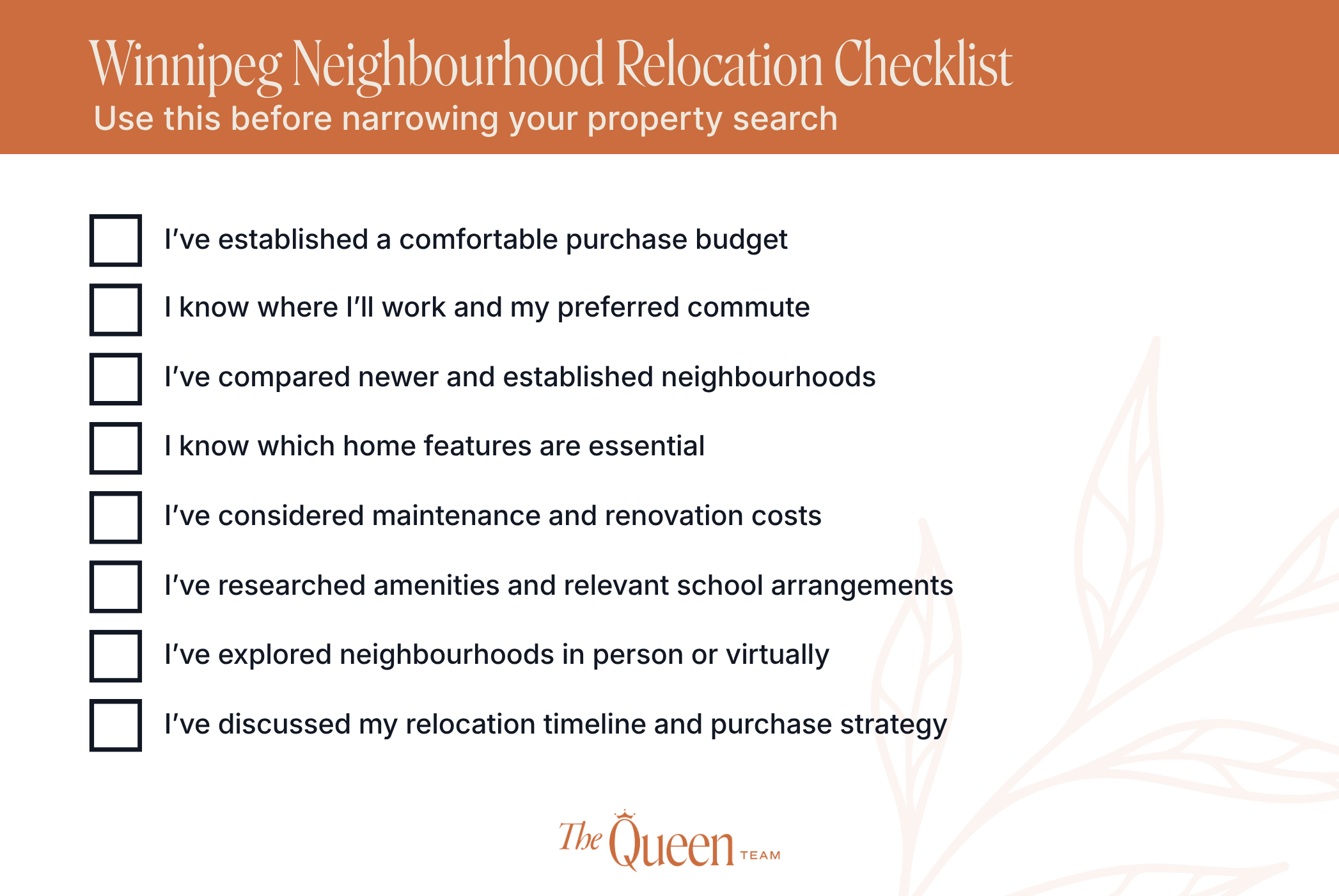
Instead of starting with neighbourhood names, start with these seven questions:
What is my comfortable purchase budget?
Where will I work?
How much commuting am I comfortable with?
Do I want a newer or older home?
How much maintenance am I willing to take on?
What amenities matter to my everyday life?
What type of neighbourhood actually feels like home to me?
Once you answer those, choosing Winnipeg neighbourhoods becomes much easier.
Key Takeaways: Choosing a Winnipeg Neighbourhood When Relocating
Start with your everyday lifestyle, workplace and comfortable housing budget before choosing neighbourhoods.
Winnipeg offers a wide variety of housing styles, from established character homes to newer suburban developments.
Compare actual commuting routes rather than relying only on distances shown on a map.
Think about maintenance expectations, property age, lot size and the features you genuinely need.
Research school catchments and program availability directly with the appropriate school division.
Don't assume every street within a larger Winnipeg area offers the same experience.
If possible, explore neighbourhoods at different times of day before buying.
Virtual showings and a well-planned house-hunting trip can help buyers relocating from another province.
There is no universally best Winnipeg neighbourhood. The right choice depends on how you want to live.
Final Thoughts
If you're relocating to Winnipeg, don't feel like you need to know the entire city before you start looking. You don't. Part of the relocation process is learning which areas fit you and eliminating the ones that don't.
The best Winnipeg neighbourhood isn't necessarily the most expensive, newest or most popular one. It's the neighbourhood where your budget, home preferences, commute and lifestyle all work together.
That's the approach I use when helping relocation clients.
Rather than simply sending you every listing that fits your price range, the goal is to understand how you want to live and use that information to narrow down the parts of Winnipeg that make the most sense.
If you're considering moving to Winnipeg and have no idea where to start, that's completely normal. Tell me what your budget looks like, where you'll be working, what kind of house you want and what's important to your lifestyle, and we can start narrowing it down from there.
Frequently Asked Questions
What is the best neighbourhood in Winnipeg for someone relocating?
There isn't one neighbourhood that's best for everyone moving to Winnipeg.
The right choice depends on your budget, workplace, preferred housing style, commuting needs and everyday lifestyle.
I recommend narrowing your search to several areas that fit your priorities before deciding which neighbourhood feels right.
Where should I live in Winnipeg if I work at the University of Manitoba?
If you're working at the University of Manitoba's Fort Garry campus, you may want to begin exploring south Winnipeg neighbourhoods such as Fort Richmond, Richmond West, Waverley West and surrounding areas.
However, your budget, preferred housing style and commuting preferences may make other locations worth considering.
I recommend testing actual travel routes and comparing available properties rather than limiting your search based on proximity alone.
What Winnipeg neighbourhoods have newer homes?
Communities such as Bridgwater, Prairie Pointe, Bison Run, Sage Creek and Highland Pointe are worth exploring if you're interested in newer construction.
Housing ages and property types vary within each development, so it's important to compare individual listings.
Which Winnipeg neighbourhoods have character homes?
River Heights, Crescentwood and St. Boniface are among the areas where buyers may find older homes with distinctive architectural features.
If you're considering a character property, pay attention to its renovation history, mechanical systems, foundation and ongoing maintenance needs.
Is it better to buy in a newer or established Winnipeg neighbourhood?
Neither is automatically better. Newer communities may offer more modern layouts and newer building systems, while established areas may appeal to buyers looking for mature landscaping, architectural character or particular locations.
I encourage buyers to compare the actual homes and ownership responsibilities rather than choosing based on age alone.
Can I buy a house in Winnipeg without visiting in person?
Yes, some buyers complete purchases remotely using virtual showings, electronic documents and local professional assistance.
However, buying without visiting in person involves additional considerations.
A detailed virtual walkthrough is helpful, but it doesn't replace appropriate inspections, financing review, legal advice or other property-specific investigations.
How do I choose a Winnipeg neighbourhood if I only have a few days to visit?
Start planning before you arrive.
Confirm your financing, identify your essential property features and work with your REALTOR® to develop a shortlist of suitable neighbourhoods.
That way, your time in Winnipeg can be spent exploring realistic options instead of trying to learn the entire city from scratch.
Should I choose a neighbourhood before looking at homes?
I recommend identifying a handful of neighbourhoods that fit your lifestyle before seriously shopping.
You don't need to choose just one area immediately.
In fact, keeping an open mind can help you discover a home or community you might otherwise have overlooked.
Snag a Copy of my Relocation Guide!
If you’re planning a move to Winnipeg, I’d love to help guide you through it. From narrowing down neighbourhoods to understanding the local market, I’m here to make your transition as smooth and informed as possible. Simply fill out the form below, and I’ll send you our Winnipeg Relocation Guide—along with any additional information tailored to your move.

Your Friend in Real Estate,
Sheyla Duncan
Phone: (204) 871-3228
Email: Sheyla@QueenTeam.ca
Sheyla Duncan is a Winnipeg REALTOR® with Queen Team at Ethos Realty Inc., helping buyers and sellers navigate the Winnipeg real estate market and surrounding communities.
Sheyla's real estate content focuses on relocating to Winnipeg, exploring neighbourhoods throughout the city and understanding the practical responsibilities of homeownership.
She believes that choosing the right home involves much more than finding the right number of bedrooms or bathrooms. It's about understanding how a property and its location fit your everyday lifestyle, budget and future plans.
Through her articles, Sheyla shares practical advice designed to help newcomers feel more confident about Winnipeg's housing options, neighbourhood differences and the homebuying process.
Whether you're moving from another province, preparing for a military relocation or simply unfamiliar with the city, Sheyla's goal is to help you approach your move with realistic expectations and a clear plan.