

There comes a point when your current home just doesn't fit your life the way it used to.
Maybe you're welcoming another child, working from home more often, dreaming of a larger yard, or simply ready for a home that better suits this next chapter. Whatever the reason, upsizing is exciting—but in a competitive market like Winnipeg, it can also feel overwhelming.
One of the biggest questions I hear is:
"How do I buy my next home when I still need to sell my current one?"
One of the biggest pieces of advice I give clients who are thinking about upsizing is to start the conversation early.
Ideally, I'd love to chat 6–12 months before you're hoping to make a move. That doesn't mean we need to list your home tomorrow or start touring houses every weekend. It means we have time to understand your options, prepare your current property and make a plan before things become urgent.
And when you're coordinating the sale of one home with the purchase of another, that extra preparation can make a huge difference.
How Do You Upsize Your Home in Winnipeg?
Upsizing often involves coordinating the sale of your current home with the purchase of your next one, so there are a lot of moving parts. The more time we have to plan: understanding your home's value, reviewing your budget, preparing your home for the market, and building a strategy that fits your situation, the smoother and less stressful the process tends to be. A little preparation goes a long way, especially in Winnipeg's competitive market.
1. Start with a Conversation at the Bank
Before you even begin looking at homes, talk to your mortgage broker or lender about your specific situation. One of the biggest questions to answer is:
Do you need to sell before you can buy, or can you carry both properties for a short period of time?
Everyone's financial situation is different. Some homeowners qualify to own both homes temporarily, which can make the buying process much less stressful. Others may need the proceeds from their current home before purchasing their next one - and that's okay too. It simply means your strategy will look a little different. Your mortgage professional can help you understand:
How much you may qualify to borrow for your next home
How your existing mortgage affects that qualification
Whether you need to sell before purchasing
What happens to your current mortgage when you move
Whether bridge financing could be an option
How much cash you'll need for your deposit, down payment and closing costs
Whether you can comfortably manage overlapping housing expenses
One thing I always encourage homeowners to remember is that what a lender approves and what you're comfortable spending aren't necessarily the same thing.
A larger home may also come with higher property taxes, utilities, insurance and maintenance expenses. Understanding those costs early helps you establish a budget that works for your lifestyle, not just your mortgage approval.
What About Bridge Financing?
Bridge financing is something I often encourage homeowners to discuss with their mortgage professional when their purchase and sale dates don't line up perfectly. In certain circumstances, it can provide short-term financing between the purchase of your next home and the closing of your current home's sale.
However, it isn't automatically available to everyone. Lenders have their own approval requirements, and bridge financing commonly depends on having a firm sale agreement for your existing property.
It also involves costs and repayment obligations. So rather than assuming bridge financing will solve a timing problem, make sure your lender has reviewed your actual situation before you commit to a purchase.
2. Know What Your Home Is Worth
The value of your current home plays a huge role in determining your next move. One of the first things I recommend is meeting with a Realtor for a current market evaluation. Not only will this give you a realistic idea of what your home could sell for today, but it also helps establish a comfortable budget for your next purchase.
The Winnipeg market changes throughout the year. Values shift, inventory changes, and buyer demand fluctuates. Please also keep in mind that your home's estimated sale price isn't the same as the amount of money you'll walk away with. You also need to consider things like:
Your outstanding mortgage balance
Any applicable mortgage payout penalty
Real estate commissions and applicable taxes
Legal fees and other selling expenses
Any additional loans secured against the property
Moving expenses and costs associated with your next purchase
The goal is to develop a realistic estimate of your available equity, not simply subtract your original purchase price from today's market value.
Winnipeg's Market Changes Throughout the Year
Something else worth remembering is that the Winnipeg real estate market isn't identical every month. Inventory, buyer demand and competition can change throughout the year. Conditions may also be very different depending on your neighbourhood, property type and price range.
That's why I encourage homeowners who are considering a move within the next six to twelve months to stay informed about their property's value. We can look at comparable sales, discuss what's happening in your particular market segment and revisit those numbers as your timeline gets closer.
I would much rather have those conversations early than have you fall in love with a home based on an unrealistic expectation of what your current property will sell for.
3. Prepare Your Current Home Early
One mistake I see homeowners make is waiting until they've found their next home before thinking about selling. I completely understand why it happens. It's much more exciting to scroll through beautiful listings than it is to organize the storage room or touch up the baseboards! But when you're upsizing, preparing early gives you more options.
That might mean:
Completing minor repairs
Decluttering closets, storage areas and the garage
Tackling touch-up painting
Organizing or packing away items you won't need
Discussing staging recommendations
Planning professional photography and marketing
Gathering documents and information about the property
You don't necessarily need to complete everything immediately. The goal is to identify what should be done, what is worth spending money on and what can wait until closer to your listing date.
Why Preparation Matters in a Competitive Market
Imagine finding a home you absolutely love, only to realize your current property needs several weeks of preparation before it can be listed. That can create a lot of unnecessary pressure.
If you've already completed the important work, you may be in a much better position to respond when the right opportunity comes along. Part of my process is that we discuss your home's presentation, staging, photography and marketing strategy well before you're ready to list.
That way, when the timing makes sense, we're not starting from scratch. And as a bonus, you'll have less to deal with while you're trying to pack up your entire life!
4. Understand What Your Budget Buys Today
Many homeowners haven't purchased a home in several years. While your current home has likely appreciated in value, so have the homes you're hoping to buy.
That's why it's so important to spend some time looking at what's currently available in your target price range.
What does $550,000 buy today?
What about $700,000?
Are the homes checking all your boxes, or do expectations need to shift slightly?
Decide What Upsizing Actually Means to You
Upsizing doesn't always mean buying the biggest house you can afford. Sometimes it means finding a better layout. Maybe you need:
An additional bedroom
A dedicated home office
A larger kitchen or dining area
More functional storage
A finished basement
A bigger yard
A second bathroom
A garage that works better for your household
I encourage buyers to think about what isn't working in their current home and what would genuinely improve their everyday lives.
Because a larger home isn't automatically a better home if it doesn't solve the problems that motivated your move.
You may also need to decide whether your preferred neighbourhood or your ideal house is the bigger priority.
That's a conversation worth having before you become attached to a specific property.
5. Have a Strategy Before You Find "The One"
This is probably the biggest piece of advice I can give. The best time to make decisions is before you're emotionally attached to a home. Work with your Realtor and Mortgage Professional to create a plan that answers questions like:
Should you buy first or sell first?
Would a longer possession help?
Would bridge financing be an option if needed?
What's your backup plan if your first offer isn't accepted?
Having these conversations in advance means you're making decisions with a clear head and not under pressure. But regardless of what you decide, both approaches have advantages and risks.
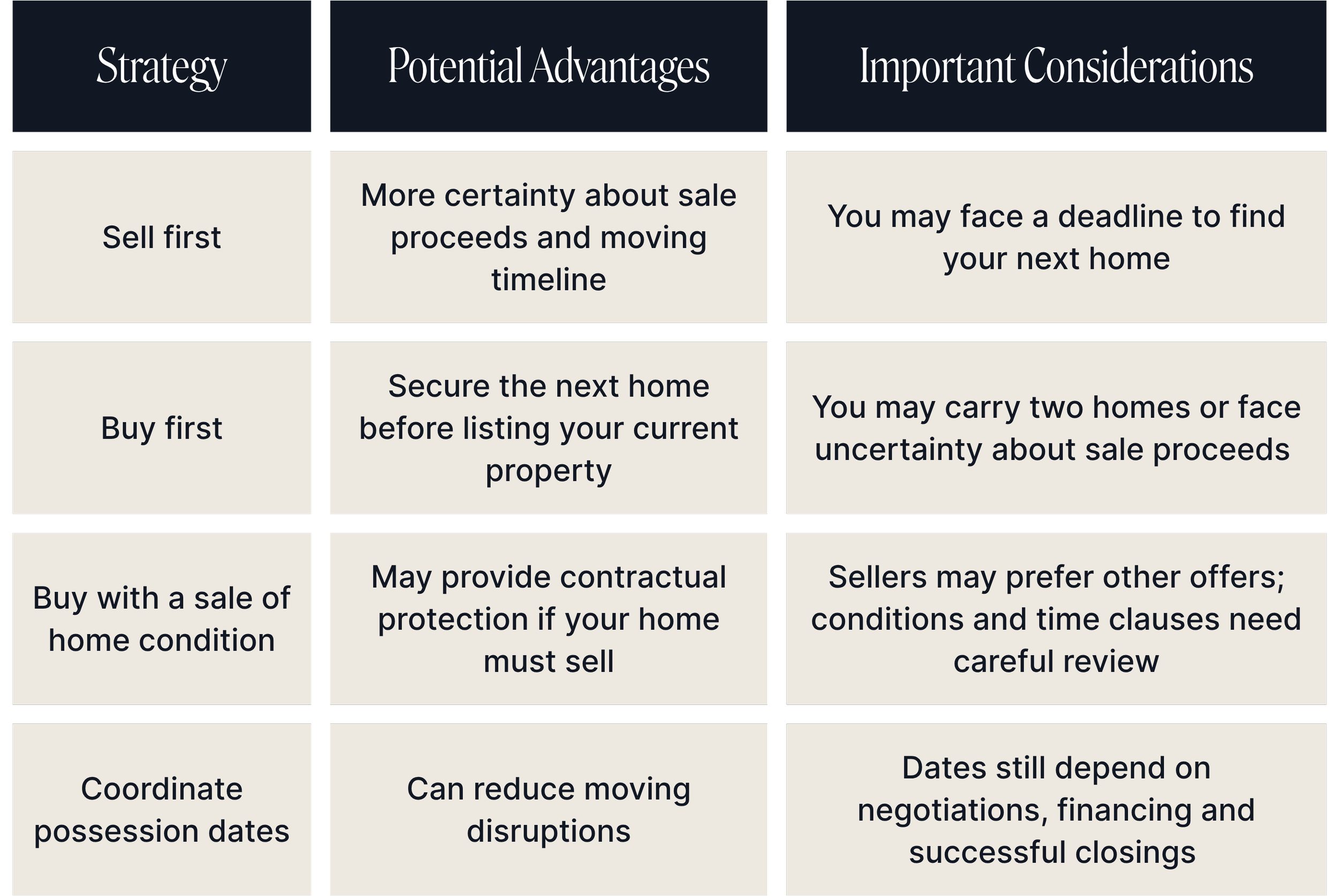
Option A: Sell Your Current Home First
Selling first can provide more certainty about your available equity and the timeline for your next move. Once you have a firm sale, you have a clearer understanding of what you can spend and when you'll need to leave your current property.
The challenge? You may need to find your next home within a specific period. If suitable inventory is limited, that can create pressure. You may need to negotiate a longer possession date, consider temporary accommodation or be prepared for the possibility of moving twice.
Option B: Buy Your Next Home First
Buying first allows you to secure a property you love before selling your existing home. That can be particularly appealing when you're searching for something specific or when suitable homes aren't coming onto the market very often.
But it also comes with risk. If your current home takes longer to sell than expected, or sells for less than anticipated, you may need to carry both properties or adjust your financial plans. That's why I would never recommend buying first based only on the assumption that your existing home will sell quickly.
We need to understand your financing, your home's likely marketability and what happens if things don't go exactly according to plan.
What About a Sale-of-Home Condition?
In some circumstances, buyers may be able to make an offer conditional on selling their existing property. Whether a seller will consider that arrangement depends on the property, market conditions and the offer itself.
Sometimes a seller will also request a time clause that allows them to continue marketing their home while the buyer works toward satisfying the sale condition. The exact wording matters.
I always recommend making sure you understand the deadlines and what happens if another offer comes along. And importantly, you shouldn't remove a sale-of-home condition unless you have a realistic way to complete the purchase without it.
6. Have a Strategy Before You Find “The One”
I know this was one of my original five tips, but I think it deserves its own emphasis. The best time to make important decisions is before you're emotionally attached to a home.
It's easy to feel calm and practical when you're discussing hypothetical properties. It's a little different when you've just walked through a house with the perfect kitchen, enough bedrooms for everyone and the backyard you've been dreaming about!
Before that happens, I like to work through a few scenarios with clients. What if:
Your dream home comes onto the market before your current property is listed?
Your home receives an offer faster than expected?
Your current home takes longer to sell?
You lose out on the first property you offer on?
The seller wants a possession date that doesn't line up with yours?
Your current home sells for less than your original estimate?
The next home requires more repairs or updates than expected?
We don't need to predict every possible outcome. But having a plan for the most likely scenarios helps you make decisions with a clear head instead of reacting under pressure.
It also means your Realtor and mortgage professional can work together to understand which options are actually available.
7. Think Carefully About Possession Dates
Possession dates might not be the most exciting part of upsizing, but they can make a big difference in how smoothly your move goes. If you're selling one home and purchasing another, ideally you'd like those dates to work together.
But there are a few things to think about.
Will you have enough time to move your belongings?
What happens if the dates don't line up?
Could you need storage or temporary accommodation?
Would carrying both properties for a short period be financially manageable?
In Manitoba, buyers should also be aware that the prescribed residential purchase form provides for completion and possession no later than 6 p.m. on the possession date, subject to the actual agreement and closing arrangements.
That means you shouldn't automatically plan on getting access to your new home first thing in the morning.
I always encourage clients to build a little flexibility into their moving plans rather than assuming everything will happen at the earliest possible moment.
When Should You Start Planning to Upsize in Winnipeg?
My preference is to start the conversation six to twelve months before you hope to move.
That gives us time to evaluate your current home, discuss potential improvements, understand your budget and begin watching the market.
Here's an example of what that planning process might look like.

These are planning examples, not fixed deadlines. Some homeowners need more time, while others may be ready to move much sooner. The important thing is to start early enough that you have options.
Key Takeaways: Upsizing in Winnipeg
Start planning your move six to twelve months ahead if possible.
Speak with your lender before shopping to understand whether you need to sell first.
Get a realistic market evaluation of your current home and estimate your available equity.
Prepare your existing property early so you're ready when the timing makes sense.
Research what your next budget can actually purchase in today's Winnipeg market.
Understand the advantages and risks of buying first versus selling first.
Discuss bridge financing, sale-of-home conditions and possession dates before relying on them.
Build a backup plan for delays, unsuccessful offers and unexpected expenses.
Remember that upsizing is about finding a home that works better for your life, not simply purchasing more square footage.
Frequently Asked Questions About Upsizing in Winnipeg
Should I sell my house before buying another one in Winnipeg?
It depends on your financial situation, your existing home's marketability and how easily you can find a suitable replacement property. Selling first may provide greater certainty about your available equity, while buying first can help you secure the right home before it's gone.
I recommend discussing both options with your Realtor and mortgage professional before committing to either strategy.
Can I buy a new house before selling my current one?
Potentially, yes. Some homeowners qualify to carry two properties temporarily. Others may need the equity from their current home to complete their next purchase.
Your lender will need to assess your income, debts, mortgage obligations and financing options before confirming what's possible.
How far in advance should I contact a Realtor about upsizing?
Ideally, I recommend starting the conversation six to twelve months before you hope to move. That gives us time to evaluate your home, discuss preparation, review market conditions and develop a strategy.
You don't need to be ready to list immediately to benefit from that conversation.
What is bridge financing when buying and selling a home?
Bridge financing is a short-term financing arrangement that may help cover the period between purchasing your next home and receiving the proceeds from the sale of your current one.
Availability depends on your lender and circumstances. A firm sale agreement is commonly required, and costs and repayment terms vary. Always confirm eligibility before relying on bridge financing in your purchase strategy.
Can I make an offer conditional on selling my current home?
Yes, a sale-of-home condition may be possible, depending on the seller and the circumstances. However, sellers in competitive situations may prefer offers without that condition.
The condition's wording, deadlines and any time clause need to be carefully reviewed so you understand your obligations and risks.
What if I find my dream home before my current home is ready to sell?
This is exactly why I encourage homeowners to prepare early. If your home is already close to market-ready, you may have more flexibility.
Before making an offer, we'll need to discuss your financing, the potential timing of your sale and what happens if the property doesn't sell as quickly as expected.
How do I know how much equity I have to put toward my next home?
Start with an updated market evaluation of your current property. Then consider your mortgage balance, potential payout penalties, selling expenses and other obligations.
Your Realtor, lender and lawyer can help you understand the different figures involved so you can establish a more realistic budget for your next purchase.
Is it better to upsize during Winnipeg's spring real estate market?
Spring can bring increased buying and selling activity in Winnipeg, but it isn't automatically the best time for every homeowner. The right timing depends on your existing property, the type of home you're hoping to purchase, available inventory and your financial situation.
I recommend evaluating both sides of your move rather than choosing a season based on general market assumptions.
Every Upsizing Journey Looks Different
There isn't one right way to move from one home to the next. Some families buy first. Others sell first. Some negotiate flexible possession dates, while others explore bridge financing to help coordinate everything.
And sometimes, the best decision is to spend a little more time preparing before making the move.
The right strategy depends on your finances, timeline, comfort with risk and the market conditions affecting both properties.
That's why I always encourage clients to start planning earlier than they think they need to. The more prepared you are, the more options you'll have when the right home comes along.
Thinking About Upsizing in Winnipeg?
If moving into a larger home has been on your mind, let's start with a conversation.
Even if you're six months or a year away, we can talk about your home's current value, what your next budget might look like and which strategy makes the most sense for your situation.
You don't have to figure everything out before reaching out.
I'm happy to help you work through the possibilities and build a plan that fits your next chapter.
A little planning today can make all the difference when the right home finally comes along.

Your Friend in Real Estate,
Samantha Scribilo Kusiak
Tel: (204) 960-8851
Email: Samantha@QueenTeam.ca
About the Author
Samantha (Sam) Scribilo-Kusiak is a Winnipeg REALTOR® with Queen Team at Ethos Realty Inc.
Sam helps buyers and sellers navigate important real estate decisions, from choosing the right neighbourhood to coordinating the purchase of a new home with the sale of an existing property.
Through her real estate articles, Sam shares practical advice about preparing to buy or sell, understanding market conditions and making informed decisions throughout the process.
She believes successful moves begin with understanding her clients' goals, having realistic conversations about their options and developing a strategy that fits their circumstances.
Whether you're buying your first home, considering an upgrade or preparing for another stage of homeownership, Sam's goal is to help make the process feel more manageable and less overwhelming.