

By Jennifer Queen, REALTOR® | Queen Team | Ethos Realty Inc.
Thinking about downsizing in Winnipeg? Start by comparing how your next home would function, what the move would actually cost and which parts of your current lifestyle you want to keep. A smaller home may reduce upkeep or free up equity, but the purchase price, condo fees, moving expenses and layout all matter. The right move should make everyday life work better for you.
There is a version of downsizing that sounds quite lovely.
Fewer rooms to clean. Less snow to shovel. A home you can lock up before a holiday without leaving someone a three-page instruction manual.
Then you start looking at properties.
The bungalow you like costs more than you expected. The condo has a beautiful kitchen, but nowhere obvious for your winter coats. Your partner is ready to move tomorrow, while you are standing in the dining room wondering how you are supposed to leave the place where everyone gathered for Christmas.
Suddenly, “let’s find something smaller” has become a much bigger conversation.
I think we do people a disservice when we make downsizing sound easy simply because the destination has fewer square feet. You are making decisions about money, belongings, independence, relationships and what you want the next stage of life to look like. That deserves a little more attention than a decluttering checklist.
It also deserves some optimism. There can be a wonderful life on the other side of this move. We just need to make sure we are planning for your version of it.
Key Takeaways
A smaller home does not automatically mean a lower purchase price or lower monthly costs.
Start exploring replacement homes before committing to a sale. Your next home is part of the plan from day one.
Compare layouts, access, storage and maintenance responsibilities alongside square footage.
A condominium can reduce hands-on work, but fees, building finances and rules deserve careful attention.
Give yourself room to sort belongings and feelings at a manageable pace.
Staying put, hiring help or renting may also be sensible options. You do not have to move to prove you are planning ahead.
First, decide what you want the move to solve
Before I would ask how many bedrooms you want, I would ask what feels difficult about the home you have now.
Is it the yard? The stairs? The cost of maintaining space you rarely use? Or are you simply ready to spend more time doing things you enjoy and less time managing a property?
Those answers lead to different searches.
A smaller detached home may reduce cleaning without doing much for the snow-clearing problem. A bungalow may put bedrooms on the main floor while leaving laundry and much of your storage downstairs. An apartment condo may simplify exterior maintenance, but you might miss having a private entrance or somewhere to putter in the garden.
Try finishing this sentence:
“I would feel good about moving if it meant I could…”
Travel more easily. Stay close to friends. Stop carrying laundry downstairs. Have predictable enough costs to feel comfortable. Spend weekends with the grandchildren instead of tackling another project.
Keep that answer beside you when you start browsing listings. It is surprisingly easy to fall for a lovely kitchen and forget why you wanted to move in the first place.
The financial reality: smaller and cheaper are separate questions
One of the first things I would want to establish is whether you need this move to release money, reduce ongoing expenses, simplify your responsibilities—or some combination of the three.
They are different goals.
You could buy a home for less and discover that the monthly savings are modest. You could spend roughly the same amount on the next property and gain a much easier daily routine. Either outcome might work, provided it matches what you intended.
Look at the price of the home you actually want
Your current home and your next home may appeal to different buyers and compete in different parts of the market.
For example, you might be selling a larger home that needs updating while hoping to buy a smaller, renovated bungalow with an attached garage in a particular Winnipeg neighbourhood. Reducing square footage does not tell us what that price difference will be.
Before deciding what your sale will make possible, we need a realistic home evaluation and a look at suitable replacement properties. What matters is the relationship between those two numbers.
Sometimes the right next step is to regroup
I have worked with downsizers who were ready to explore a smaller home, but the properties we toured felt too tight for the life they wanted to keep. They still wanted the kids and grandchildren over. Having everyone together mattered, and the main living spaces we were seeing did not offer enough room for that.
That is useful information to discover before selling your home.
So we put the search on hold for a while. The following spring, suitable options came onto the market, and there was something worth revisiting. I cannot promise that the right property will appear next spring for everyone. But that experience is one reason I encourage people to explore their options early. It gives us time to understand what works, recognise what does not and regroup when we need to.
I also find that dining space can become a surprisingly important part of these conversations. Some newer homes, including bungalow-style condominiums, have less room for a dining set than clients are accustomed to in their longtime homes. We need to look beyond the bedroom count and square footage and ask whether the spaces they use most will actually accommodate them.
If gathering around the table is a part of life you want to keep, that belongs in the search criteria.
Downsizing involves compromise. My job is to help you work out which compromises feel comfortable and which would take away something you were hoping to enjoy in your next home. Sometimes we adjust the search. Sometimes we pause. And sometimes we have a frank conversation about whether the home you want is available within the choices you are willing to consider.
You do not have to force a move simply because you have started looking.
Work out what you will have left after the move
The difference between your sale price and purchase price is only the beginning. Your plan should account for:
The mortgage or other secured debt being paid out.
Selling costs, including real estate fees and applicable taxes.
Legal fees, registration charges and purchase closing costs.
Manitoba land transfer tax, where applicable.
Mortgage penalties or related lender charges, if applicable.
Preparing the current home, moving, packing and clearing out belongings.
Furniture, window coverings or improvements needed at the next property.
Any period of overlap between the two homes.
Manitoba generally charges land transfer tax when title transfers, subject to exceptions. Have your lawyer include the applicable amount in the purchase budget.
Here is a deliberately simplified illustration—not a quote for any particular transaction:
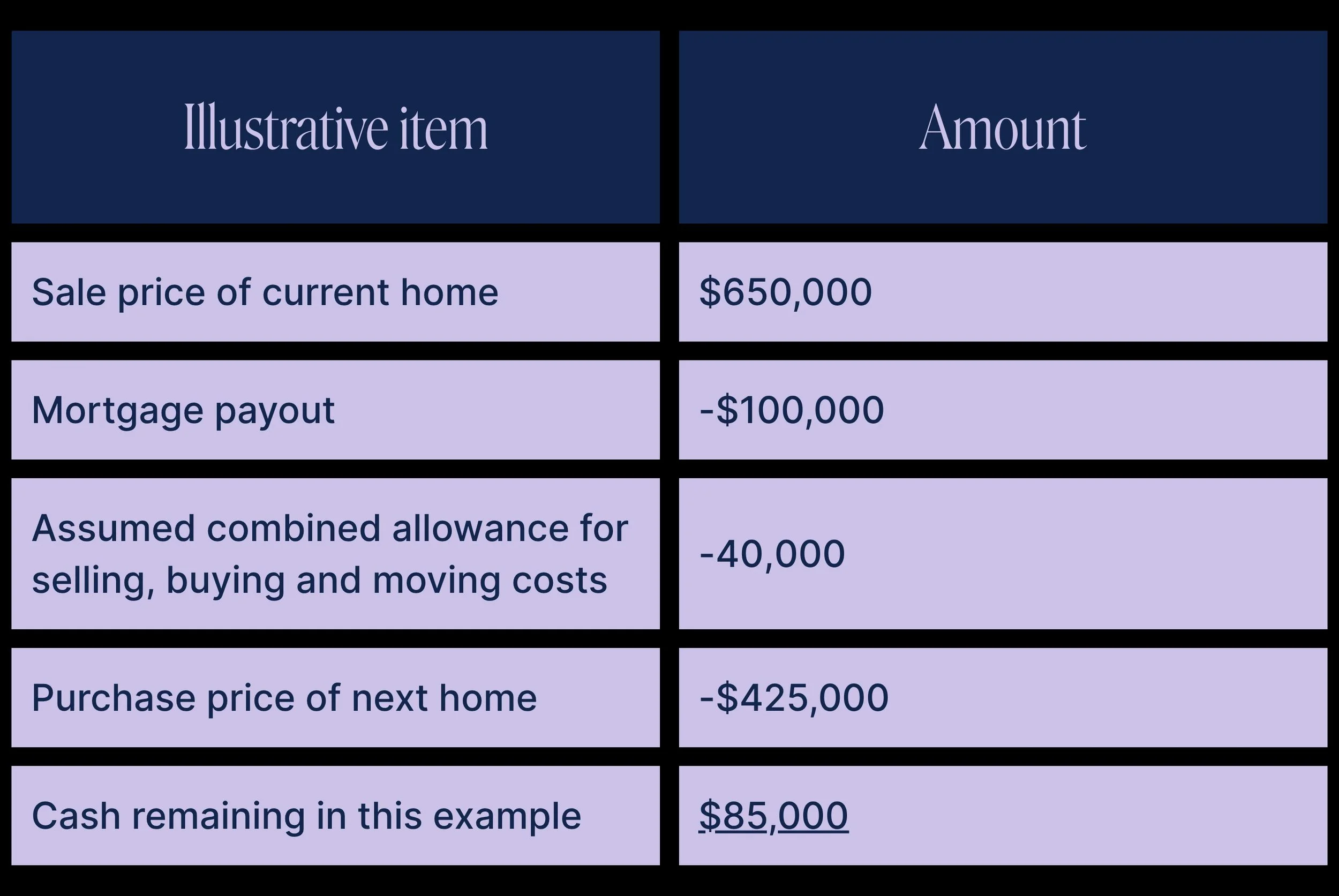
That $40,000 allowance is simply an invented planning figure. Replace it with estimates for your own transaction, including any work or purchases you intend to make after moving. The example assumes the mortgage is paid out and the next home is purchased without a new mortgage.
The point is to understand the money available at the end before deciding what you can comfortably spend along the way.
Compare ongoing costs fairly
A condo fee can feel like a new expense if you have never paid one before. But your house already has expenses, even when they arrive irregularly.
Compare the full picture:
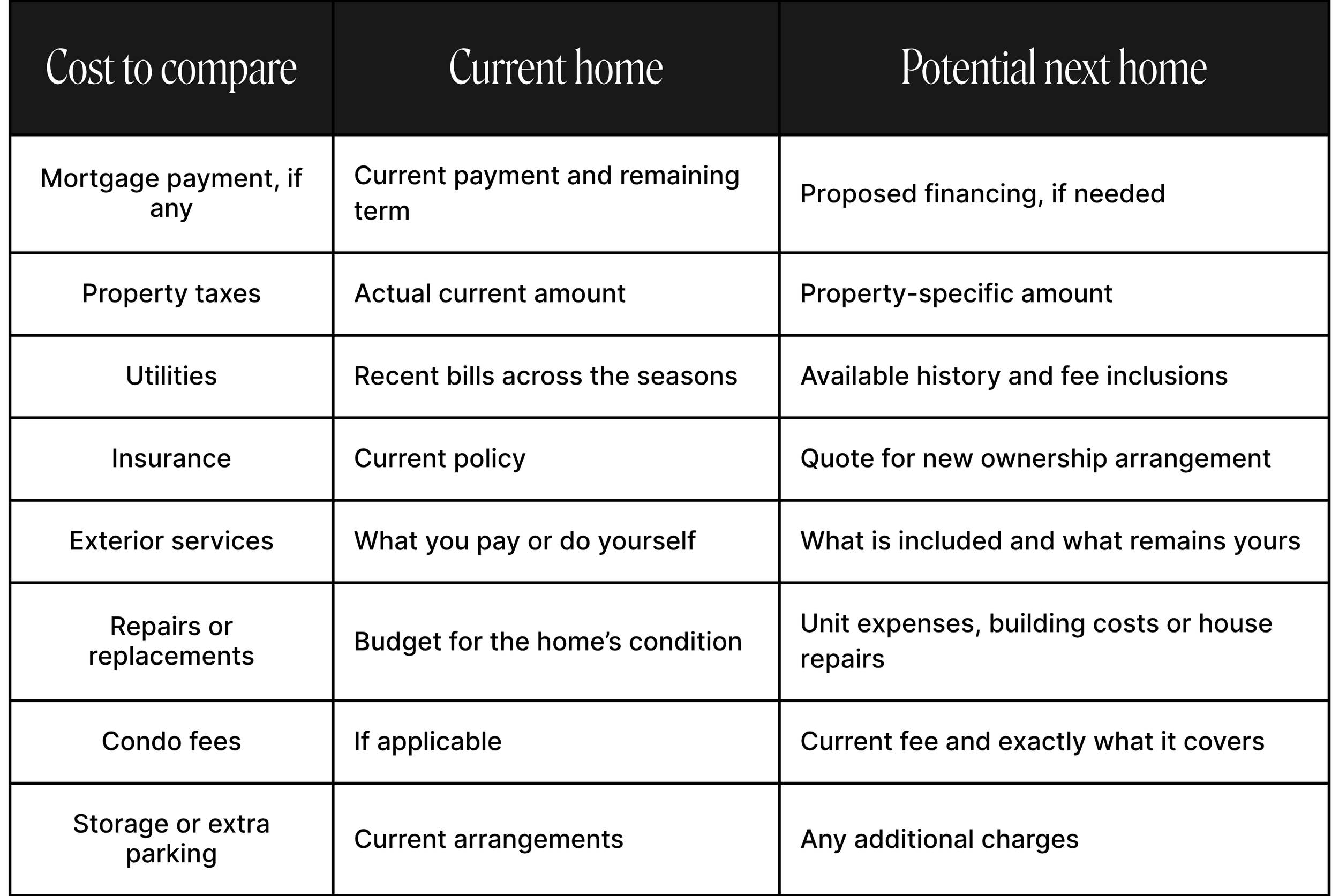
Avoid counting an included service twice. Equally, avoid assuming the condo fee includes heat, water or every repair simply because another building did.
And give your own time some value. You may be perfectly capable of mowing the lawn. You may also be quite ready to spend that afternoon doing something else.
If you have a mortgage, ask questions early
The American mortgage examples in a lot of downsizing advice do not translate neatly to Canadian financing.
Ask your lender what happens if you sell, reduce your borrowing or move the mortgage to another property. Breaking a closed mortgage normally involves a prepayment penalty; your lender can calculate the charges and explain the options available under your contract.
Do this while you are exploring, particularly if your plan depends on new financing. A comfortable budget starts with confirmed information.
The floor plan matters more than the square footage
Picture two smaller homes.
One has a generous bedroom, an office that can accommodate guests, main-floor laundry and useful storage beside the entrance. The other has an extra bedroom, but a tight entry, awkward furniture placement and laundry down a flight of stairs.
The second might look better in a search filter. The first might work better every single day.
I would rather help you find a home that functions well than congratulate you on giving up a certain number of square feet.
Walk through an ordinary day
At a showing, think beyond where the sofa goes.
Imagine bringing groceries in on a slippery January afternoon. Coming home in boots and a winter coat. Doing laundry. Having someone stay for the weekend. Getting up during the night. Spending an afternoon at home while your partner watches television or takes a phone call.
Look at the route from parking to your door, the entrance steps, bathroom access, laundry location and places where each person can have some breathing room.
Open layouts can be lovely, but sound and privacy deserve attention. In a condo, consider the unit’s position relative to elevators, entrances, the parkade and shared amenities. Ask about construction and arrange another visit when possible if noise is a major concern. One quiet showing cannot tell you everything about a building.
Think ahead without making the house feel like a medical checklist
You do not need to anticipate every possible future need. It is still sensible to consider whether the home could accommodate changes over time.
Where are the bedroom and a full bathroom? Are there entrance steps? How convenient is the elevator from the parking space? Would the bathroom layout allow for changes if needed?
A bungalow can still have access challenges. A condo can still involve a long walk from the car. Look at the actual property rather than relying on its label.
Your next home needs room for a Winnipeg winter
Storage is easy to underestimate when the cupboards at a showing are beautifully organized and only half full.
Now add winter boots, several coats, a shovel if you will still need one, holiday decorations, luggage and the things you use only occasionally but would genuinely miss.
If your current home has a basement and a garage, be especially honest about how much they hold. That space can quietly absorb years of decisions you have not had to make yet.
Before committing to a property, make a storage inventory by category. Then give each category an actual home on the floor plan. Confirm the size, location and availability of any locker rather than treating “storage included” as the whole answer.
There is nothing wrong with keeping seasonal decorations or a hobby you love. But paying indefinitely for off-site storage should be a conscious budget decision. Otherwise, you may end up maintaining a second address for things you rarely visit.
Choosing between a bungalow, a condo and renting
Downsizing does not require moving into an apartment. Nor does owning your next home automatically make more sense than renting.
Here is how I would start comparing the options:
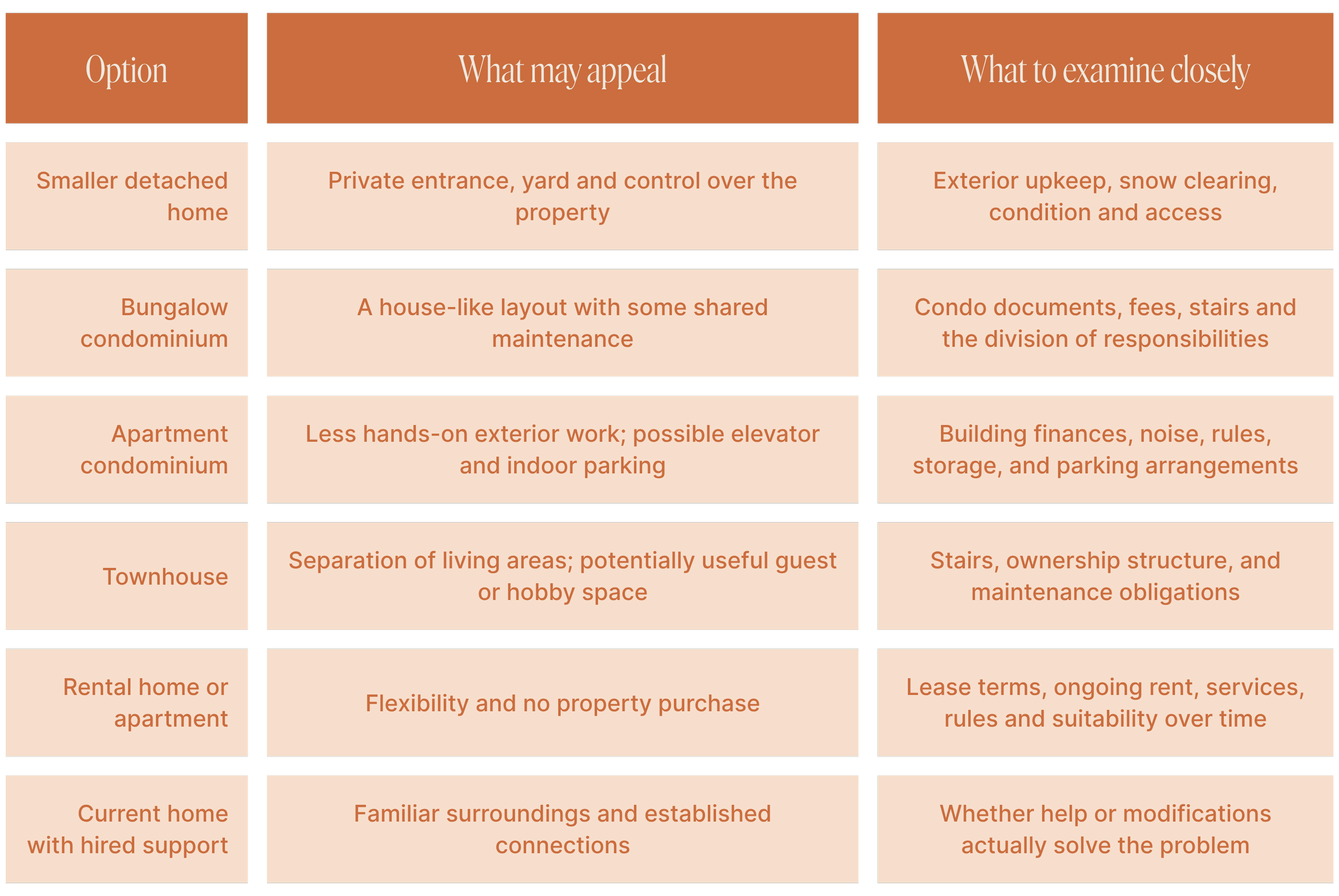
These are starting points. Maintenance responsibilities and services vary by property and agreement.
Buying a condo means understanding the building, too
The kitchen is yours to enjoy. The corporation’s financial position is also part of what you are buying into.
For a Manitoba condominium, review the disclosure package with your REALTOR® and lawyer. Pay attention to the budget, financial statements, reserve fund information, available reserve fund study or updates, and any disclosed assessments or significant projects. Check rules affecting pets, visitors, rentals, renovations, parking and how you want to use the property.
A reserve fund helps pay for qualifying longer-term repairs and replacements within the corporation’s responsibilities. Special assessments can require additional owner contributions. Those are reasons to understand the finances and responsibilities before purchasing.
I would not choose a building simply because it has the lowest monthly fee. I would want to understand what the fee covers, how the property is being maintained and what expenses may be ahead.
Manitoba also provides condominium buyers with a statutory cooling-off period to review the required disclosure documents. Have your lawyer confirm the timing that applies to your transaction.
The furniture conversation is really a priorities conversation
Let’s talk about the dining room table.
Sometimes it is just a table. Sometimes it is where your children did homework, where someone announced an engagement and where you have hosted every holiday for decades.
“Just get a smaller one” can be a fairly insensitive answer to that.
If keeping the table matters, measure it properly, including the clearance needed to pull out chairs and move around the room. Make it part of the search criteria early.
Then consider the trade-off. Would you spend significantly more on a home to accommodate it? Would you give up the location you want? Could a different arrangement preserve the gatherings that matter to you?
There is no universal answer. A dedicated dining space may be essential for one household and an expensive room to dust for another.
The same applies to a workshop, sewing room, library or garden. You do not have to abandon the things that make your life enjoyable to qualify as someone who has successfully downsized.
Sorting belongings takes more than a weekend and good intentions
The physical work is one part. The decisions can be the exhausting part.
What do you keep? What do you offer to family? What has resale value? What do you do with something meaningful that nobody has room for?
I would start with the easiest categories. Duplicate kitchen tools. Old manuals. The cupboard full of containers whose lids appear to have moved out years ago.
Save the photographs, letters and deeply sentimental belongings for a time when you have more energy and support.
Give family a clear invitation, with a clear timeline
Instead of assuming children or grandchildren will want things—or that they will want nothing—ask.
Send photographs. Offer specific pieces. Set a reasonable collection date. A vague “come by sometime and see what you want” can leave everyone waiting for someone else to begin.
If they decline, try not to turn that into a verdict on the item or the memories attached to it. Their home may already be full. Their needs may simply be different.
Keep resale expectations separate from the moving budget
Some belongings may be worth selling, especially items with a suitable buyer or specialist market. Others may take more time and effort to sell than you want to invest.
For potentially valuable pieces, consider an appropriate appraisal or an opinion from a qualified specialist. For everything else, decide whether selling, donating, gifting or arranging removal best serves the move.
I would not make the purchase budget depend on an optimistic estimate of what the furniture will bring in.
Bring in help where it makes a difference
A professional organizer, move manager, auction service, packer or mover may be useful, depending on the household. You can hire help for a defined part of the job rather than handing over the entire process.
For sentimental belongings, smaller decisions can help: keep a few representative pieces, photograph a collection or create a memory box with a size limit you choose.
You are allowed to find this hard. Being ready for a different home and being sad to leave this one can happen at the same time.
Protect the routines and relationships you want to keep
Moving closer to family can be a wonderful reason to downsize. So can staying close to friends, a familiar walking route or the community centre where someone knows your name.
Before choosing an address, map the places that make up an ordinary week: groceries, appointments, recreation, friends, family and your favourite coffee stop.
Then test the location. Visit at different times. Consider winter travel and how you would get around if you drove less in the future. If you are exploring a new area, use our Winnipeg neighbourhood guides as a starting point, then spend time there yourself.
A beautifully finished home can still be inconvenient for your life. A familiar neighbourhood may be worth a little less space or a different style of property.
If family proximity is a major motivation, talk about expectations before making the move. Being nearby does not automatically mean daily visits or unlimited childcare. A kind, clear conversation now is much easier than building a housing decision around an assumption.
Should you sell first or buy first when downsizing?
My starting point is to explore the replacement options before putting the current home on the market. That gives us information; it does not commit you to buying first.
Once we understand the choices, we can plan the sequence.
Selling first gives you a clearer sale result and budget, but may create pressure to secure the next home. We need to discuss possession dates and what you would do if the search takes longer than expected.
Buying first can make sense when a particularly suitable property appears, but requires a financial plan for carrying both homes if the current property takes longer to sell or sells for less than hoped.
An offer conditional on selling your current home may be an option, depending on the property, seller and negotiations. It should never be treated as something every seller will accept.
Temporary accommodation can create flexibility, but adds another move, possible storage costs and disruption.
There is no sequence I would recommend to everyone. Your finances, flexibility and the properties available should guide the decision. Our selling process gives you an overview of the listing side so we can consider both transactions together.
Give the preparation a sensible timeline
You do not have to begin with a garage sale or a renovation contractor.
Begin with a conversation, a look at the numbers and a few replacement properties. Then work backward from the timing that suits you.
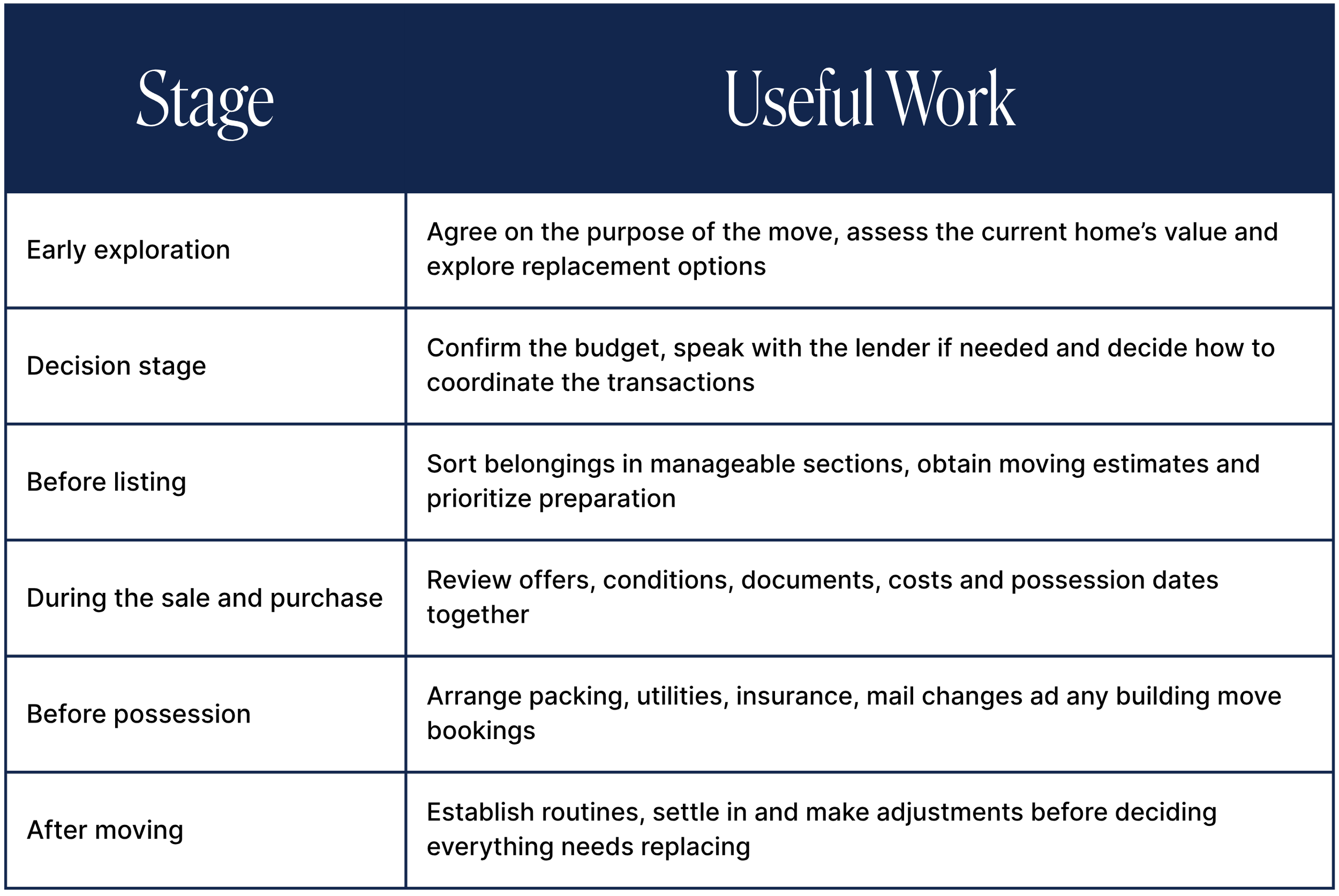
If you have months, use them. If a change in circumstances means you have weeks, we can focus on the decisions that matter most and identify where practical help would relieve the pressure.
Prepare the current home without turning it into another major project
Please talk to us before undertaking extensive renovations solely to sell.
I would rather help you decide which repairs, cleaning, staging and presentation work are likely to matter to buyers than have you spend money and energy on changes that do little for your result.
At Queen Team, we can coordinate the marketing and presentation side while helping you think through the move itself. A thoughtful plan should reduce the number of decisions sitting on your shoulders at once.
When staying put may be the better decision
Sometimes the useful outcome of a downsizing conversation is realizing you would prefer to stay.
Perhaps you still love the location, use the space and enjoy the garden. Perhaps the main problem is snow clearing, and paying for that service would be much less disruptive than moving. Or perhaps the right replacement home is not available at a price that works for you.
Compare the cost and practicality of hired help or suitable modifications with the cost of moving. If access is a concern, professional advice about the home’s suitability may help you understand the options.
I would rather you stay because we worked through the choices than move because someone said a person your age “should.”
Planning ahead gives you information. You are still allowed to decide that today is not the day.
What a well-planned move can give you
We have spent a lot of time on the practical details because they matter. But there is a reason people look forward to this change.
It can mean a home where the spaces you use are easier to reach. Fewer jobs waiting when you get home. More freedom to travel. A location that puts the people you love closer. Money released for priorities you have been putting off.
It can also mean discovering that you enjoy having less to manage.
You may still miss the old house. I would not measure the success of a move by whether you ever feel nostalgic. I would look at whether your new home supports the life you hoped to create.
My favourite question to end with is this: what would you like an ordinary Tuesday to feel like in your next home?
That answer tells us a great deal about what to look for.
Frequently Asked Questions About Downsizing in Winnipeg
Does downsizing in Winnipeg always save money?
No. The result depends on your sale proceeds, replacement property, transaction costs and ongoing expenses. Compare both the cash remaining after the move and the annual cost of living in each home. A move may still be worthwhile if it simplifies daily life without producing substantial savings.
Is a bungalow or a condo better for downsizing?
It depends on which responsibilities you want to reduce and how you want to live. A detached bungalow may provide privacy and a yard while leaving exterior maintenance with you. A condo may reduce some hands-on work but introduces shared decisions, fees and property-specific rules. Inspect the actual layout and responsibilities in either case.
Should I find my next home before selling?
Explore suitable homes before listing so you understand availability, costs and trade-offs. Whether you should actually purchase first is a separate decision based on your finances, risk tolerance and ability to manage a period of overlap.
How early should I start planning to downsize?
Start when you begin seriously considering a change. Having several months can make sorting and decision-making more manageable, but there is no required timeline. The first step can simply be establishing your options and budget.
What should I review before buying a Winnipeg condo?
Review the required disclosure package with your REALTOR® and lawyer, including financial information, reserve fund details and relevant rules. Confirm what the fee covers, what you maintain, parking and storage arrangements, and any disclosed assessments or major projects. Also evaluate access, noise and the layout for your daily needs.
What if my children do not want the things I hoped to give them?
Ask about specific items and give everyone a reasonable timeline. If family members decline, consider other recipients, suitable resale options, donation or removal. Keep selected meaningful pieces that fit your next home, rather than making the entire move depend on finding a family home for every item.
Can I downsize without leaving my neighbourhood?
Possibly. Start by looking at the housing options in the area and deciding what you can compromise on. Staying nearby might mean choosing a different property type, retaining more space than expected or waiting for a suitable home. Availability needs to be checked against your actual requirements.
What if my partner and I are not ready at the same time?
I have worked with couples where one person was thoroughly tired of looking after the yard, while the other would happily have stayed in the home forever. In those situations, the couples I have worked with have eventually reached a shared decision, although sometimes it has taken longer than one partner would have liked.
Start by understanding what each person wants to gain and what they are worried about losing. Touring a few properties or reviewing the costs can be a useful first step without becoming a commitment to move. Give yourselves room to work through the decision together.
Let’s work out what makes sense for you
If downsizing is on your mind, we can start before the donation boxes arrive.
We can look at your current home, explore realistic replacement options and build a plan around the parts of life you want to make easier. If you are still deciding whether the timing is right, our blog for knowing when to downsize in Winnipeg is a helpful companion to this article.
When you are ready, please reach out. We are happy to help! Bring the questions, the wish list and, yes, the measurements for the dining room table.
Download our Downsizing Guide
If you’re preparing to sell and wondering where to start, we’ve created something to help. It is much more comprehensive than the blog above.

Your Friend in Real EstaTe,
Jennifer Queen
Phone: (204) 797-7945
Email: Jennifer@QueenTeam.ca
About the Author
Jennifer Queen is a Winnipeg REALTOR® and leader of Queen Team at Ethos Realty Inc. She helps homeowners navigate the decisions involved in selling and choosing their next home, with a focus on thoughtful preparation, professional marketing and practical advice. Her approach to downsizing starts with understanding what clients want their next chapter to look like, then building the real estate plan around those priorities.