

By Sheyla Duncan, REALTOR® | The Queen Team | Ethos Realty Inc.
What should you know before moving to Winnipeg for work?
Start with your exact workplace, work schedule and comfortable housing budget, then compare neighbourhoods around the daily routine you want. Test your commute, consider winter travel and decide whether renting or buying fits your timeline. If you plan to buy, speak with a mortgage professional about your job change before making an offer, and coordinate your home search, financing and possession date with your move.
Moving to Winnipeg for a new job often means making some big decisions before you really know the city.
Where should you live? How far should you be from work? Should you rent first or buy right away? And if you’re buying from another province, how do you choose a neighbourhood when you’ve never actually lived here?
You don’t need to have every answer before you arrive. But a little planning can help you avoid choosing a home that looks right online and feels inconvenient once real life begins.
Here are the things I think matter most when relocating to Winnipeg for work.
Start With Where You’ll Actually Be Working
Before choosing a neighbourhood, look at where your workplace is located and be specific.
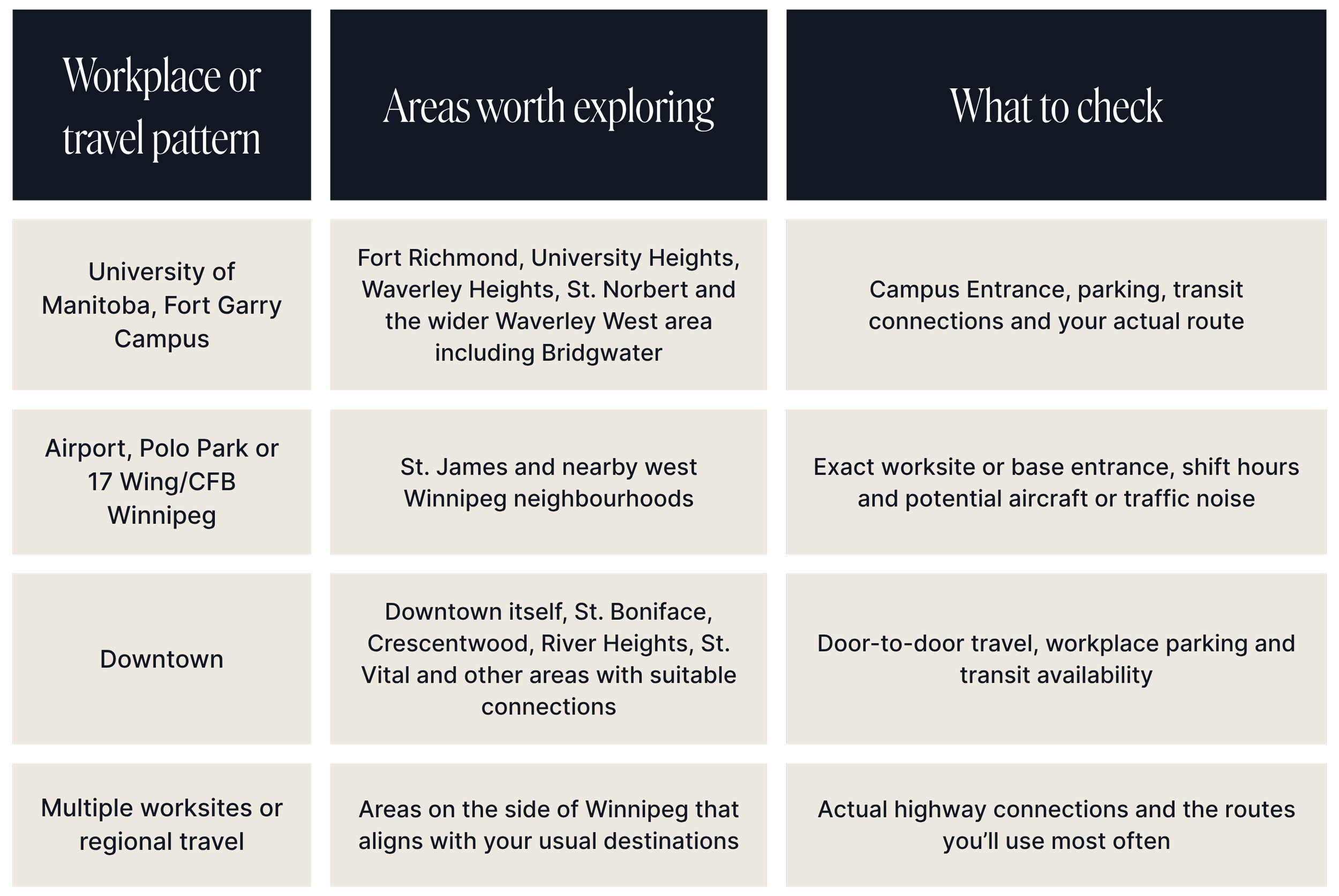
“University of Manitoba,” for example, could mean the Fort Garry campus or Bannatyne campus. Those locations create very different home-search starting points. An airport-area job might also involve an employee entrance well away from the passenger terminal.
Ask your employer about your usual worksite, parking, shift times and whether you’ll regularly travel between locations.
Winnipeg is spread out. Living on the opposite side of the city from work may look fine on a map, but rush hour, construction and winter weather can change how that drive feels.
This is why I usually recommend starting with your workplace and lifestyle, then narrowing down neighbourhoods, rather than finding a house you love first and figuring out the commute afterward.
Neighbourhood Starting Points for Different Work Locations
These are areas to investigate, rather than a ranking or a promise about travel times. Your exact address, budget, transportation and preferred home type will determine the right fit.
For broader city and lifestyle information, start with our complete guide to moving to Winnipeg. This article focuses on fitting your housing decision around your new job.
Check the Commute You’ll Actually Make
I would be cautious about choosing a home based on a general statement that everything in Winnipeg is a short drive away.
A route that works well outside peak hours may feel different when you need to be at work at a specific time. Bridge crossings, railway crossings, roadwork, traffic signals and weather can all matter.
When comparing two properties, check:
The trip at your usual departure and return times.
Parking availability and the walk from your parking spot to work.
Whether daycare or school drop-off changes the route.
Alternative routes if your usual one is delayed.
How the journey works during an early shift, evening shift or weekend.
If you’re visiting Winnipeg before moving, try driving your likely commute at the time you would normally travel.
If You’ll Be Taking Transit, Check the Full Journey
Distance alone doesn’t tell you whether a transit commute will work.
Use Winnipeg Transit’s Navigo trip planner with the actual home and work locations and your intended arrival time. Check the trip home too, especially if you work evenings or weekends. The City recommends planning with your starting point, destination and desired travel time.
Include the walk to the stop, waiting time and any transfers. If you’ll be commuting in winter, think about those outdoor portions of the trip as well.
A property that looks slightly farther away may still offer a more convenient journey. It depends on the connection.
You Don’t Have to Live Downtown to Work Downtown
Working downtown doesn’t automatically mean you need to live downtown.
If you want a more urban setting, downtown and nearby neighbourhoods may suit you. If you’d prefer a detached home, yard or garage, you can also explore residential neighbourhoods elsewhere in Winnipeg and assess the commute from there.
River Heights, Crescentwood, St. Boniface and St. Vital are examples worth investigating, depending on your budget and the part of downtown where you work.
The important comparison is the whole routine: housing costs, travel, parking and how you want to spend your time outside work.
Don’t rule downtown in or out simply because you’re arriving with expectations shaped by another city.
Should You Rent Before Buying in Winnipeg?
There isn’t one right answer.
Renting first can give you time to understand Winnipeg before committing to a property. Buying right away can make sense when your plans are established and you’ve had enough time to investigate your options.
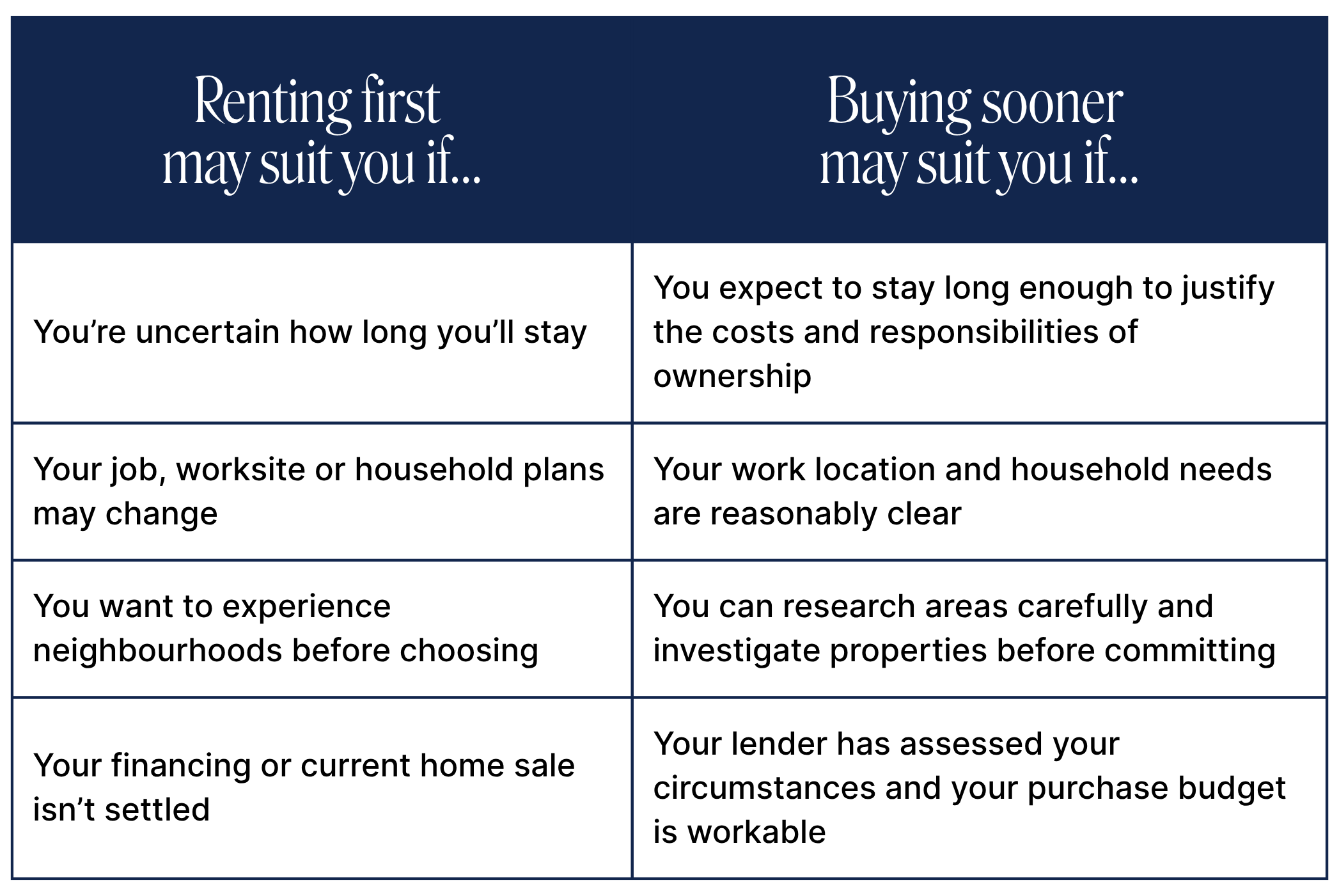
I wouldn’t automatically recommend renting for a year simply because you’re new to Winnipeg. Many of my relocation clients purchase right away.
But buying shouldn’t become a deadline you force yourself to meet because you’re starting a new job.
Compare the Costs of Both Options
Renting first may mean moving twice, paying for storage and spending time finding a second home. Buying immediately brings purchase costs and the possibility that your first neighbourhood choice won’t suit you as well as expected.
If your stay could be short, consider the cost of selling again, potential mortgage charges and the uncertainty of future resale conditions. There is no fixed ownership period that guarantees you’ll come out ahead.
The right decision is the one that fits your finances, certainty and comfort level.
Get Your Financing Organized Before House Hunting
If you’re relocating because of a new job, speak with a mortgage professional early—even if your new position pays more.
Lenders assess income, employment, debt and other financial information. The Financial Consumer Agency of Canada explains that mortgage preapproval involves financial documentation and does not guarantee final mortgage approval.
Tell your lender about the move and ask how they will assess your employment contract, start date, probationary period and any variable income. Their requirements may differ depending on your circumstances.
Don’t assume an earlier approval still applies after an employment change. I would also discuss:
Whether you need to sell your current home before buying.
When your down payment will be available.
Whether an overlap between homes is financially manageable.
How to align financing with your intended possession date.
Getting organized helps you make informed offers. It doesn’t remove the need to discuss appropriate financing and inspection conditions for the property you choose.
Budget for the Move and the Home
Your purchase price is only one part of relocating.
Before setting your maximum budget, account for legal fees and closing adjustments, applicable Manitoba land transfer tax, inspections, moving expenses and any temporary accommodation or storage.
Then consider the ongoing costs: property taxes, insurance, utilities, maintenance, condominium fees where applicable, and transportation or workplace parking.
Ask your lawyer and mortgage professional to help estimate the costs that apply to your purchase. Keeping some room in your budget for settling in can make the first few months easier.
Ask About Employer Relocation Support Early
If your employer offers relocation assistance, request the written policy before booking services or committing to costs you hope to have reimbursed.
Ask about approved providers, spending limits, receipts, deadlines and whether prior authorization is required. Your employer or relocation administrator should confirm eligibility.
If you’re moving for a military posting to 17 Wing/CFB Winnipeg, review the instructions for your specific move with the appropriate relocation representative. Don’t assume a colleague’s benefits or approvals also apply to you.
You can also explore The Queen Team’s relocation services to discuss local housing and home-search support.
You Can Start Your Winnipeg Home Search From Another Province
You don’t necessarily need to make multiple trips to Winnipeg before finding a home.
Much of the search and communication can happen remotely, including virtual showings, neighbourhood videos, comparable-sales reviews and conversations with your REALTOR®, lender, inspector and lawyer.
If I’m showing a property virtually, I’m not just showing the nicest parts of the house.
I want you to see the things that are difficult to understand from listing photos: neighbouring properties, traffic on the street, backyard privacy, basement condition, how renovations look up close and anything else I would point out if you were standing beside me.
What I’d Want You to Understand Before Buying Remotely
A useful virtual showing should help answer questions such as:
How do the rooms connect, and will your furniture fit?
What is behind or beside the property?
What is visible in the basement and mechanical areas?
Are there repairs, past work or property records worth investigating?
What can’t be assessed properly through a screen?
Video has limits. It can’t replace an inspection or specialist assessment, and it may not communicate sound, condition or the feel of a space the way an in-person visit would.
Where practical, a visit can help you understand both the property and its surroundings. If you’re buying remotely, we should discuss those limitations and the investigations you need before committing.
Your Manitoba lawyer and lender should also confirm signing, identity-verification and funds-transfer arrangements early. Don’t assume every closing step can happen from anywhere without advance planning.
Think About Winter Before Choosing Your Home
A commute that feels comfortable on a summer visit may feel different during winter weather.
When comparing properties, consider how far you’ll regularly travel, whether you have alternative routes and where you’ll park at home and at work.
A garage may become a higher priority once you think through your winter routine. So might driveway size, snow clearing, outdoor steps and the walk to a transit stop.
The house itself deserves attention too. Ask about heating systems, insulation, windows, drainage, available maintenance records and the scope of your home inspection. Qualified professionals can help investigate property-specific concerns.
The goal is to understand the responsibilities that come with the home you’re considering.
If Your Job Takes You Outside Winnipeg, Choose the Right Side of the City
Not everyone relocating to Winnipeg works at one location inside the city.
If you regularly travel to rural communities, construction sites or other regional destinations, access to the appropriate highway may matter more than proximity to downtown.
Being near the Perimeter Highway can be useful, but check the actual connection. A home that looks close on a map may not give you the convenient access you expect.
For a hypothetical example, someone travelling west most days would compare different routes than someone regularly heading east or south. Start with the destinations you’ll actually use.
If you’re considering a property outside Winnipeg, also investigate the services and responsibilities associated with that specific property, which may include private water or wastewater systems.
Relocating With Children: Map the Whole Day
If you’re moving with children, don’t choose an area based on the house alone.
Consider school locations, childcare, recreation, support systems and the sequence of your daily trips.
Before relying on a school assignment, confirm the exact property address, grade and intended program directly with the relevant school division. Ask about registration, transportation and any program-specific requirements.
For childcare, contact providers about availability and hours rather than assuming a nearby centre can accommodate your family.
Two neighbourhoods may both have suitable homes within your budget but create very different routines. A useful question is: “What would a normal Tuesday look like if we lived here?”
That can tell you more than a list of neighbourhood features.
A Practical Checklist for Moving to Winnipeg for Work
Before You Shortlist Neighbourhoods
Confirm your workplace address, start date, schedule and travel requirements.
Identify your comfortable housing budget and moving costs.
Ask your mortgage professional about your employment change.
Review any employer relocation policy.
Decide whether to rent first, buy sooner or arrange temporary accommodation.
Before You Make an Offer
Compare a small shortlist of areas around your actual routine.
Check commute routes and transit at the times you’ll use them.
Confirm school and childcare details where relevant.
Review the home’s condition, records and appropriate investigations.
Discuss offer terms, financing, inspection and possession with your professionals.
Before You Move
Coordinate possession, travel, movers and a contingency plan if dates don’t align.
Confirm legal signing and funds-transfer arrangements.
Arrange required insurance, utilities and access details.
Keep essential documents and first-night supplies with you.
You don’t need every decision made on day one. You do need the major pieces—work, housing, financing and timing—to fit together.
Key Takeaways
Start with your workplace and routine before choosing a Winnipeg neighbourhood.
Check actual commute routes rather than relying on citywide travel-time estimates.
Renting first can be helpful, but it isn’t necessary for every relocation buyer.
Discuss employment changes with your mortgage professional before making an offer.
A remote home search needs clear communication, appropriate investigations and early closing arrangements.
Include winter, childcare, transportation and moving costs in your decision.
Frequently Asked Questions
Where should I live if I’m moving to Winnipeg for work?
Start with your exact workplace, schedule and transportation needs. Then compare areas that fit your budget, preferred home type and daily routine. There is no single neighbourhood that suits every relocation buyer.
How long does it take to commute across Winnipeg?
There is no reliable travel time that applies to every cross-city trip. Your route, travel time, traffic, construction and weather all matter. Check the actual home-to-work journey and, where possible, test it during your usual commuting hours.
Should I rent before buying when moving to Winnipeg?
Renting can help if your job plans or preferred area are uncertain. Buying sooner may suit you if your longer-term plans, financing and neighbourhood research are established. Compare the costs and trade-offs of both choices before deciding.
Can I buy a Winnipeg home while living in another province?
You can conduct much of the search remotely through virtual showings and communication with local professionals. Discuss property investigations and the limits of video with your REALTOR®, and confirm closing arrangements with your lawyer and lender early.
Can starting a new job affect my mortgage application?
Your lender needs to assess your employment and income. Tell your mortgage professional about your new role, start date and any probation or income changes so they can explain what documentation and approval requirements apply.
Do I need a car if I’m moving to Winnipeg?
It depends on where you live, where you work and your schedule. Check transit connections for both directions of your commute and consider groceries, childcare and other regular trips. A convenient route for one household may not work for another.
Where should I look if I’ll be working at 17 Wing/CFB Winnipeg?
St. James and nearby west Winnipeg areas are reasonable starting points. Confirm your actual worksite or entrance, commute and housing needs before narrowing your search. For a military move, check relocation requirements with the representative responsible for your file.
How early should I start planning my move?
Start when you have enough information about the job to discuss your likely location, budget and timing. Earlier conversations can help identify financing questions, a current-home sale, childcare needs or temporary accommodation before those become urgent.
Let’s Start With Your Workday and Build From There
If you’re moving to Winnipeg for work, I wouldn’t begin by asking, “What’s the best neighbourhood?”
I’d start with where you’ll work, what your day looks like, what you can comfortably afford and what matters to you outside the office.
Tell me your workplace location, approximate budget, moving timeline and the things you want in a neighbourhood. I can help you compare your options and create a home-search plan that fits your move.
Snag a Copy of my Relocation Guide!
If you’re planning a move to Winnipeg, I’d love to help guide you through it. From narrowing down neighbourhoods to understanding the local market, I’m here to make your transition as smooth and informed as possible. Simply fill out the form below, and I’ll send you our Winnipeg Relocation Guide—along with any additional information tailored to your move.

Your Friend in Real Estate,
Sheyla Duncan
Phone: (204) 871-3228
Email: Sheyla@QueenTeam.ca
Sheyla Duncan is a Winnipeg REALTOR® with The Queen Team at Ethos Realty Inc. Her content focuses on relocating to Winnipeg, homeownership and maintenance, and South Winnipeg neighbourhoods.
Sheyla helps buyers think beyond listing photographs to consider how a property’s location, condition and surroundings fit their everyday lives. In her relocation articles, she shares practical guidance on researching neighbourhoods, planning a home search from another province and asking useful questions before buying.
Her goal is to help readers arrive at their next move informed, prepared and comfortable with their decisions.
