

By Sheyla Duncan, REALTOR® | The Queen Team, Ethos Realty Inc.
There’s a point in almost every move when the exciting questions - “What will our new home look like?” -start sharing space with the practical ones.
Who do we call about the water? Will the moving truck arrive before we get the keys? And where, exactly, did we pack the winter boots?
If you’re moving to Winnipeg, you don’t need to figure everything out at once. You do need a plan that puts the important decisions in the right order.
Whether you’re coming for work, moving closer to family or starting a new chapter, here’s the moving to Winnipeg checklist I’d use to help you get organized, from choosing a neighbourhood to finding your new favourite coffee stop.
What should you do before moving to Winnipeg?
Start by confirming your moving timeline, housing budget and neighbourhood priorities. Then arrange housing, movers, school or childcare plans, utilities and insurance. If you’re moving from another province, add Manitoba health coverage, your driver’s licence and vehicle registration to your checklist. Before moving day, confirm your possession or move-in time and keep essential documents, medication and winter gear with you.
This guide focuses mainly on moves from elsewhere in Canada. International moves involve additional immigration, financing, health-coverage and vehicle requirements.
Still deciding whether Winnipeg is the right fit? Start with our complete Winnipeg relocation guide. This checklist is for turning that decision into a workable plan.
Your moving to Winnipeg timeline at a glance
Treat these as planning windows, rather than deadlines everyone must follow. A work transfer or military posting may mean doing several steps at once.
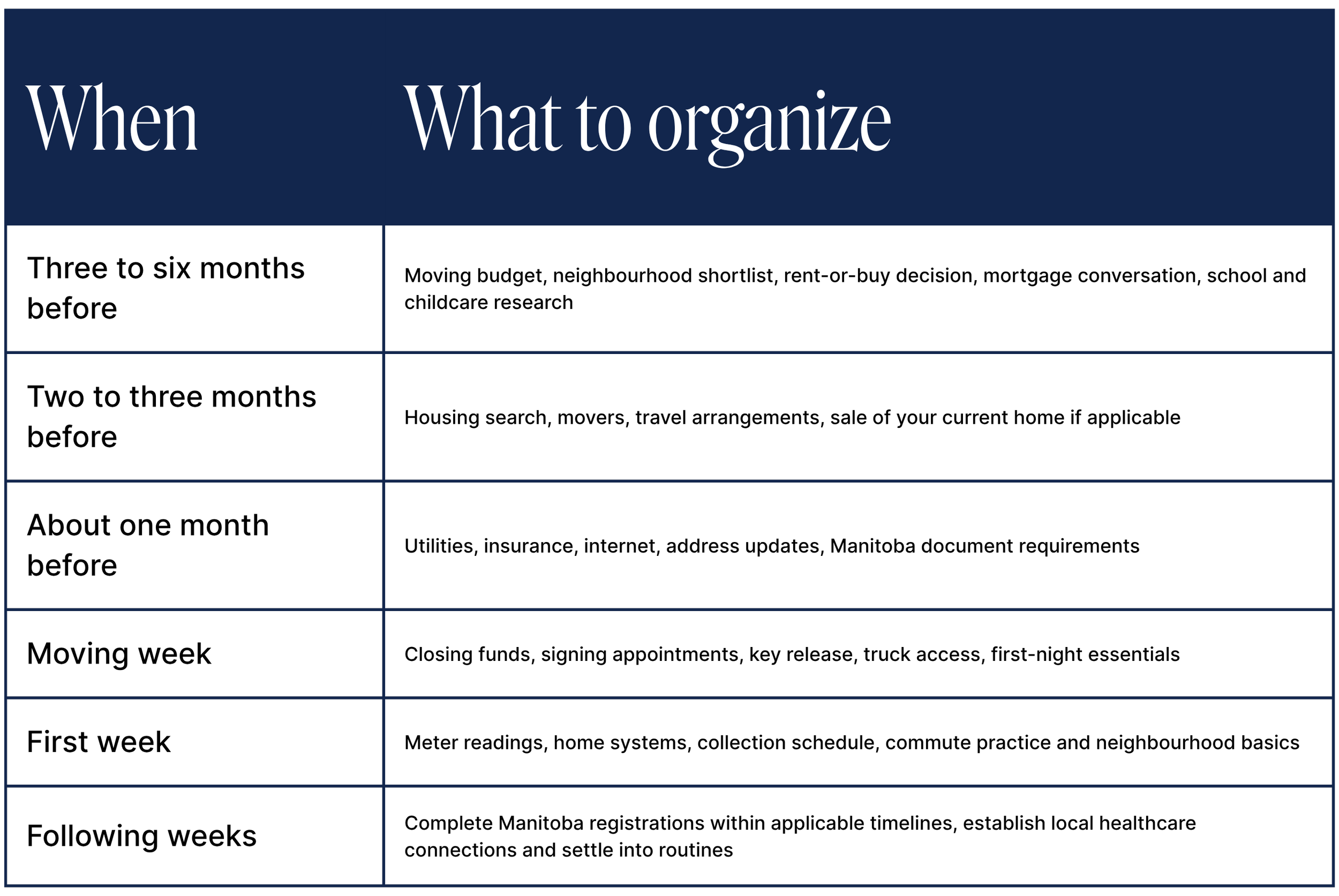
Three to six months before: build a plan around your actual life
1. Choose your neighbourhood priorities before choosing a house
One thing I always encourage relocating buyers to consider is their daily commute.
A house can look perfect online. But if getting to work, childcare and evening activities turns every weekday into a driving marathon, that extra bedroom may lose some of its appeal.
Start with a few questions:
Where will you work, and how often will you need to be there?
Do you want to walk to everyday amenities or are you comfortable driving?
Are schools, childcare, transit or recreation facilities important to your routine?
Do you prefer a newer layout or an established street with mature trees?
How much home and yard maintenance do you want to take on?
For example, someone working at 17 Wing Winnipeg might begin by exploring St. James and nearby areas. Someone whose routine revolves around the University of Manitoba might begin in south Winnipeg. Those are starting points for a conversation, rather than automatic answers.
Bridgwater, Prairie Pointe and Sage Creek offer options for buyers drawn to newer housing. River Heights and Crescentwood may appeal to those who love established streets and character homes. St. Vital, Transcona and Charleswood each offer a range of housing choices worth exploring.
My advice: map your regular destinations before falling in love with a listing. If transit is part of your plan, check the actual route, transfers and service times for that address.
Our guide to Winnipeg neighbourhoods for different lifestyles can help you narrow the possibilities.
2. Decide whether to rent first or buy before arriving
There isn’t one right answer here.
Renting first can give you time to learn the city, test a commute or settle into a new job. It may also mean paying for temporary storage and moving twice.
Buying before you arrive can offer a more direct transition, especially if you know the city and expect to stay. It also means making a significant decision while coordinating travel, financing and a long-distance move.
Renting first may suit you if…
You want time to explore neighbourhoods
Your job or length of stay is uncertain
You need flexibility in your arrival date
You’re comfortable with a second move later
Buying before arrival may suit you if…
You already have a clear neighbourhood shortlist
Your employment and longer-term plans are established
You can coordinate possession with your move
You’re financially ready and want one move into a longer-term home
Neither choice means you’ve planned better than someone else. The useful question is which one gives your household the right balance of flexibility, stability and financial comfort.
3. Build two budgets: the move itself and life after the move
A moving quote is only one part of the cost. Your moving budget might include:
Movers or truck rental, packing supplies and storage.
Travel, meals, accommodation and pet transportation.
Temporary housing if arrival and possession dates don’t align.
Housing overlap or a second move.
Initial household purchases, winter clothing and vehicle preparation.
If you’re buying, also plan for:
Your deposit and remaining down payment, with their different payment dates.
Legal fees, registration costs and applicable Manitoba land transfer tax.
Inspection costs and lender-required expenses.
Closing adjustments, insurance and immediate repairs or purchases.
Your lawyer can prepare a closing-cost estimate for the actual purchase. Ask early enough that those funds are part of the plan.
Then work out your monthly budget: mortgage or rent, property taxes where applicable, utilities, insurance, transportation, childcare, condo fees if relevant and a maintenance reserve.
For a closer look at ongoing expenses, read our cost of living in Winnipeg guide.
4. Talk to a mortgage professional before booking a house-hunting trip
If you’re buying, start the financing conversation before the showings.
Tell your lender about your move, employment changes, probationary periods, any existing mortgage and whether your down payment depends on selling your current home. Ask what documents they’ll need and when.
A pre-approval helps establish a working budget; the lender still needs to approve the property and confirm your circumstances before final financing is in place.
My advice: aim for a payment that leaves room for your life after the move. Having the keys is exciting. Having breathing room once you’re unpacked matters, too.
5. Begin school and childcare research early
If a particular school or program matters to your family, investigate it while narrowing your neighbourhood search.
Confirm the school assignment and program availability for the exact address directly with the school division. The nearest school isn’t necessarily the one your child will attend.
For childcare, use Manitoba Child Care Search to identify licensed facilities, then contact providers about openings and their individual waitlists. Researching options and having a confirmed space are two different stages.
If your move depends on a work start date, think through a backup childcare plan as well.
Two to three months before: secure housing and moving arrangements
6. Make your home search efficient, especially from a distance
When working with relocating buyers, I like to understand more than their budget and bedroom count. We discuss their work location, routines, comfort with maintenance and what they want life here to feel like.
That helps us build a useful shortlist before a house-hunting trip.
If you’re viewing remotely, ask for a live walkthrough that goes beyond the listing photos. Look at storage, the basement, the yard, neighbouring properties and the street. Ask what the camera isn’t showing.
An inspection and a clear understanding of the home’s condition matter whether the house is old or new. For an older home, questions about previous water issues, electrical and plumbing updates, heating and maintenance history are particularly useful.
Also ask your Realtor to explain the offer process for each property. Depending on the home and current market, there may be a scheduled offer date or competing buyers. The asking price is a starting point for analysis; comparable sales and condition help establish what an offer should look like.
Our home-buying guide for relocating buyers goes further into those decisions.
7. Book movers with a realistic delivery plan
Ask for written quotes and compare the details, including packing, storage, delivery windows, extra charges and the protection provided if belongings are damaged or delayed.
Before paying a deposit, understand the cancellation terms and what happens if your possession date changes.
Most importantly, coordinate the truck with the time you can actually access the property. Buying a home on a particular date doesn’t mean you can necessarily unload at breakfast.
For a condominium, ask about elevator bookings, loading access, move-in rules and any related fees or deposits. For a house, consider truck access and parking.
8. Coordinate your arrival with your sale, purchase and work schedule
If you’re selling in another province, put the major dates in one shared calendar: sale closing, purchase possession, moving pickup, delivery, travel and your first day of work.
Look for gaps and overlaps while you still have time to solve them.
If you’re moving through an employer or military relocation program, confirm booking procedures and eligible expenses with your relocation contact before making commitments. Our relocation services page explains how we can help with the housing side.
About one month before: arrange services and paperwork
9. Organize utilities, internet and insurance
Make a property-specific list, because responsibilities differ between houses, condominiums and rentals.
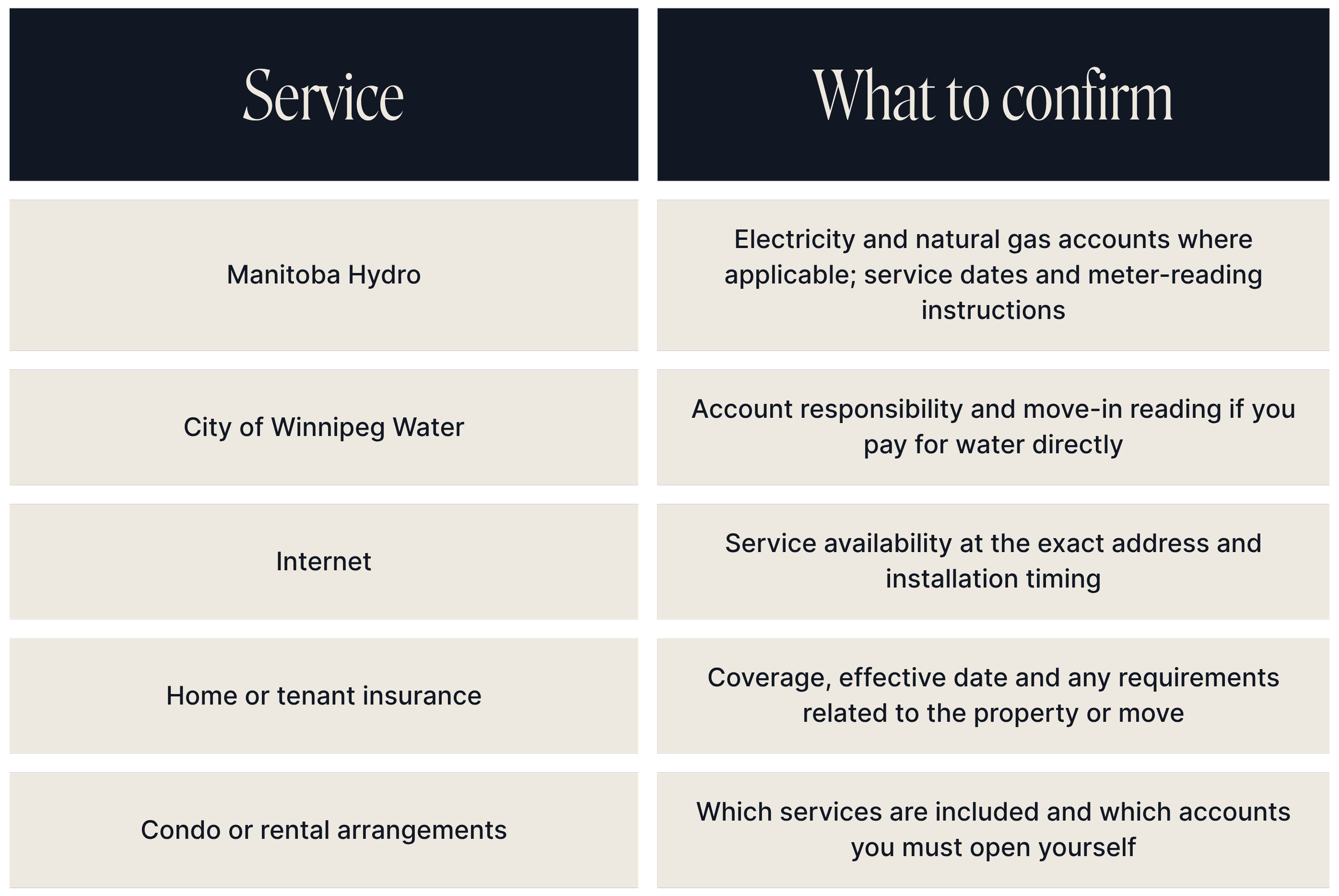
Use Manitoba Hydro’s new-customer instructions and the City’s MyUtility moving information to organize the relevant accounts.
If you’re buying, arrange insurance early enough to address any questions about the property and have coverage in place when required for your purchase.
10. Plan your Manitoba health, licence and vehicle updates
These tasks deserve their own spot on the checklist.
Health coverage: Apply for Manitoba Health coverage promptly after arriving. For eligible people moving from another province or territory, coverage generally begins on the first day of the third month after arrival. Confirm your previous plan’s transition coverage as well. Manitoba waives the waiting period for Canadian military families; its moving to Manitoba health page explains the applicable rules.
Driver’s licence and vehicle: MPI says most new residents must exchange their licence and transfer vehicle registration and insurance within three months. Your circumstances can affect the process, so review MPI’s new-resident instructions and ask an Autopac broker what documents and any inspection arrangements you’ll need.
Healthcare continuity: Keep prescriptions, medication and important records accessible. Arrange enough medication for the transition and begin researching local care rather than waiting until a refill becomes urgent.
11. Update your address beyond the obvious accounts
Along with banks, credit cards, your employer and insurance providers, remember:
Canada Revenue Agency and other relevant government accounts.
Schools, childcare and healthcare providers.
Subscriptions, delivery services and online shopping accounts.
Professional registrations and memberships.
Pet identification and microchip contact details.
Mail forwarding, if needed.
Updating a delivery app may feel like a small detail - until dinner is on its way to your old front door.
12. Prepare for the season you’re arriving in
If you’re moving in winter, pack coats, boots, mitts and toques where you can reach them. The bottom of the moving truck is an inconvenient place for everyone’s warm clothing.
Plan for suitable tires, an ice scraper, snow brush and emergency supplies. Check whether your vehicle has a block heater and how to use it according to the manufacturer’s guidance.
If you’ll be responsible for snow clearing, have a shovel ready or arrange a service. Ask about parking access and leave room in your travel schedule for weather delays.
For the home, get familiar with the heating system and seasonal maintenance instructions. You don’t need to become a furnace expert overnight; you should know who to call and where the filter goes.
Moving week: make the first day easier
13. Confirm closing funds, signing and key release
If you’re buying, confirm with your lawyer and lender:
When and how your closing funds must arrive.
Whether all financing requirements are complete.
Your signing arrangements, especially if you’re outside Manitoba.
Your insurance arrangements.
Your possession date, time and key-release process.
Build in time for funds to move between institutions. A transfer initiated is not always a transfer available for closing.
Keep your Realtor, lawyer, lender and mover’s contact details together so you’re not searching through your inbox with a truck waiting outside.
14. Pack for your first night separately
Keep these with you:
Identification, essential documents, medication and chargers.
Toiletries, towels, bedding and a change of clothes.
Basic cleaning supplies, toilet paper, snacks and drinking water.
Children’s comfort items and pet supplies.
Seasonal clothing, a small toolkit and scissors for boxes.
If possible, make the first night a low-expectation night. A made bed and something to eat count as a very successful start.
Your first week: learn the home and the neighbourhood
15. Take meter readings and locate the important systems
If you’re responsible for the accounts, take photos of the relevant meters and follow the providers’ submission instructions. The City of Winnipeg asks customers moving into a home to submit a water meter reading on move-in day.
Locate the main water shut-off, electrical panel, furnace filter, hot water tank, sump pump if present, and smoke and carbon monoxide alarms. Review the inspection report and make a short list of immediate tasks and later maintenance.
Find your garbage and recycling collection schedule, any applicable parking restrictions, and the instruction manuals or service information left with the home.
16. Practise a weekday before living one
Try your work route, locate the school drop-off area and find the grocery store and pharmacy you’ll actually use.
A practice run can reveal small things that a map misses: which entrance to use, where to turn, or how long a transit connection really takes.
Then make room for something enjoyable. Visit The Forks, explore Assiniboine Park, walk through St. Boniface or find a nearby café. You don’t have to wait until every box is unpacked to start enjoying your new city.
Key takeaways
Choose neighbourhoods around your daily routine, commute and housing preferences.
Budget separately for the move, closing costs and ongoing life in Winnipeg.
Begin school, childcare and financing conversations early.
Coordinate delivery with your confirmed possession or move-in time.
Plan Manitoba health, licence and vehicle updates before the paperwork becomes urgent.
Keep first-night essentials accessible and give yourself time to settle in.
Frequently asked questions about moving to Winnipeg
How far ahead should I plan a move to Winnipeg?
Three to six months is a useful starting point when you can manage it, particularly if you’re selling a home or arranging childcare. Shorter timelines are possible; prioritize housing, financing, movers and essential family needs first.
Should I rent before buying in Winnipeg?
Renting first can help if you’re unfamiliar with the city or unsure how long you’ll stay. Buying before arrival can work when your finances, location preferences and longer-term plans are clear. Consider the cost and disruption of a second move alongside the value of flexibility.
Can I buy a Winnipeg home while living in another province?
Yes. Buyers can coordinate remote showings, financing, inspections and legal arrangements from elsewhere in Canada. Arrange the process with your local REALTOR®, lender and Manitoba lawyer early, including signing and closing-fund requirements.
How much money do I need to move to Winnipeg?
There’s no useful single figure for every household. Add up moving quotes, travel, temporary accommodation, housing costs, setup expenses and a contingency. Buyers should also obtain a closing-cost estimate and keep those funds separate from the moving budget.
Which utilities do I need to arrange in Winnipeg?
Common arrangements include Manitoba Hydro, City of Winnipeg water, internet and home or tenant insurance. Some utilities may be included in rent or condominium fees, so check the specific property before opening accounts.
When should I apply for Manitoba health coverage?
Apply promptly after you arrive. Eligible interprovincial newcomers generally begin coverage on the first day of the third month after arrival. Canadian military families have a waiting-period waiver. Check Manitoba Health’s official instructions for your circumstances and confirm transition coverage with your previous province.
How long do I have to change my driver’s licence and vehicle registration?
MPI says most new residents must make these changes within three months. Requirements and exceptions depend on your situation and vehicle, so contact MPI or an Autopac broker before assuming your existing documents are all you need.
Do I need a car to live in Winnipeg?
It depends on your address and routine. Some locations make walking, cycling and transit practical, while others involve more driving. Check the route between the specific home and your regular destinations, including evenings and weekends if relevant.
Planning your move to Winnipeg? Let’s make the next steps clearer.
You don’t need to arrive knowing every neighbourhood or having every question answered.
Tell me where you’ll be working, when you hope to move and what you want everyday life here to look like. We can start there and build a housing plan around it.
Snag a Copy of my Relocation Guide!
If you’re planning a move to Winnipeg, I’d love to help guide you through it. From narrowing down neighbourhoods to understanding the local market, I’m here to make your transition as smooth and informed as possible. Simply fill out the form below, and I’ll send you our Winnipeg Relocation Guide—along with any additional information tailored to your move.

Your Friend in Real Estate,
Sheyla Duncan
Phone: (204) 871-3228
Email: Sheyla@QueenTeam.ca
Sheyla Duncan is a Winnipeg REALTOR® with Queen Team at Ethos Realty Inc., helping buyers and sellers navigate the Winnipeg real estate market and surrounding communities.
Sheyla's real estate content focuses on relocating to Winnipeg, exploring neighbourhoods throughout the city and understanding the practical responsibilities of homeownership.
She believes that choosing the right home involves much more than finding the right number of bedrooms or bathrooms. It's about understanding how a property and its location fit your everyday lifestyle, budget and future plans.
Through her articles, Sheyla shares practical advice designed to help newcomers feel more confident about Winnipeg's housing options, neighbourhood differences and the homebuying process.
Whether you're moving from another province, preparing for a military relocation or simply unfamiliar with the city, Sheyla's goal is to help you approach your move with realistic expectations and a clear plan.
